Whisky or Whiskey: Which Spelling Is Correct?
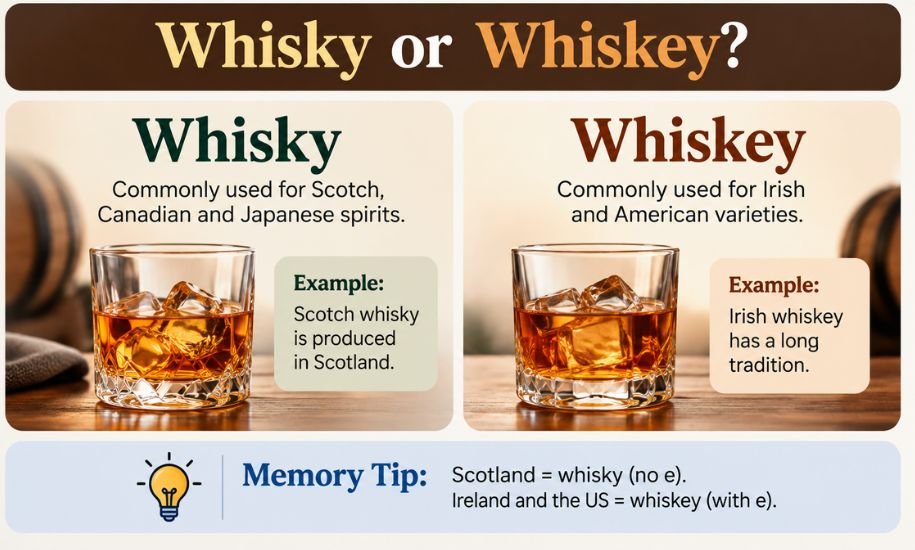
If you have ever wondered whether the drink should be called whisky or whiskey, you are not alone. Both spellings are correct, but they are generally associated with different countries and traditions. Whisky is commonly used for Scotch, Canadian and Japanese spirits, while whiskey is standard for Irish and American varieties. The difference is therefore usually geographical rather than a difference in quality or meaning. There are also some exceptions, so the producer’s own spelling is the safest guide when referring to a particular brand.
Both whisky and whiskey are correct spellings. “Whisky” is commonly used for Scotch, Canadian and Japanese spirits, while “whiskey” is generally used for Irish and American varieties. The spelling usually reflects regional tradition, not a difference in quality.
Whisky or Whiskey: What’s the Difference?
The simplest way to understand the distinction is to look at where the spirit is produced.
| Spelling | Common association | Example |
|---|---|---|
| Whisky | Scotland | Scotch whisky |
| Whisky | Canada | Canadian whisky |
| Whisky | Japan | Japanese whisky |
| Whiskey | Ireland | Irish whiskey |
| Whiskey | United States | American whiskey |
This is a useful general rule, but it is not an absolute one. Some producers use a spelling that differs from the convention most commonly associated with their country. When writing about a specific product, follow the spelling used by the producer or on the bottle.
The important point is that neither spelling is inherently more correct than the other.
What Does “Whisky” Mean?
Whisky is a noun referring to a distilled alcoholic spirit traditionally made from fermented grain and matured in wooden casks, depending on the type and legal definition involved.
The spelling without the e is strongly associated with Scotland, where Scotch whisky is one of the world’s best-known categories. It is also used in places such as Canada and Japan.
For example:
- Scottish whisky is produced in Scotland.
- Japanese whisky has been strongly influenced by Scotch whisky-making traditions.
- Canadian whisky has its own production traditions and regulations.
- She bought a bottle of single malt whisky.
- The distillery produces several different whiskies.
The plural form is normally whiskies when referring to multiple types or varieties.
What Does “Whiskey” Mean?
Whiskey has the same basic meaning: it refers to a distilled grain spirit. The difference is primarily the spelling convention.
The form with an e is particularly associated with Ireland and the United States.
For example:
- Irish whiskey has a long-established distilling tradition.
- Bourbon is a type of American whiskey.
- Tennessee whiskey is produced in the United States.
- The shop sells several American whiskeys.
- Irish whiskey is often discussed separately from Scotch whisky.
The plural can be written whiskeys.
So the spelling changes, but the basic word refers to the same broad family of distilled spirits.
Whisky or Whiskey in the UK
In the UK, the answer depends on the type of spirit being discussed.
When referring to Scotch, the standard spelling is whisky. Therefore, you would write:
Scotch whisky is produced in Scotland.
You would not normally write:
Scotch whiskey is produced in Scotland.
However, the UK is also home to products from other countries, including Irish whiskey and American whiskey. Therefore, British English does not mean that every reference to the drink must use whisky.
A writer should use the spelling appropriate to the particular product.
What About Ireland?
For Ireland, the conventional spelling is whiskey.
For example:
Irish whiskey is made by distilleries across Ireland.
The spelling with the e has become firmly established in Irish usage.
This is why a comparison between Scotch and Irish products will normally look like this:
Scotch whisky
Irish whiskey
The difference is easy to overlook because the two words sound almost identical in ordinary speech.
What About Scotland?
For Scotland, use whisky.
The term Scotch whisky is particularly important because it refers to whisky produced in Scotland under defined requirements. Scotch whisky includes categories such as single malt Scotch whisky, single grain Scotch whisky and blended Scotch whisky.
Examples include:
- Highland whisky
- Islay whisky
- Speyside whisky
- Single malt Scotch whisky
- Blended Scotch whisky
Therefore, if you are writing specifically about Scottish products, whisky is the appropriate spelling.
Is Jack Daniel’s Whisky or Whiskey?
Jack Daniel’s is whiskey.
The brand describes its product as Tennessee Whiskey, so when referring to Jack Daniel’s, the spelling with the e should be retained.
This illustrates an important writing principle: don’t assume that every product follows a simple geographical rule. Brand names and official product names should normally be written exactly as the producer presents them.
So:
Jack Daniel’s Tennessee Whiskey
is correct.
Writing “Jack Daniel’s Tennessee Whisky” would change the brand’s established terminology.
Does the Spelling Affect the Taste?
No. The presence or absence of the letter e does not determine how the drink tastes.
Flavour can be influenced by many factors, including:
- The grains used
- Distillation methods
- Maturation
- The type of cask
- The length of ageing
- Blending
- Production techniques
- The particular style of spirit
A Scotch whisky and an American whiskey can taste very different, but those differences come from their ingredients, production methods, maturation and regional traditions—not from the spelling.
Whisky or Whiskey: Which Is Better?
There is no universally correct answer to which one is “better.”
Someone who enjoys smoky Scotch might prefer a particular whisky, while someone who enjoys bourbon might prefer an American whiskey. Personal taste matters much more than the spelling.
It is also worth remembering that these are broad categories. Not every Scotch tastes smoky, and American whiskey encompasses several styles.
So if the question is about spelling, neither form wins. If the question is about taste, the answer depends on the individual spirit and the drinker’s preferences.
Whisky or Whiskey: Does Price Differ?
There is no fixed price difference simply because one product is called whisky and another is called whiskey.
Prices can vary enormously within both categories. Factors such as age, rarity, brand reputation, production costs, maturation, limited availability and demand can all influence the price.
A basic bottle may be relatively affordable, while an old or rare release can cost considerably more.
Therefore, it would be misleading to say that whisky is always cheaper than whiskey, or vice versa.
What About Alcohol Percentage?
Neither spelling indicates a particular alcohol percentage.
The alcohol content depends on the specific product and the legal requirements governing its production and sale. Different whiskies and whiskeys can therefore have different ABVs.
For example, a standard retail bottle may have a different strength from a cask-strength or specially bottled expression.
If you need the exact alcohol percentage of a particular product, check its label or official product information rather than relying on whether it is spelled whisky or whiskey.
Why Are the Two Spellings Confused?
The confusion is understandable because the two words have the same basic meaning and are pronounced similarly.
The distinction developed through different regional and historical traditions. The word ultimately traces back to Gaelic terms associated with “water of life.” Over time, different spelling conventions developed, with whisky becoming strongly associated with Scotland and whiskey becoming established in Ireland and the United States.
Today, the spelling often provides a useful clue about the spirit’s tradition or origin.
A simple rule is:
Scotland = whisky; Ireland and the United States = whiskey.
Then remember that Canada and Japan commonly use whisky as well.
Correct Usage Examples
Here are some examples showing how the two forms work naturally.
Correct:
I bought a bottle of Scotch whisky.
Correct:
Irish whiskey has its own distinctive traditions.
Correct:
Bourbon is an American whiskey.
Correct:
Japanese whisky has gained international recognition.
Correct:
The distillery produces several whiskies.
Correct:
The bar has a selection of American whiskeys.
The key is not to treat one spelling as a universal replacement for the other.
A Simple Way to Remember the Difference
A useful shortcut is:
Whisky without E → Scotland and several other countries
Whiskey with E → Ireland and the United States
You can remember Ireland = E and America = E.
This is only a general guide, however. When a specific brand or product is involved, check its official spelling.
Common Mistakes to Avoid
1. Calling all whisky “whiskey”
This ignores established regional conventions. Scotch is normally whisky, not whiskey.
2. Assuming “whisky” is British and “whiskey” is American
This is too simplistic. Irish English also uses whiskey, while Canadian and Japanese products commonly use whisky.
3. Changing a brand’s official spelling
If a producer uses “whiskey,” retain that spelling when discussing its product.
4. Assuming the spelling determines quality
It does not. The spelling primarily reflects convention and origin.
5. Treating one form as a misspelling
Both words are legitimate English spellings. Neither should automatically be marked as incorrect.
Final Verdict: Whisky or Whiskey?
Both whisky and whiskey are correct. The main difference is regional: whisky is strongly associated with Scotland and is also commonly used in Canada and Japan, while whiskey is standard in Ireland and the United States.
When referring to a particular spirit, the best approach is to follow its established regional or brand spelling. Once you remember that Scotch is whisky and Irish and American products are generally whiskey, the distinction becomes much easier. For more clear explanations of easily confused English terms, Grammarifyr provides the same kind of practical word-by-word guidance.
You may also Read : Buses or Busses: Meaning and Correct Usage