Journeys or Journies: The Correct Spelling Explained
English plural rules can be surprisingly easy to mix up, especially when a word ends in -y. That is why writers sometimes hesitate between “journeys” and “journies.” The two forms may look as though they should follow the same pattern as city → cities or story → stories, but journey follows a different rule. If you are wondering whether it is journeys or journies, the answer is simple: journeys is the correct spelling. The form journies is a misspelling and should not be used in standard English.
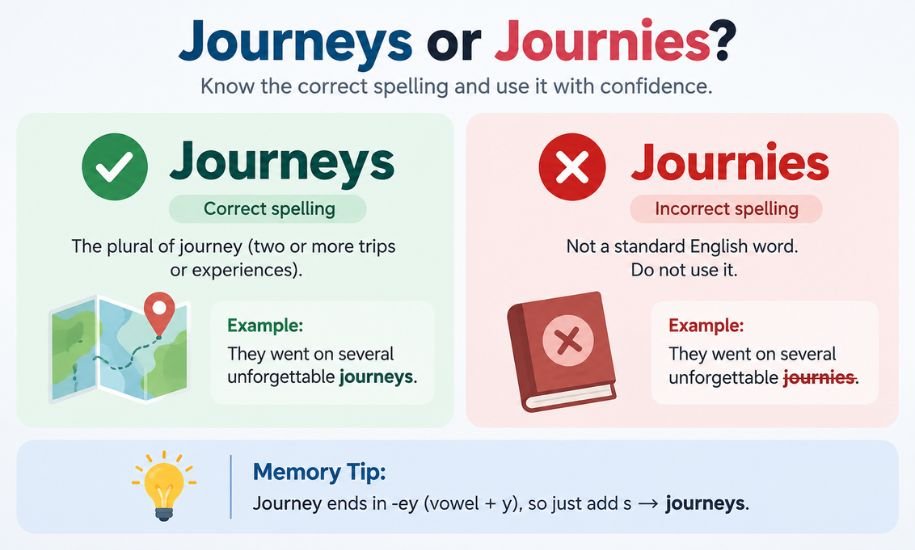
Journeys is the correct plural of journey. “Journies” is incorrect. Because journey ends in a vowel followed by y, you simply add -s to make the plural: journey → journeys.
Journeys or Journies: Which Is Correct?
The correct spelling is journeys.
Journey is the singular form, while journeys is the plural form. If you are talking about two or more trips, experiences, or processes, use journeys.
| Form | Correct? | Use |
|---|---|---|
| journey | ✅ Yes | Singular |
| journeys | ✅ Yes | Plural |
| journie | ❌ No | Incorrect spelling |
| journies | ❌ No | Incorrect spelling |
For example:
- She went on a long journey through the mountains.
- They have taken several unforgettable journeys together.
The spelling journies does not represent an alternative form of the word. It is simply an incorrect plural spelling.
Why Is “Journeys” the Correct Plural?
The confusion comes from a common English spelling rule involving words that end in y.
When a word ends in a consonant + y, the y often changes to i before adding -es:
- city → cities
- baby → babies
- story → stories
- country → countries
However, when a word ends in a vowel + y, the y usually remains unchanged and you simply add -s.
For example:
- boy → boys
- toy → toys
- key → keys
- day → days
- journey → journeys
The word journey ends in -ey. The letter immediately before the y is e, which is a vowel. Therefore, the plural is formed by adding -s, not by changing y to i.
Journey → Journeys
Not:
Journey → Journies
This is the key rule to remember.
What Does “Journey” Mean?
Journey is a noun that generally describes travel from one place to another. It can refer to a short trip, a long expedition, or travel that takes a significant amount of time.
The word can also be used figuratively to describe a process of development, change, discovery, or personal experience.
Examples include:
- Our journey to the coast took five hours.
- Her educational journey began at a small local school.
- Starting a new career can be a challenging journey.
- The novel describes a character’s emotional journey.
The singular form is appropriate when you are talking about one journey.
Journey as a Verb
Although journey is commonly used as a noun, it can also function as a verb.
For example:
- She journeys across the country each summer.
- The travelers journeyed through several remote villages.
In the sentence “He journeys alone,” journeys is a verb rather than a plural noun. Its spelling is still journeys.
What Does “Journeys” Mean?
Journeys can be the plural noun form of journey or the third-person singular present-tense form of the verb journey.
As a plural noun:
The travelers described their different journeys.
Here, journeys means more than one journey.
As a verb:
She journeys into the countryside whenever she needs a break.
Here, journeys describes an action performed by she.
The surrounding sentence usually makes the grammatical function clear.
Examples of the Plural Noun
- We talked about our childhood journeys.
- Their journeys took them across three countries.
- The photographs capture some of their most memorable journeys.
- Everyone experiences different journeys in life.
Is “Journies” a Real Word?
No. Journies is not the standard plural spelling of journey.
It is best understood as a misspelling that results from applying the wrong pluralization pattern. You may occasionally encounter it in informal writing, typing, or user-generated content, but that does not make it an accepted standard spelling.
If you are writing an essay, article, email, report, application, or other formal text, always use journeys.
Incorrect:
The travelers shared stories about their journies.
Correct:
The travelers shared stories about their journeys.
There is no separate meaning that makes journies appropriate in this context.
Why Do People Write “Journies”?
The most likely reason is confusion with words such as cities, countries, families, and stories.
These words follow the familiar consonant-plus-y pattern:
- city → cities
- family → families
- country → countries
- story → stories
Someone who remembers only the general idea—“words ending in y change to ies”—may incorrectly apply it to journey.
But the letter before the y matters.
Compare:
Consonant + y
- city → cities
- party → parties
- library → libraries
Vowel + y
- day → days
- key → keys
- journey → journeys
This small distinction explains why journeys is correct.
Journey or Journies: Understanding the Forms
If you encounter the question “journey or journies,” there is actually a third form worth remembering: journeys.
The standard forms are:
- journey — singular noun
- journeys — plural noun
- journey — base form of the verb
- journeys — third-person singular present form
- journeyed — past tense
- journeying — present participle/gerund
There is no standard English form journies.
For example:
One journey can change your perspective.
Several journeys can create lasting memories.
She journeys through the countryside every spring.
This makes it easier to see that journeys is a legitimate grammatical form, while journies is not.
Correct Examples in Sentences
Here are several natural examples showing how the word should be used:
- Their journeys across the country lasted several months.
- The photographs document the family’s different journeys.
- We listened to stories about their journeys abroad.
- Personal journeys often involve both successes and setbacks.
- The book follows the journeys of four travelers.
- Their separate journeys eventually brought them to the same destination.
- Every traveler has a different journey.
- After several difficult journeys, they finally reached their destination.
Notice that the spelling remains journeys regardless of whether the journey is physical or metaphorical.
An Easy Way to Remember the Spelling
A simple trick for remembering journeys is to look at the ending:
journey → journeys
Think:
Vowel + Y? Keep the Y and add S.
So:
- day → days
- boy → boys
- key → keys
- journey → journeys
By contrast:
Consonant + Y? Change Y to I and add ES.
So:
- city → cities
- baby → babies
- story → stories
Remembering the letter immediately before y will help you avoid writing journies.
Common Mistakes to Avoid
1. Writing “journies” as the plural
Incorrect:
The journies were difficult but rewarding.
Correct:
The journeys were difficult but rewarding.
2. Assuming every word ending in “y” becomes “ies”
This rule is incomplete. You need to check whether the letter before y is a consonant or vowel.
Journey has e + y, so the plural is journeys.
3. Using “journie” as the singular
The singular is journey, not journie.
Correct:
It was a memorable journey.
4. Confusing “journey” and “journeys”
Use journey for one:
The journey took three days.
Use journeys for more than one:
The journeys took place over several years.
5. Treating “journies” as a British or American variation
Journies is not simply a British-versus-American spelling difference. Standard English uses journeys in both American and British English.
Frequently Asked Questions
Is it journeys or journies?
Journeys is correct. It is the plural of journey. Journies is a misspelling and should not be used in standard English.
How do you spell the plural of journey?
The correct spelling is journeys. Simply add -s to journey: journey → journeys.
Why isn’t the plural “journies”?
Because journey ends in a vowel followed by y. Words ending in vowel + y generally keep the y when forming the plural, so journey becomes journeys.
Is “journeys” singular or plural?
As a noun, journeys is plural. The singular is journey. However, journeys can also be a singular verb form, as in “She journeys across the country.”
Is “journies” ever correct in English?
No, not as the standard spelling of the plural of journey. In normal English writing, use journeys.
What is an easy way to remember journeys?
Remember that journey ends in -ey, just like key. Since key → keys, you can remember journey → journeys. Keep the y and add s.
Final Verdict: Journeys or Journies?
When choosing between journeys or journies, always choose journeys. Journey is the singular form, and journeys is its standard plural. The spelling journies incorrectly applies the consonant-plus-y plural rule to a word that actually ends in vowel-plus-y. Once you remember that distinction, the correct spelling is easy to recognize. For more straightforward explanations of confusing English words and spelling choices, Grammarifyr helps you know the difference and use the right words.
You may also Read : Modeling or Modelling: Correct Spelling Guide


One Comment