Buses or Busses: Meaning and Correct Usage
It is easy to hesitate over the plural of bus. Since many English words ending in -s form their plurals with -es, the spelling busses can look perfectly natural. However, when you mean more than one passenger vehicle, buses is the standard spelling in modern English. Busses is also recorded as an alternative plural, particularly in American English, but it is much less common. The two spellings can also cause confusion because buss is a separate word meaning a kiss.
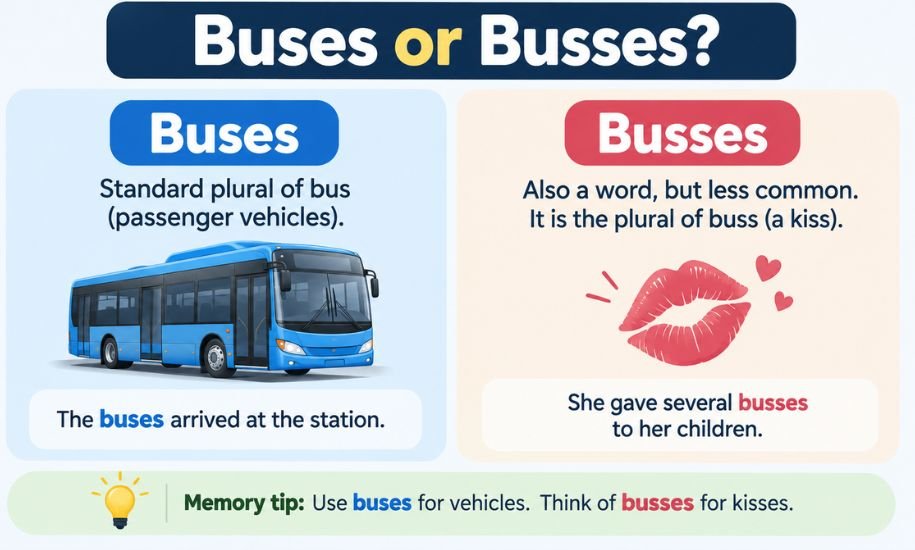
Buses is the standard plural of bus when referring to passenger vehicles. Busses is an accepted but uncommon variant, especially noted in US English. For everyday, academic, professional, and formal writing, buses is the better choice.
Buses or Busses: Which Is Correct?
When bus means a vehicle that carries passengers, the usual plural is buses.
- One bus
- Two buses
- Several buses
- School buses
- City buses
For example:
The buses arrived at the station just after noon.
The spelling busses is not simply a made-up mistake. Some dictionaries recognize it as an alternative plural. Nevertheless, it is far less common in contemporary writing, so buses is the form readers will normally expect.
Quick comparison
| Form | Status | Meaning | Best choice? |
|---|---|---|---|
| bus | Correct | One passenger vehicle | Yes |
| buses | Standard plural | More than one bus | Yes |
| busses | Alternative plural | More than one bus | Less common |
| buss | Separate word | A kiss | Yes, but different meaning |
So, if you are writing about public transportation, buses is the safest spelling.
What Does “Buses” Mean?
Buses is the plural noun formed from bus. A bus is a large road vehicle designed to transport several passengers.
Examples include:
- The buses are waiting outside the terminal.
- Three buses leave the station every hour.
- The school purchased new buses for its students.
- Electric buses are becoming more common in some cities.
The word can also have technical meanings. In electrical engineering, for example, a bus can refer to a conductor or electrical pathway used to distribute power. In computing, a bus can describe a communication system that transfers data or signals between components.
In those technical contexts, buses is also commonly used as the plural.
Is “Busses” a Real Word?
Yes. Busses can be a real word, but its status depends on the context.
When it is intended as the plural of bus, dictionaries recognize it as an alternative spelling. It is especially associated with American English in some dictionary entries.
For example:
The busses were lined up outside the stadium.
This sentence can be understood as meaning that several buses were outside the stadium. However, most writers would naturally choose:
The buses were lined up outside the stadium.
There is another reason the spelling can be confusing: buss is a separate English word meaning a kiss. Its plural is busses.
Therefore, busses does not always mean multiple passenger vehicles.
Why Do People Confuse the Two Spellings?
The confusion is understandable because English has a familiar plural pattern involving -es.
Consider:
- class → classes
- glass → glasses
- dress → dresses
- kiss → kisses
It is therefore tempting to apply the same pattern to bus and write busses. However, buses has become the standard plural spelling for the vehicle.
There is also a genuine word buss, which can make the spelling appear even more plausible.
The important distinction is simply:
bus → buses
while:
buss → busses
The second pattern is connected with the noun buss, not normally with the preferred plural spelling of the transportation word.
Buses or Busses in UK English
In British English, buses is the normal plural spelling.
For example:
The buses are often crowded during the morning rush.
British writers should generally use buses when referring to public transportation.
The alternative busses may be understood, but it is not the usual choice in standard British writing. If your audience is primarily in the UK, buses should therefore be your default.
Buses or Busses in American English
American English also normally uses buses for the plural of the transportation noun.
However, American dictionaries recognize busses as an alternative form. This means that seeing busses in American writing does not necessarily mean the writer has made a simple spelling error.
For example:
The city operates hundreds of buses.
is the conventional choice.
You may occasionally encounter:
The city operates hundreds of busses.
The latter is recognizable, but buses is the clearer and more widely preferred form for general writing.
The important point is that this is not a simple US-versus-UK spelling difference like color and colour. Both British and American English commonly use buses.
The Verb “Buses” Is Different
There is another grammatical use worth knowing.
Bus can also be a verb. In one sense, it means to transport people by bus. In North American English, it can also mean to clear dishes from tables in a restaurant.
The third-person singular present form can be written buses:
The company buses workers between the two locations.
There are also alternative spellings such as busses for some verb uses.
Other forms can likewise vary:
- bus
- buses / busses
- bused / bussed
- busing / bussing
These variations can make the spelling issue more complicated than it first appears. However, when you are simply talking about several passenger vehicles, there is no need to overthink it: buses is the standard choice.
Examples of Correct Usage
Here are some natural examples using the preferred plural:
- Several buses stopped outside the hotel.
- The school operates twelve buses.
- We waited for the buses near the main entrance.
- The buses were delayed by heavy traffic.
- Modern electric buses produce less tailpipe pollution than conventional diesel buses.
- Two buses arrived at the terminal at the same time.
Correct vs. less common
Preferred:
The buses left the station at six o’clock.
Acceptable but uncommon:
The busses left the station at six o’clock.
For polished writing, the first version is the better option.
What About “Busses” Meaning Kisses?
This is an important distinction.
Buss is an English noun and verb associated with kissing. As a noun, a buss can mean a kiss. Its plural is busses.
For example:
The old poem describes several affectionate busses.
This use is uncommon in modern everyday English, but the word is legitimate.
As a verb, buss can also mean to kiss. Because of this separate word, busses may sometimes have nothing to do with transportation.
That is one reason context matters when interpreting the spelling.
Easy Way to Remember the Correct Plural
For transportation, remember this simple pattern:
One bus → several buses.
Think of buses as the default spelling whenever you are talking about public transportation, school transportation, coaches used as buses, or multiple passenger vehicles.
If you encounter busses, do not automatically assume it is impossible. Instead, check the context. It may be an alternative spelling of the plural of bus, or it may relate to the separate word buss.
For normal writing, however, choosing buses will almost always be the clearest option.
Common Mistakes to Avoid
1. Treating “busses” as always wrong
Although buses is preferable, busses is recorded as an alternative plural. Calling it universally impossible would be too strong.
2. Assuming it is a strict US/UK difference
Both American and British English commonly use buses. The alternative busses is particularly noted in some American dictionary entries, but it is not equivalent to a standard US-versus-UK spelling pair.
3. Confusing “bus” and “buss”
These are different words. Bus can mean a passenger vehicle, while buss can mean a kiss.
4. Using “busses” automatically because of the -es pattern
English plural spelling is not always predictable from a single rule. The established standard for the vehicle is buses.
Frequently Asked Questions
Is “busses” grammatically correct?
Yes, busses is recorded as an alternative plural of bus by major dictionaries. However, it is much less common than buses when referring to passenger vehicles, so buses is normally the preferred form.
What is the plural of bus?
The standard plural is buses. For example: One bus was waiting outside, but several buses were already at the station.
Is “busses” American or British?
Busses is recognized in both varieties as an alternative form, but it is particularly identified as a US variant in some dictionaries. Buses is the normal spelling in both American and British English.
Is “busses” a misspelling?
Not necessarily. It can be a legitimate alternative plural of bus. It can also be the plural of the separate word buss, meaning a kiss. Nevertheless, buses is the preferred spelling for multiple passenger vehicles.
What is the singular of “buses”?
The singular is bus. For example, one bus becomes two buses.
How should I spell it in formal writing?
Use buses when referring to multiple passenger vehicles. It is the standard, familiar form and is the clearest choice for formal, academic, professional, and general writing.
Final Verdict: Buses or Busses?
When you mean multiple passenger vehicles, buses is the standard spelling and the form you should normally use. Busses is a recognized alternative, but it is uncommon and can also be confused with the plural of buss, meaning kisses.
For readers who want clear answers to tricky English choices, Grammarifyr follows the same principle: understand the distinction, choose the form that fits the context, and write with confidence.
You may also Read : Caraway vs GreenPan: Performance, Safety and Durability