Whoever or Whomever: Difference and Examples
Choosing between whoever and whomever can be surprisingly tricky. Both are correct English words, but they do not serve the same grammatical function. The key is to determine whether the person referred to is acting as the subject or receiving the action as an object. Once you know what role the pronoun plays inside its clause, the choice becomes much easier.
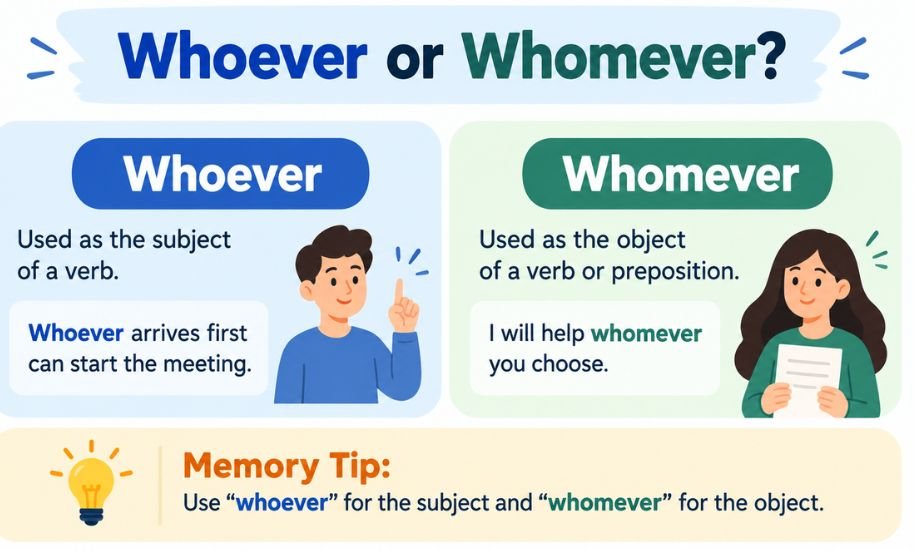
Whoever is used when the person is the subject of a clause, while whomever is traditionally used when the person is the object. Try replacing the word with “he” or “they” for whoever, or “him” or “them” for whomever. In everyday English, whoever is also very common, even in situations where formal grammar might traditionally favor whomever.
Whoever vs. Whomever: The Basic Difference
The easiest way to understand the distinction is to compare these two forms with the familiar pronouns who and whom.
| Word | Grammatical role | Similar pronoun | Example |
|---|---|---|---|
| Whoever | Subject | he, she, they | Whoever arrives first can start. |
| Whomever | Object | him, her, them | Choose whomever you trust. |
The difference is therefore not about meaning. Both words refer to an unknown, unspecified, or unrestricted person or group of people.
The difference is about grammatical function.
For example:
- Whoever calls first will get an appointment.
- I’ll speak to whomever you recommend.
In the first sentence, whoever performs the action of calling. In the second, whomever receives the action of being recommended.
What Does “Whoever” Mean?
Whoever is an indefinite relative pronoun meaning roughly “any person who” or “the person who.”
It is used when the person referred to is the subject of the relevant clause.
Consider:
Whoever finishes the project first will receive the award.
The clause is whoever finishes the project first. The person represented by whoever performs the action finishes.
You can test it by replacing whoever with they:
They finish the project first.
Because they works as the subject, whoever is the appropriate choice.
Examples with “whoever”
- Whoever arrives first can choose a seat.
- Whoever knows the answer should raise a hand.
- Whoever wins the competition will receive a trophy.
- Whoever made this cake did an excellent job.
In each case, the pronoun represents the person doing something.
What Does “Whomever” Mean?
Whomever is the object form corresponding to whoever. It is traditionally used when the person referred to functions as the object of a verb or preposition.
For example:
Choose whomever you trust.
Here, you is the subject of trust, while the person being trusted is the object.
Try replacing whomever with them:
You trust them.
Because them is the object form, whomever fits the traditional grammatical pattern.
Examples with “whomever”
- Choose whomever you trust.
- Invite whomever you want.
- We will interview whomever the manager recommends.
- Give the documents to whomever you select.
In each sentence, another person is performing the action, and the person represented by whomever receives that action.
The Best Trick: Use “He/They” or “Him/Them”
If grammar terminology makes the choice confusing, use a simple substitution test.
If “he” or “they” works, use “whoever”
Whoever arrives first should call me.
Replace the pronoun:
They arrive first.
That works, so whoever is correct.
Another example:
Whoever wants to participate can join.
→ They want to participate.
Again, whoever is correct.
If “him” or “them” works, use “whomever”
I’ll invite whomever you choose.
Replace the pronoun:
You choose them.
That works, so whomever is the traditional formal choice.
Another example:
She will hire whomever the director recommends.
→ The director recommends him.
Therefore, whomever fits the formal grammatical pattern.
Easy rule
Whoever = he/she/they
Whomever = him/her/them
This is one of the quickest ways to distinguish the two.
Look Inside the Clause, Not Just at the Whole Sentence
This is where many otherwise careful writers make mistakes.
The grammatical role of the entire phrase is not necessarily the same as the role of whoever or whomever inside that phrase.
Consider:
Whomever you choose will lead the meeting.
At first, the sentence can look confusing because “whomever you choose” is the subject of the whole sentence.
However, look inside the clause:
You choose whomever.
You is the subject, choose is the verb, and whomever is the object.
That is why whomever is traditionally appropriate.
Now compare:
Whoever chooses the leader will lead the meeting.
Inside the clause:
Whoever chooses the leader.
The person represented by whoever performs the action chooses. Therefore, whoever is the subject.
This “look inside the clause” approach is more reliable than simply asking whether the whole phrase acts as a subject or object.
Whoever or Whomever Examples
Here are some practical examples showing the difference:
Whoever
Whoever calls first can leave a message.
The person performs the action of calling.
Whoever finishes early may leave.
The person performs the action of finishing.
Give the position to whoever qualifies.
Inside the clause whoever qualifies, the person is the subject of qualifies.
Work with whoever is available.
The person represented by whoever is the subject of is available.
Whomever
Choose whomever you trust.
You trust that person, making the pronoun the object of trust.
I’ll contact whomever you recommend.
You recommend that person.
Invite whomever you want.
You want that person to attend.
The committee will select whomever the director nominates.
The director nominates that person, so the pronoun functions as the object of nominates.
Why “to Whoever” Can Be Correct
One particularly confusing construction involves a preposition.
You might see:
Give the package to whoever arrives first.
Some writers assume that because whoever follows the preposition to, it must be whomever.
But the important question is what role the pronoun plays in its own clause.
Look at:
whoever arrives first
The person represented by whoever performs the action arrives.
You could say:
They arrive first.
So whoever is traditionally correct.
Compare that with:
Give the package to whomever you choose.
Here:
You choose whomever.
The person is the object of choose, so whomever follows the traditional formal rule.
The difference is subtle but important.
What About “Whoever or Whomever Is Available”?
The correct form is:
Whoever is available can help.
Why?
Because the person represented by whoever is the subject of is available.
You can replace it with:
They are available.
Therefore, whoever is appropriate.
The same pattern appears in:
- Whoever is ready can begin.
- Whoever is interested should apply.
- Whoever is available can attend.
- Whoever is responsible should contact us.
The word following the pronoun is often a useful clue. When the pronoun is followed by a verb that it performs, whoever is generally the traditional choice.
What About “Whoever or Whomever It May Concern”?
The familiar expression is:
To whom it may concern
rather than to whoever it may concern or to whomever it may concern.
However, whoever and whomever can appear in other constructions involving an unspecified person.
For example:
Whoever it may concern should review the notice.
Here, whoever functions as the subject of may concern in the relevant construction.
Because expressions involving whom and whoever can become structurally complicated, it is better to examine the clause rather than choose a form simply because it sounds formal.
Is “Whomever” Too Formal?
Whomever is a real and grammatically established word, but it is less common in everyday English than whoever.
In casual conversation, many speakers use whoever in places where traditional formal grammar might recommend whomever. That does not mean the distinction has no value. It simply means actual English usage can be less rigid than the traditional rule.
For formal writing, especially when grammatical precision matters, the subject/object distinction remains useful.
For everyday writing, forcing whomever into a sentence merely because it sounds more sophisticated can sometimes make the sentence feel unnatural.
The goal should be clarity and grammatical accuracy, not using the more complicated-looking word.
Common Mistakes to Avoid
1. Treating “whomever” as a fancier version of “whoever”
These words are not interchangeable under the traditional grammatical distinction.
Whoever arrives first gets the seat.
Correct.
Whomever arrives first gets the seat.
Not the traditional grammatical choice, because the pronoun is the subject of arrives.
2. Automatically using “whomever” after a preposition
A preposition can make the choice look obvious, but the following clause may change the answer.
Give it to whoever arrives first.
Here, whoever is the subject of arrives.
3. Looking only at the main verb
In a sentence such as:
Whomever you select will represent the team.
The phrase whomever you select is the subject of the main sentence, but whomever is the object of select.
The internal clause determines the traditional form.
4. Assuming “whoever” is always wrong in informal English
Modern English frequently favors whoever, particularly in everyday communication. The formal distinction is useful, but real-world usage is not always as rigid as textbook grammar.
An Easy Way to Remember the Difference
Think about the familiar pair who/whom.
If the person is doing the action, think who → whoever.
If the person is receiving the action, think whom → whomever.
An even easier version is:
Whoever → they
Whomever → them
For example:
Whoever wants to come may join us.
→ They want to come.
But:
Invite whomever you trust.
→ You trust them.
If you can make that substitution naturally, the correct choice becomes much easier.
Whoever or Whomever: Quick Quiz
Try choosing the correct form in each sentence.
- ______ arrives first can open the office.
- We will invite ______ you recommend.
- Give the prize to ______ wins.
- Choose ______ you trust.
- ______ is responsible should explain what happened.
Answers
- Whoever — the person performs arrives.
- Whomever — the person is the object of recommend.
- Whoever — the person performs wins.
- Whomever — the person is the object of trust.
- Whoever — the person is the subject of is responsible.
The same simple principle works throughout: identify the grammatical role inside the relevant clause.
Frequently Asked Questions
Is “whoever” or “whomever” correct?
Both are correct words. Whoever is the traditional subject form, while whomever is the traditional object form. The correct choice depends on the grammatical role of the pronoun inside its clause.
Is “whomever” a real word?
Yes. Whomever is a standard English pronoun and is traditionally used as the object form corresponding to whoever. It is less common in everyday speech than whoever, but it remains appropriate in formal constructions where the object form is called for.
Is it “whoever is available” or “whomever is available”?
The traditional grammatical choice is “whoever is available.” The person represented by whoever is the subject of is available. You can think of it as “They are available.”
How can I remember the difference?
Use the they/them test. If you could replace the word with they, use whoever. If you could replace it with them, use whomever. For example, “Whoever arrives” becomes “They arrive,” while “whomever you choose” becomes “you choose them.”
Should I always use “whomever” in formal writing?
No. Use whomever when its grammatical role calls for the object form. Do not choose it simply because it sounds more formal. If whoever is the subject of its clause, whoever remains the appropriate traditional choice.
Final Verdict: Whoever or Whomever?
The simplest rule is to focus on the pronoun’s role inside its own clause. Use whoever when the person performs the action, and use whomever when the person receives the action or functions as an object. When in doubt, try the they/them test. Learning this small distinction can make confusing sentences much easier to write correctly, and Grammarifyr is here to help you make those word choices with confidence.
You may also Read : Repass or Repast: Meaning and Usage Explained