Purposely or Purposefully: Which Is Correct?
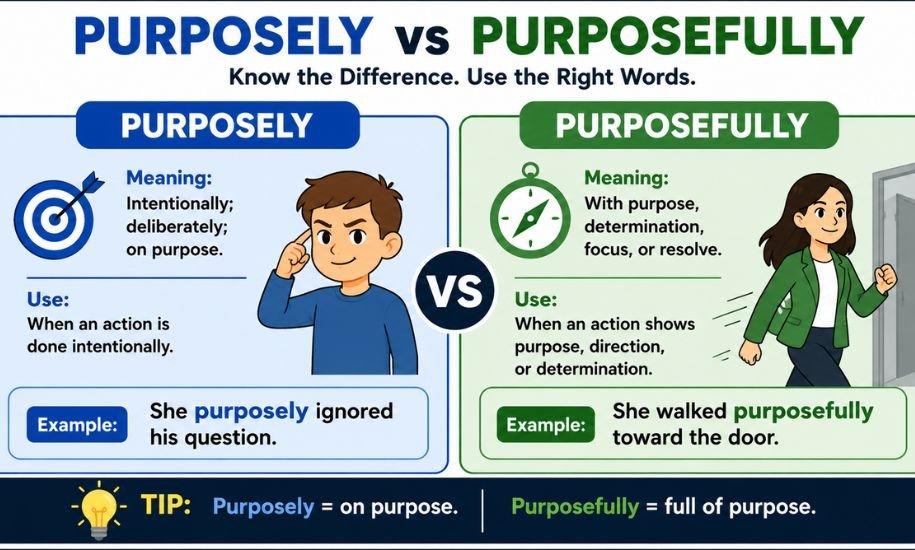
If you have ever hesitated between purposely and purposefully, you are not alone. Both words are spelled correctly, both function as adverbs, and both are connected to the idea of having a purpose. The important difference is in what that purpose means in context. Purposely usually means intentionally or on purpose, while purposefully generally describes doing something with purpose, determination, or resolve.
Both “purposely” and “purposefully” are correct words. Use purposely when you mean “intentionally” or “on purpose.” Use purposefully when you want to emphasize acting with purpose, focus, determination, or resolve.
Purposely or Purposefully: The Key Difference
The easiest way to distinguish these words is to focus on the intended meaning.
| Word | Basic meaning | Useful substitute | Example |
|---|---|---|---|
| Purposely | Intentionally; deliberately | on purpose | She purposely ignored the warning. |
| Purposefully | With purpose, determination, or resolve | deliberately and with focus | She walked purposefully toward the exit. |
Both words are adverbs, but they emphasize slightly different ideas. Purposely focuses on the fact that an action was intentional rather than accidental. Purposefully focuses more on the manner or direction of the action—someone is acting with a clear aim or determined attitude.
There can be overlap. In some sentences, either word can be grammatically possible, but changing the adverb can subtly change the emphasis.
What Does “Purposely” Mean?
Purposely means intentionally, deliberately, or on purpose.
It tells the reader that something was done because the person intended to do it. The important contrast is usually between an intentional action and an accidental one.
For example:
- She purposely left the door unlocked.
- He purposely avoided the question.
- I purposely chose the earlier train.
- They purposely changed the schedule.
In each sentence, the action was intentional.
A useful test is to replace purposely with “on purpose.” If the sentence still has essentially the same meaning, purposely is probably the right choice. Grammarly gives this same practical distinction, describing purposely as synonymous with “intentionally” and “on purpose.”
Purposely in a sentence
Consider:
Marcus purposely left his phone at home.
This means Marcus intentionally left his phone at home. It does not necessarily tell us that he acted with determination or that his behavior visibly showed a sense of purpose. It simply tells us that the decision was deliberate.
Another example:
She purposely didn’t mention the surprise.
The meaning is that she deliberately chose not to mention it.
What Does “Purposefully” Mean?
Purposefully generally means in a way that shows purpose, determination, focus, or resolve.
It can describe the manner in which someone performs an action. The word often creates an image of someone acting in a focused or deliberate way rather than simply making an intentional choice.
Examples include:
- She walked purposefully toward the podium.
- He spoke purposefully about the company’s plans.
- The team worked purposefully toward its goal.
- She moved purposefully through the crowded hallway.
In these examples, the word does more than tell us that the action was intentional. It suggests direction and determination.
Purposefully meaning in context
Consider:
He walked purposefully toward the office.
The sentence suggests that he walked with a clear intention or determined manner. His movement appears focused.
Compare that with:
He purposely walked toward the office.
This means he intentionally walked toward the office rather than doing so accidentally.
The difference is subtle but useful: purposely answers “Did he intend to do it?”, while purposefully can answer “How did he do it?”—with focus or determination.
Is “Purposely” a Word?
Yes, purposely is a real and standard English word.
There is no need to replace purposely with purposefully simply because the latter sounds longer or more formal. Purposely is an established adverb meaning intentionally or deliberately. Merriam-Webster and other established language resources recognize it as a legitimate word. Grammarly likewise specifically notes that purposely can be the unequivocally correct choice when the intended meaning is “on purpose.”
For example:
Correct: She purposely ignored the message.
There is nothing grammatically wrong with this sentence.
You could also write:
She intentionally ignored the message.
or:
She ignored the message on purpose.
All three convey essentially the same basic idea.
Purposely or Purposefully: Which Is Correct?
The answer depends on your intended meaning.
Choose “purposely” for intentional action
Use purposely when you mean that someone deliberately did something.
Tom purposely left the meeting early.
The sentence tells us Tom intended to leave early.
The child purposely knocked over the blocks.
The child did it deliberately rather than accidentally.
I purposely saved the document in a separate folder.
The separate folder was a deliberate choice.
Choose “purposefully” for determined or focused action
Use purposefully when the sentence emphasizes a person’s manner, direction, resolve, or goal.
The speaker walked purposefully to the microphone.
The speaker’s movement appears confident and focused.
She purposefully organized the project around three priorities.
The organization was carried out with a clear objective.
He purposefully worked through each stage of the plan.
The emphasis is on a focused and methodical approach.
Microsoft’s usage guide makes the same distinction: purposely conveys deliberate action, whereas purposefully can describe action performed in a way that demonstrates determination and resolve.
Purposely or Purposefully Examples
Seeing the two words side by side makes the distinction easier.
Example 1: Ignoring someone
She purposely ignored his question.
Meaning: She intentionally chose not to answer.
Example 2: Moving toward something
She walked purposefully toward the door.
Meaning: Her movement appeared focused and determined.
Example 3: Designing something
The website was purposely designed to be simple.
Meaning: Its simplicity was intentional.
The website was purposefully designed to be simple.
This version can place more emphasis on the deliberate, considered nature of the design process. In some contexts, the practical meaning may be almost identical.
Example 4: Working toward a goal
They purposely chose the cheaper option.
They made that choice intentionally.
They worked purposefully toward their financial goal.
Their work was focused and directed toward a particular objective.
Can the Two Words Be Interchanged?
Sometimes, but not always without changing the nuance.
Because both words relate to intentionality and purpose, certain sentences can accept either form. Microsoft notes that the words can sometimes be grammatically interchangeable, although replacing one with the other can alter the sentence’s connotation.
For example:
The team purposely designed the building for accessibility.
This emphasizes that accessibility was an intentional design decision.
The team purposefully designed the building for accessibility.
This can suggest a deliberate, considered design process focused on that objective.
Neither sentence is automatically wrong. The better choice depends on what you want to emphasize.
However, the distinction is clearer in sentences such as:
She purposely hid the gift.
This means she hid it intentionally.
versus:
She walked purposefully across the room.
Here, purposefully naturally describes the determined manner of walking.
An Easy Way to Remember the Difference
Use this simple two-question test:
Can I replace the word with “on purpose”?
If yes, choose purposely.
He purposely broke the rule.
He broke the rule on purpose.
Does the action show focus, determination, or a clear sense of purpose?
If yes, purposefully may be the better choice.
She walked purposefully toward the stage.
A short memory aid is:
Purposely = on purpose.
Purposefully = full of purpose.
This distinction closely matches the practical guidance provided by Grammarly and Microsoft.
Common Mistakes to Avoid
1. Assuming “purposely” is incorrect
It isn’t. Purposely is a correct word.
Correct: He purposely changed the answer.
Do not automatically replace it with purposefully.
2. Using “purposefully” whenever you mean “on purpose”
If your only meaning is intentionality, purposely is often the clearest choice.
Clear: She purposely deleted the file.
The sentence simply says the deletion was intentional.
3. Treating the difference as an absolute rule
The two words overlap in some contexts. It is not accurate to claim that purposely can never be used where purposefully appears, or vice versa. Context determines the intended nuance.
4. Choosing the longer word because it sounds more formal
Purposefully is not simply a more sophisticated version of purposely. They have related but distinct uses.
If you mean “intentionally,” purposely is perfectly appropriate.
Purposely vs. Purposefully: A Few More Sentence Pairs
Here are some quick comparisons:
Purposely:
Daniel purposely arrived early.
He intentionally decided to arrive early.
Purposefully:
Daniel walked purposefully into the interview room.
His manner of walking appeared focused and determined.
Purposely:
The teacher purposely changed the seating arrangement.
The change was intentional.
Purposefully:
The teacher purposefully arranged the desks to encourage discussion.
The arrangement was made with a specific goal in mind.
Purposely:
She purposely chose not to respond.
She deliberately decided not to respond.
Purposefully:
She purposefully addressed each concern raised by the audience.
She addressed the concerns in a focused, deliberate way directed toward a goal.
Frequently Asked Questions
Is purposely a word?
Yes. Purposely is a standard English adverb meaning intentionally, deliberately, or on purpose. It is not a misspelling of purposefully, and it should not be avoided simply because purposefully is also a valid word.
Is it purposely or purposefully?
Both are correct. Purposely usually means “intentionally” or “on purpose,” while purposefully usually emphasizes acting with purpose, determination, focus, or resolve.
Which is correct: purposely or purposefully?
Neither is universally more correct. Choose purposely when you want to emphasize intention. Choose purposefully when you want to emphasize purposeful, focused, or determined action.
What is the meaning of purposefully?
Purposefully means in a way that shows purpose, determination, focus, or resolve. For example, “She walked purposefully toward the stage” suggests that she moved with clear direction and determination.
Can purposely and purposefully be used interchangeably?
Sometimes. Their meanings overlap in certain sentences, particularly when an action is clearly deliberate. However, purposefully can add the idea of determination or a focused manner, so substituting one for the other can change the nuance.
What is the easiest way to remember the difference?
Remember: purposely = on purpose, while purposefully = with purpose. If you are talking about whether something was intentional, purposely is usually the natural choice. If you are describing focused or determined action, purposefully may be better.
The Bottom Line
Purposely and purposefully are both correct English words. Use purposely when the key idea is that something happened intentionally or “on purpose.” Use purposefully when the sentence highlights purpose, focus, direction, or determination. Once you ask whether you are emphasizing intention or purposeful manner, the choice becomes much easier. That simple distinction is exactly the kind of practical word guidance Grammarify aims to provide: Know the Difference. Use the Right Words.