Manuel or Manual: Meaning and Correct Usage
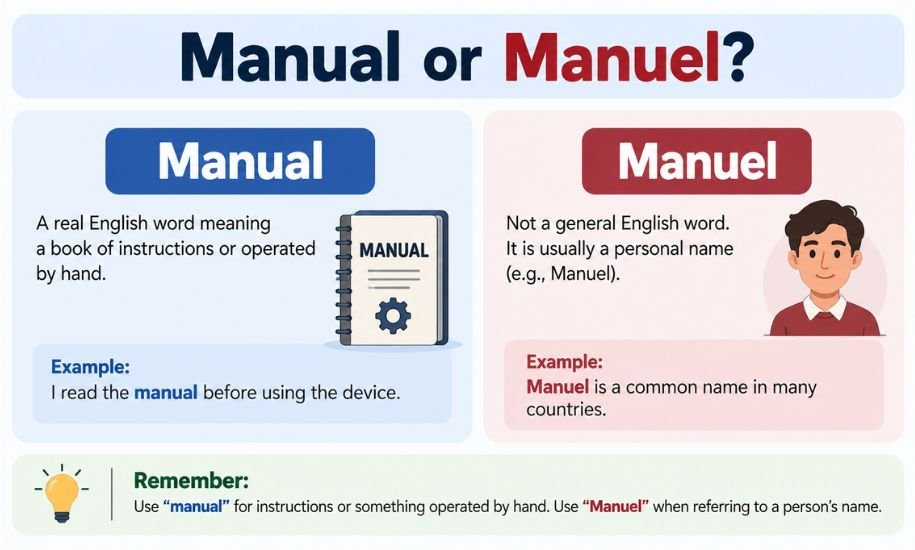
It is easy to confuse manuel and manual because they look almost identical and differ by only one letter. However, in standard modern English, they do not normally have the same function. Manual is the word you need when talking about an instruction book, something operated by hand, or work performed by hand. Manuel, with a capital M, is most commonly a personal name, particularly in Spanish and Portuguese. The distinction becomes especially important in phrases such as “user manual,” “manual labor,” and “manual transmission.”
Manual is the standard English spelling when you mean an instruction book, guide, or something done or operated by hand. Manuel is generally a personal name, not an alternative spelling of the English word “manual.” For example, write “Read the user manual,” but “Manuel is waiting outside.”
Manuel or Manual: What’s the Difference?
The simplest way to distinguish these two forms is to look at what they are doing in the sentence.
| Feature | Manual | Manuel |
|---|---|---|
| Word type | Common noun or adjective | Usually a proper noun |
| Main English use | Instructions, hand-operated work, physical work | Personal name |
| Example | “Read the manual.” | “Manuel called earlier.” |
| Capitalization | Usually lowercase | Usually capitalized |
| Can it mean an instruction book? | Yes | No, not in standard English |
| Can it refer to a person? | Not normally | Yes |
So, if you are writing about a book of instructions, the correct spelling is manual.
If you are referring to someone named Manuel, the spelling with -uel is correct.
What Does “Manual” Mean?
Manual is a standard English word that can function as both a noun and an adjective.
Manual as a noun
As a noun, manual commonly means a book, document, or guide containing instructions for using, operating, or understanding something.
For example:
- Please read the manual before operating the machine.
- I lost the printer manual.
- The installation manual explains each step.
- You can find the information in the user manual.
This is why user manual, instruction manual, employee manual, and service manual are all standard expressions.
Manual as an adjective
As an adjective, manual generally describes something done by hand or operated by a person rather than automatically.
Examples include:
- The machine has a manual control.
- The workers performed a manual inspection.
- He prefers a manual transmission.
- The data must be entered manually.
The word’s connection with the hand is also reflected in its history. Dictionary.com traces manual to Latin manuālis, related to manus, meaning “hand.”
What Does “Manuel” Mean?
Manuel is primarily used as a personal name. It is especially associated with Spanish and Portuguese usage, although the name is also used in several other European languages. Reference material on names identifies it as a Spanish and Portuguese form of Emmanuel.
For example:
- Manuel arrived at the office early.
- I sent the message to Manuel.
- Manuel’s car is parked outside.
- We met Manuel at the conference.
Because it is a person’s name, it is normally capitalized.
This means that Manuel can absolutely be a correct spelling—but it is correct when you are referring to the name, not when you mean an instruction guide.
Is “Manuel” a Misspelling of “Manual”?
When someone writes manuel while intending to mean an English instruction book or something done by hand, it is a spelling error.
For example:
Incorrect:
“Please read the user manuel.”
Correct:
“Please read the user manual.”
But the following is perfectly correct:
Correct:
“Manuel sent me the document.”
The difference is not simply a matter of capitalization. The two forms have different functions and meanings in English.
There is also an important linguistic qualification: manuel is a real word in some other languages. For example, French uses manuel for meanings related to “manual,” including something done by hand, and as a noun for a handbook or manual.
So it would be inaccurate to say that the letter sequence manuel can never be a word. The important point for an English spelling question is that manuel is not the standard English spelling of the common word manual.
Why Are Manuel and Manual Confused?
The confusion is understandable because the two spellings are extremely close:
- manual
- manuel
They share most of the same letters, but the vowel arrangement differs.
There is also a meaning-related reason for confusion: someone may hear a word such as “manual” and remember its approximate sound without remembering the exact spelling.
Context usually solves the problem quickly.
Compare:
“Read the manual before using the equipment.”
Here, the sentence clearly refers to an instruction guide.
Now compare:
“Manuel will help you install the equipment.”
Here, the sentence refers to a person.
Current English usage references discussing this specific confusion likewise distinguish manual as the standard English vocabulary word from Manuel as a personal name.
Common Uses of “Manual”
Knowing the phrases in which manual frequently appears can make the correct spelling easier to recognize.
User manual
A user manual explains how to use a product, machine, application, or device.
“The user manual explains how to reset the device.”
Instruction manual
An instruction manual provides directions for completing a task or operating something.
“Follow the instruction manual carefully.”
Manual labor
Manual labor refers to physical work involving human effort, particularly work performed with the hands.
“The construction project requires a lot of manual labor.”
Manual transmission
A manual transmission is a vehicle transmission in which the driver controls gear changes rather than relying on a fully automatic system.
“She learned to drive a car with a manual transmission.”
Manual process
A manual process requires a person to perform steps rather than having them carried out automatically.
“The records still have to be checked through a manual process.”
These expressions all use manual, not manuel.
Correct and Incorrect Examples
Here are some straightforward examples that show the difference.
When you mean an instruction book
Correct:
“Where is the camera manual?”
Incorrect:
“Where is the camera manuel?”
When you mean something done by hand
Correct:
“The workers completed a manual inspection.”
Incorrect:
“The workers completed a manuel inspection.”
When you mean a person’s name
Correct:
“Manuel is coming to the meeting.”
Incorrect:
“Manual is coming to the meeting.”
Of course, Manual could technically appear as a person’s name in a particular context if someone were actually given that spelling. But in ordinary English, the intended distinction is clear: manual is the vocabulary word, while Manuel is commonly a personal name.
Manual or Manuel in British and American English
There is no British-versus-American spelling difference here.
Both British English and American English use manual for the ordinary English word.
For example:
British English:
“Please check the vehicle manual.”
American English:
“Please check the vehicle manual.”
The spelling remains manual in both varieties.
Likewise, Manuel remains the usual spelling when referring to a person with that name.
This makes the pair different from comparisons such as colour/color or centre/center, where regional spelling conventions genuinely differ.
A Simple Way to Remember the Difference
Use this quick rule:
Manual = instructions or hands.
Manuel = a person’s name.
Think of a manual as something you hold in your hands or use to learn how to operate something.
For example:
“Read the manual.”
Think of Manuel as a person’s name:
“Ask Manuel.”
You can also remember the capitalization:
- manual → ordinary English word
- Manuel → usually a person’s name
Capitalization is not an absolute test because a word can be capitalized at the beginning of a sentence, but it is a useful clue when the word appears in the middle of a sentence.
Common Mistakes to Avoid
1. Writing “user manuel”
This is probably the most obvious mistake when referring to an instruction guide.
Wrong: “Download the user manuel.”
Right: “Download the user manual.”
2. Treating Manuel as a spelling variation
Manuel is not the normal British or American alternative spelling of manual.
If you mean “instruction guide,” use manual.
3. Using lowercase “manuel” for a person’s name
A person’s name normally receives a capital letter.
Better: “Manuel sent the email.”
Not:
“manuel sent the email.”
4. Assuming the words have the same meaning
They do not normally function as interchangeable words in English. One refers to instructions or hand-related activity; the other is generally a personal name.
5. Assuming British English uses “manuel”
It does not. British English uses manual for the standard English word.
How to Choose the Right Word
When you hesitate between the two spellings, ask what you are talking about.
If you mean:
- an instruction book → manual
- a guide for operating something → manual
- work done by hand → manual
- something operated by hand → manual
- a manual transmission → manual
- a person’s name → Manuel
A quick substitution test can help too.
If you can replace the word with “instruction guide” or “by hand,” you almost certainly need manual.
For example:
“Read the instruction guide.”
Therefore:
“Read the manual.”
But if the sentence could be replaced with a person’s name, Manuel may be the intended form:
“Tell Manuel about the meeting.”
Frequently Asked Questions
Is it “manuel” or “manual”?
For the standard English word meaning an instruction book or something done by hand, the correct spelling is manual. Manuel is generally a personal name and should not replace manual in phrases such as “user manual.”
Is “Manuel” a real word?
Yes, but its status depends on the language and context. In English, Manuel is primarily recognized as a personal name. In languages such as French, manuel is also a vocabulary word with meanings corresponding to English manual.
How do you spell “manual” as in a book?
The correct spelling is manual: M-A-N-U-A-L. For example, “Please read the instruction manual before using the product.”
Is “Manuel” the British spelling of “manual”?
No. British English uses manual, just like American English. Manuel is not a British spelling variant of the word.
Is “manuel” correct for a person?
If the person’s name is Manuel, then yes. Names should be written according to the person’s actual spelling, so Manuel can be completely correct when referring to someone with that name.
How can I remember the difference?
Remember manual = hands or instructions and Manuel = person. If you are reading a book of instructions, you need a manual. If you are speaking to someone named Manuel, use Manuel.
The Bottom Line
For standard English, use manual when you mean an instruction book, a hand-operated system, or something performed by hand. Use Manuel when referring to a person with that name. Although manuel is also a legitimate word in some other languages, it is not the standard English spelling of manual. If you enjoy resolving tricky word choices like this, Grammarifyr helps make these small but important distinctions easier to understand.
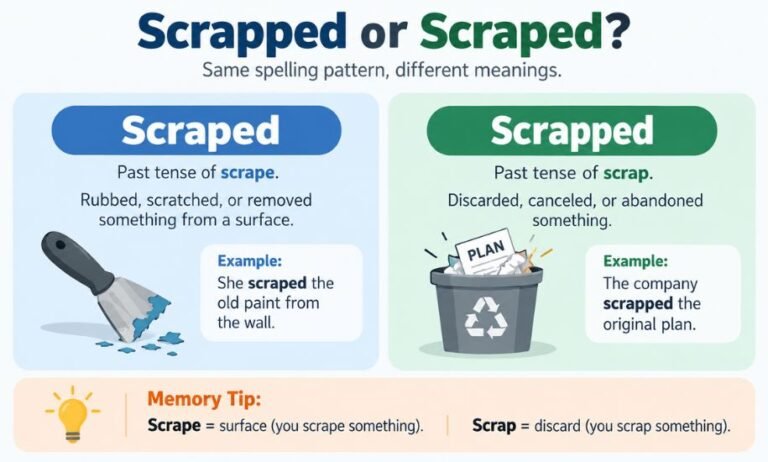
You may also Read : Scraped or Scrapped: Easy Difference With Examples
One Comment