Fiancé or Fiancée: Spelling, Meaning and Examples
If you have ever wondered whether to call an engaged man a fiancé or an engaged woman a fiancée, the difference comes down to one small spelling detail. Both words are correct, and both describe a person who is engaged to be married. The traditional distinction is based on gender: fiancé refers to a man, while fiancée refers to a woman. Because the two words are pronounced almost identically in English, it is easy to confuse them when writing.
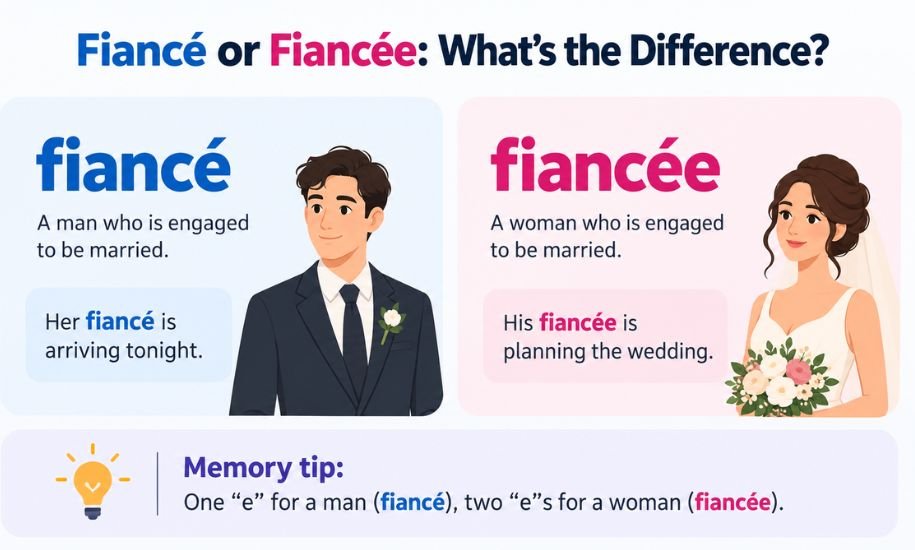
Fiancé traditionally means a man who is engaged to be married, while fiancée traditionally means a woman who is engaged to be married. Both forms are correct; the extra “e” in fiancée marks the traditional feminine form. In speech, they are generally pronounced the same.
Fiancé or Fiancée: Which One Is Correct?
Both fiancé and fiancée are correct words. The right choice depends on the person you are describing.
| Word | Traditional meaning | Example |
|---|---|---|
| fiancé | A man engaged to be married | “Her fiancé is arriving tonight.” |
| fiancée | A woman engaged to be married | “His fiancée is planning the ceremony.” |
The distinction comes from French, where nouns can have masculine and feminine forms. English has retained the two spellings when referring to an engaged person.
So, if a woman is engaged to a man, she can describe him as her fiancé. If a man is engaged to a woman, he can describe her as his fiancée.
What Does “Fiancé” Mean?
Fiancé is a noun traditionally used for a man who is engaged to be married.
For example:
- Maria introduced her fiancé to her family.
- Her fiancé proposed during their holiday.
- Daniel is excited to become a husband; his fiancé is helping plan the wedding.
- She bought a present for her fiancé.
The word describes someone’s relationship status before marriage. A boyfriend does not automatically become a fiancé simply because the relationship is serious. The person is normally called a fiancé after the couple has become engaged.
Is “fiancé” male or female?
In traditional usage, fiancé is masculine, so it refers to a man who is engaged.
For example:
James is my fiancé.
Here, James is the man who is engaged to the speaker.
However, some English speakers use fiancé more broadly as a gender-neutral term. If you want to follow the traditional distinction, use fiancé for a man and fiancée for a woman.
What Does “Fiancée” Mean?
Fiancée is a noun traditionally used for a woman who is engaged to be married.
Examples include:
- Michael introduced his fiancée at the family dinner.
- His fiancée chose the wedding venue.
- My fiancée and I are getting married next spring.
- He bought flowers for his fiancée.
The important visual difference is the final letter:
fiancé → one e after the “c”
fiancée → two es after the “c”
Is “fiancée” male or female?
Traditionally, fiancée is feminine, so it refers to a woman who is engaged.
For example:
Emily is my fiancée.
Emily is the woman engaged to the speaker.
If you are writing in a context where the traditional masculine/feminine distinction is expected, fiancée is the appropriate form for an engaged woman.
Why Are the Two Words Confused?
The confusion is understandable because the words look almost identical and sound essentially the same in ordinary English pronunciation.
The only major spelling difference is the additional e in fiancée:
- fiancé
- fiancée
Both words also have the same basic relationship meaning: someone who is engaged to be married.
The difference is therefore much easier to see in writing than to hear in conversation.
Another source of confusion is that English speakers do not normally use gendered endings for most relationship nouns. We say partner, spouse, friend, or relative without changing the spelling according to gender. The French-derived forms fiancé and fiancée are an exception that English has retained.
Fiancé vs. Fiancée in Sentences
Seeing the words in context makes the distinction easier.
Examples with “fiancé”
- My fiancé is meeting my parents this weekend.
- Her fiancé works in London.
- She showed me a photograph of her fiancé.
- The bride-to-be thanked her fiancé for the surprise.
In each example, the person being described as the fiancé is a man.
Examples with “fiancée”
- His fiancée is studying medicine.
- Mark asked his fiancée to choose the restaurant.
- She introduced her fiancée to her colleagues.
- The groom-to-be bought a gift for his fiancée.
In these examples, the person being described as the fiancée is a woman.
Is Your Boyfriend or Girlfriend a Fiancé or Fiancée?
Not necessarily.
A boyfriend or girlfriend is someone you are romantically involved with, but the relationship does not necessarily include an agreement to marry.
A fiancé or fiancée is traditionally someone who is engaged to be married.
Consider these stages:
Dating → Engagement → Marriage
For example:
- “Alex is my boyfriend.” — They are dating.
- “Alex is my fiancé.” — They are engaged to marry, and Alex is a man.
- “Alex is my husband.” — They are married.
For a woman, the middle form would traditionally be fiancée.
So, being someone’s boyfriend or girlfriend does not by itself make that person a fiancé or fiancée.
Can “Fiancé” Be Gender-Neutral?
Traditional English usage makes a distinction between the two forms. However, modern English sometimes uses fiancé more broadly, particularly when the writer does not want to emphasize gender.
This means you may encounter fiancé being used for an engaged person regardless of gender. Such usage does not mean that fiancée has become meaningless or incorrect. The traditional feminine form remains well established.
If gender neutrality is important, you can avoid the issue altogether with alternatives such as:
- engaged partner
- partner
- betrothed
For example:
My engaged partner will be joining us for dinner.
This avoids choosing between the two traditional forms.
For formal writing where the person’s gender is known and the traditional distinction is appropriate, however, fiancé and fiancée remain clear choices.
How Do You Pronounce Fiancé and Fiancée?
In English, fiancé and fiancée are generally pronounced the same. The final extra e in the written feminine form does not create a separate pronunciation in ordinary English.
That means you cannot usually rely on pronunciation to decide which spelling to write.
This is why the distinction is particularly useful to learn visually:
Man → fiancé
Woman → fiancée
The accent marks may also look unfamiliar to English speakers, but they are part of the traditional spellings borrowed from French.
What About “Fiance” and “Fiancee” Without Accents?
You may also see the words written as fiance and fiancee, without the acute accent.
The accented forms are the traditional spellings:
- fiancé
- fiancée
The unaccented forms also occur in English, particularly where writers are using a keyboard or system that does not easily support accented characters. In polished writing, however, retaining the accents is a good choice.
The gender distinction remains the same:
- fiancé → traditionally a man
- fiancée → traditionally a woman
An Easy Way to Remember the Difference
A simple spelling trick can help:
Fiancé = one “e” → traditionally male
Fiancée = two “e”s → traditionally female
You can think of the two es in fiancée as the feminine form.
This is only a memory aid, not a general English grammar rule. It works specifically for remembering the traditional spelling distinction between these two French-derived words.
Common Mistakes to Avoid
1. Using “fiancée” for an engaged man
If you are following traditional usage, this is incorrect.
Correct: She introduced her fiancé.
Incorrect: She introduced her fiancée.
2. Using “fiancé” for an engaged woman
Again, the traditional form is different.
Correct: He introduced his fiancée.
Incorrect: He introduced his fiancé.
3. Assuming boyfriend and fiancé mean the same thing
They describe different relationship stages. A boyfriend may not be engaged to his partner, while a fiancé has traditionally agreed to marry.
4. Assuming the words sound different
They are generally pronounced alike in English, so pronunciation does not reliably tell you which spelling to use.
5. Thinking one of the two spellings is a misspelling
Neither fiancé nor fiancée is a misspelling. They are two established forms with a traditional gender distinction.
Frequently Asked Questions
Is fiancé for a man or a woman?
Traditionally, fiancé is used for a man who is engaged to be married. The corresponding traditional feminine form is fiancée.
Is fiancée only for a woman?
Traditionally, yes. Fiancée refers to a woman who is engaged to be married. Some modern writers use fiancé more broadly as a gender-neutral form, but the traditional distinction remains useful and widely recognized.
Are fiancé and fiancée pronounced differently?
Generally, no. In English, the two forms are normally pronounced the same or very similarly. Their main distinction is in spelling and traditional gendered usage.
Is a boyfriend automatically a fiancé?
No. A boyfriend is a romantic partner, while a fiancé is traditionally someone who is engaged to be married. An engagement is what distinguishes the two relationship terms.
Can I write “fiance” without the accent?
Yes, fiance is encountered as an unaccented spelling in English, but fiancé is the traditional spelling. Likewise, fiancée is the traditional feminine form.
What is the easiest way to remember fiancé and fiancée?
Remember that fiancé has one final “e” and traditionally refers to a man, while fiancée has two final “e”s and traditionally refers to a woman.
Final Verdict: Fiancé or Fiancée?
Both forms are correct, but they traditionally refer to different people. Fiancé is the traditional term for an engaged man, while fiancée is the traditional term for an engaged woman. Because they are generally pronounced the same, remembering the spelling is the key. If you want a gender-neutral alternative, engaged partner is a simple option.
For more clear explanations of confusing English words, spelling choices, and everyday usage, Grammarifyr helps you know the difference and use the right words.
You may also Read : Lable or Label: Meaning and Correct Usage