Lable or Label: Meaning and Correct Usage
It is easy to hesitate over lable or label, especially because the word does not sound exactly the way it is spelled. If you are writing about a product tag, adding information to a package, or describing something with a particular name, you need the standard spelling. The correct form is label. Lable is a misspelling and should not be used in standard English. The confusion often comes from the pronunciation of label, which can make the spelling feel less obvious than it looks.
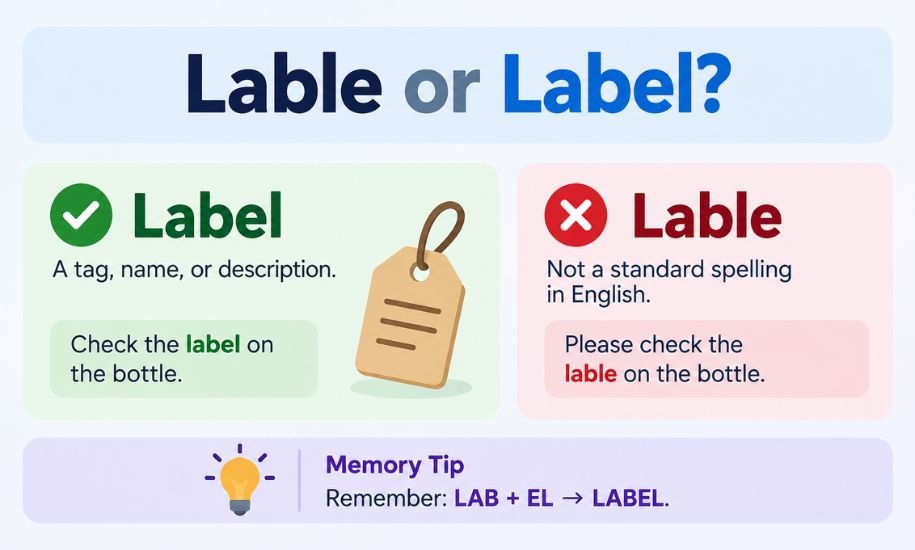
Label is the correct spelling. Lable is a common misspelling and is not the standard spelling of the word. In both British and American English, the base word is spelled label.
Label or Lable: Which One Is Correct?
The correct spelling is label.
Lable is not the standard spelling in English. If you are writing an essay, email, article, report, product description, or other formal text, use label.
| Feature | Label | Lable |
|---|---|---|
| Standard spelling? | Yes | No |
| Meaning | A tag, name, description, or classification | No standard English meaning in this context |
| Part of speech | Noun and verb | Misspelling |
| British English | Correct | Incorrect |
| American English | Correct | Incorrect |
Correct:
- Please check the label on the bottle.
- Label each box before moving it.
- The shirt’s label shows its size.
Incorrect:
- Please check the lable on the bottle.
- Lable each box before moving it.
- The shirt’s lable shows its size.
The important point is simple: when you mean the standard English word, write label.
What Does “Label” Mean?
Label has several related meanings and can function as both a noun and a verb.
As a noun, a label can be a piece of paper, fabric, plastic, or another material attached to something to provide information. A label might tell you a product’s name, size, ingredients, price, instructions, or manufacturer.
For example:
- The label on the package lists the ingredients.
- I checked the washing instructions on the label.
- The bottle has a colourful label.
- The name was printed on a small label.
The word can also refer to a descriptive name or category.
For example:
- The term “classic” is often used as a label for this type of music.
- He did not want the label of being difficult.
- The book is sold under a well-known publishing label.
In music and fashion, label can also refer to a company or brand.
How Is “Label” Used as a Verb?
Label can also be used as a verb. In this form, it means to put a label on something or to describe or classify someone or something in a particular way.
For example:
- Please label the folders clearly.
- We need to label each package before shipping it.
- The teacher asked the students to label the diagram.
- It is unfair to label someone based on one mistake.
The meaning depends on the context. When you attach identifying information to an object, you are literally labelling it. When you give a person or idea a particular description or category, the meaning is more figurative.
Is “Lable” a Real Word?
In ordinary modern English, lable is not the standard spelling of the word meaning a tag, description, or classification.
It should not be treated as a separate word with a different meaning. Instead, it is usually a spelling error for label.
For example:
Incorrect: The lable on the box was damaged.
Correct: The label on the box was damaged.
Similarly:
Incorrect: Please lable all the containers.
Correct: Please label all the containers.
If you encounter lable in someone’s writing, the intended word is almost certainly label.
Why Do People Spell It “Lable”?
The error is understandable because English spelling does not always provide an obvious guide to pronunciation.
The standard word is pronounced roughly like “LAY-buhl.” Because the second syllable is weak, some writers may mentally simplify the spelling and leave out the second e.
This creates:
label → lable
However, pronunciation should not be used as a reason to change the established spelling. The standard written form remains label.
Another reason the mistake can persist is simple visual familiarity. Words such as table and cable have similar endings, and writers may unconsciously apply a familiar spelling pattern to label. The safest approach is simply to remember the standard form.
Label in British and American English
If you are wondering about label or lable in UK English, the answer does not change.
Label is correct in both British and American English.
The difference between the two varieties appears in some forms created from the word, particularly when -ed and -ing are added.
| Form | British English | American English |
|---|---|---|
| Base form | label | label |
| -ing form | labelling | labeling |
| Past form | labelled | labeled |
So British English commonly uses labelling and labelled, while American English generally uses labeling and labeled.
Importantly, neither variety changes the basic spelling to lable.
British English
- The bottles were labelled carefully.
- The process involves labelling each item.
American English
- The bottles were labeled carefully.
- The process involves labeling each item.
If you are writing specifically for a British audience, use label, labelled, and labelling consistently. For an American audience, label, labeled, and labeling are standard choices.
Examples of “Label” in Sentences
Seeing the word in different contexts can make the spelling easier to remember.
As a noun
- The label on the jacket says it should be washed by hand.
- I could not read the label because the print was too small.
- The package had a fragile label on the front.
- Always check the food label before buying a product.
- The artist signed with an independent record label.
As a verb
- Please label the files according to their contents.
- The nurse asked us to label the samples.
- We should label the boxes before putting them into storage.
- The diagram requires students to label each part.
- It is dangerous to label an entire group based on one person’s actions.
These examples show that the word works naturally as both a noun and a verb.
Label Spelling: Common Mistakes to Avoid
The most obvious mistake is writing lable instead of label, but there are a few related forms worth remembering.
1. Lable
This is the common misspelling.
Incorrect: The lable is missing.
Correct: The label is missing.
2. Labled
This form combines the same spelling mistake with the past-tense ending.
Incorrect: The products were labled incorrectly.
Correct in American English: The products were labeled incorrectly.
Correct in British English: The products were labelled incorrectly.
3. Labling
This incorrectly removes one of the letters needed before the -ing ending.
Incorrect: The worker is labling the boxes.
Correct in American English: The worker is labeling the boxes.
Correct in British English: The worker is labelling the boxes.
Remembering the base form first makes these related spellings easier to handle.
An Easy Way to Remember the Correct Spelling
A useful trick is to remember that the word contains “label”, not “lable.”
Think of it as:
LAB + EL → LABEL
The final e belongs in the base spelling.
When you add endings, the spelling changes according to the English variety you are using:
- label
- labeled / labelled
- labeling / labelling
You do not need to memorize a complicated rule. Just remember that label is the base form.
Label Maker and Label Printer: Related Uses
You may also encounter the word in phrases such as label maker and label printer.
A label maker is a device or tool used to create printed labels. A label printer is a printer designed specifically to produce labels, often for packages, files, shelves, products, or other items.
Examples:
- I bought a label maker for organizing my files.
- The warehouse uses a label printer for shipping packages.
- Make sure the information on every label is accurate.
These expressions all use the same standard spelling: label.
How to Choose the Right Form
When you are unsure whether to write lable or label, choose label.
If you are referring to a tag attached to an object, use label:
The price is written on the label.
If you mean to attach identifying information, use label as a verb:
Label each container before storing it.
If you are using British English and need a past-tense or participle form, use labelled and labelling. If you are following American English conventions, use labeled and labeling.
The spelling lable does not become correct in either variety.
Frequently Asked Questions
Is “lable” a word?
No, lable is not the standard spelling of the English word label. In ordinary writing, it should be treated as a misspelling. Use label when referring to a tag, description, classification, brand, or the act of attaching or assigning one.
How do you spell label in the UK?
The base word is spelled label in British English. When adding endings, British English commonly uses labelled and labelling, with a double l. The spelling lable is not the British form.
Is “label” American or British English?
Label is used in both American and British English. The main regional difference appears in forms such as labeled/labelling and labeling/labelling, rather than in the base word itself.
What is the meaning of label?
A label can be a tag or piece of material attached to something to provide information. It can also mean a descriptive category or name. As a verb, label means to attach identifying information or classify something or someone.
Is “label” a noun or a verb?
It can be both. As a noun, a label is a tag, name, category, or description. As a verb, label means to attach a label or describe something using a particular term.
How can I remember the spelling?
Remember the standard base form as label, with the final e: l-a-b-e-l. If you are tempted to write lable, pause and check whether the word contains that second e.
Final Verdict: Lable or Label?
Label is the correct spelling in standard English, while lable is a misspelling. The correct form works as both a noun and a verb and is used in British and American English. British English uses labelled/labelling, while American English generally uses labeled/labeling. Keeping the base spelling label in mind will help you avoid the error in everyday and formal writing. For more clear explanations of easily confused English words, Grammarifyr helps you know the difference and use the right words.
You may also Read : Uber or Lyft: Which Is Better for Riders and Drivers?