Unphased or Unfazed: Meaning, Examples and Usage
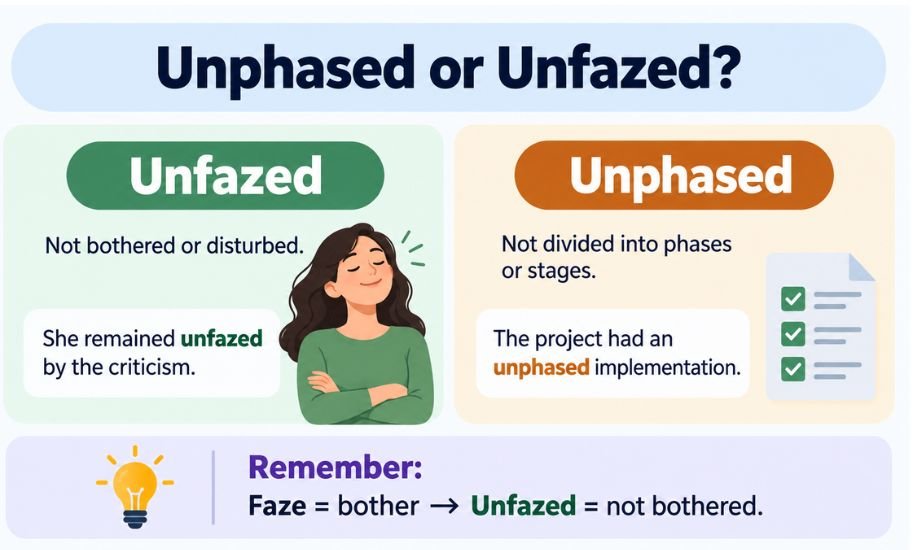
If you want to describe someone who stays calm and does not seem bothered by something, the correct word is usually unfazed. The confusion with unphased is understandable because phase is a familiar English word, and the two words sound similar. However, they come from different words and have different uses. Unfazed means not disturbed, worried, surprised, or discouraged. Unphased is much rarer and can have a specialised meaning related to something not being divided into phases or stages.
Unfazed is the standard spelling when you mean “not bothered,” “not worried,” or “not disturbed.” Unphased is generally not the word you want in this context, although it can occasionally be used in a specialised sense related to phases or stages. For describing a calm person, choose unfazed.
Unphased or Unfazed: Which Is Correct?
For ordinary English, unfazed is the correct choice when describing someone’s reaction to an event.
| Feature | Unfazed | Unphased |
|---|---|---|
| Standard everyday usage | Yes | Rare |
| Meaning | Not bothered or disturbed | Rarely, not divided into phases/stages |
| Describes a person’s reaction | Yes | No, normally |
| Related word | Faze | Phase |
| Example | She remained unfazed by the criticism. | The project had an unphased implementation. |
The distinction becomes much easier once you remember that faze and phase are completely different words.
If something doesn’t faze you, you are unfazed by it.
What Does “Unfazed” Mean?
Unfazed is an adjective meaning calm and unaffected by something that might normally cause worry, surprise, embarrassment, fear, or annoyance.
It can describe a person who does not appear disturbed by a difficult situation.
For example:
- She was unfazed by the negative comments.
- He remained unfazed when the interview became difficult.
- The goalkeeper looked unfazed by the pressure.
- I was completely unfazed by the sudden change in plans.
In each sentence, the person remains composed rather than allowing the situation to upset or unsettle them.
Unfazed synonyms
Depending on the context, useful synonyms include:
- unperturbed
- untroubled
- calm
- composed
- undisturbed
- unaffected
- unbothered
- unconcerned
- undaunted
- collected
These are not always perfect substitutes. For example, unbothered can sound more informal, while unperturbed is somewhat more formal.
What Does “Unphased” Mean?
Unphased is much less common than unfazed, and it is frequently used when someone actually means unfazed.
However, it is worth being precise rather than simply saying that the word can never exist.
The word phase refers to a stage or period in a process. Therefore, unphased can sometimes be used to describe something that is not divided or introduced in separate phases.
For example:
The changes were introduced in an unphased manner rather than gradually.
Here, the idea concerns stages of implementation, not someone’s emotional response.
This specialised use is uncommon, though. In most everyday writing, if your intended meaning is “not bothered,” unfazed is the appropriate word.
Why Do People Confuse These Words?
The main source of confusion is the similarity between faze and phase.
They sound alike in many varieties of English, but their meanings are unrelated.
Faze
Faze means to disturb, unsettle, or make someone feel worried or uncomfortable.
- The criticism did not faze her.
- The difficult question fazed him.
- Nothing seems to faze the experienced performer.
From this verb comes unfazed:
un + fazed = unfazed
Phase
Phase refers to a stage in a process or development.
- The project entered its final phase.
- The company will phase in the new system.
- The work will be completed in several phases.
So, although the pronunciation can cause confusion, the words are built on entirely different meanings.
Unfazed in Sentences
Seeing the word in different contexts makes its meaning clearer.
Example 1: Criticism
Correct:
She remained unfazed by the criticism.
This means the criticism did not upset or discourage her.
Example 2: Pressure
Correct:
The young player seemed unfazed by the pressure of the final.
The player stayed calm despite a stressful situation.
Example 3: Unexpected news
Correct:
He appeared unfazed when he heard the unexpected news.
He did not seem particularly shocked or disturbed.
Example 4: Difficult circumstances
Correct:
Despite the setbacks, the team remained unfazed.
The setbacks did not cause the team to lose confidence or composure.
Correct vs. Incorrect Usage
When you mean “not bothered,” use unfazed.
Correct:
The teacher was unfazed by the student’s challenging question.
Incorrect in standard everyday usage:
The teacher was unphased by the student’s challenging question.
Another example:
Correct:
She seemed unfazed by the sudden change.
Not the usual choice:
She seemed unphased by the sudden change.
The reason is simple: the relevant verb is faze, meaning to disturb or unsettle someone.
Is “Unphased” a Real Word?
The answer is yes, but with an important qualification.
Unphased does appear as a word in some dictionaries and can be encountered in specialised contexts involving phases or stages. It can also appear as an alternative form in some references.
But that does not make it interchangeable with unfazed.
If you are writing:
He was ___ by the criticism.
the natural standard answer is:
He was unfazed by the criticism.
If you are talking about whether a programme, policy, or process was divided into stages, unphased may appear in that specialised context.
For general writing, however, using unfazed when you mean “not bothered” avoids ambiguity and follows standard usage.
Unphased or Unfazed in British English
The distinction does not change simply because you are writing British English.
British writers also use unfazed to mean calm, undisturbed, or unaffected.
For example:
She was unfazed by the difficult interview.
The spelling is unfazed, not unphased, when the meaning concerns someone’s emotional reaction.
This is therefore not a case like color/colour, where both spellings represent established regional standards. The choice here depends primarily on meaning, not on American versus British spelling.
How to Remember the Correct Spelling
The easiest memory trick is to connect fazed with bothered.
Think:
fazed = bothered
unfazed = not bothered
So if you want to say that something did not bother someone, use unfazed.
You can also remember:
Faze → feelings
Phase → stages
A difficult question might faze someone. A project might have several phases.
That simple distinction can prevent the spelling mistake.
Common Mistakes to Avoid
1. Using “unphased” for emotional reactions
If you mean someone was not bothered, use unfazed.
She was unfazed by the criticism.
2. Confusing “faze” with “phase”
These verbs have different meanings.
Nothing could faze him.
means nothing could disturb him.
By contrast:
The company will phase in the new policy.
means the policy will be introduced gradually.
3. Assuming the spelling must contain “ph”
Because phase is familiar, it can seem logical to spell the adjective unphased. But the emotional word comes from faze.
4. Treating the two forms as ordinary alternatives
They should not normally be treated as interchangeable. If you are describing a person’s reaction, unfazed is the clear choice.
Frequently Asked Questions
Is “unfazed” the correct spelling?
Yes. Unfazed is the standard spelling when you mean someone is not bothered, worried, surprised, or disturbed by something.
Is “unphased” a word?
Unphased can occur as a rare word related to the idea of phases or stages, but it is commonly used incorrectly in place of unfazed. It should not normally replace unfazed when describing someone’s emotional reaction.
What is an unfazed person?
An unfazed person remains calm or composed despite something that could reasonably cause concern, surprise, embarrassment, or stress. For example, someone who stays calm during a difficult interview can be described as unfazed.
What is a synonym for unfazed?
Depending on the context, synonyms include unperturbed, calm, composed, unaffected, unbothered, undisturbed, untroubled, and undaunted.
Is “unfazed” used in British English?
Yes. Unfazed is used in British English as well as American English. It is the normal spelling when the meaning is “not bothered” or “not disturbed.”
How can I remember “unfazed” vs. “unphased”?
Remember faze = bother. Therefore, unfazed = not bothered. Reserve phase for stages or parts of a process.
Final Verdict: Unphased or Unfazed?
When you mean calm, unaffected, or not bothered, unfazed is the word to use. It comes from faze, meaning to disturb or unsettle someone. Unphased is much rarer and may have a specialised connection to phases or stages, but it is not the normal spelling for an emotional reaction.
Choosing the right form is easier when you remember the distinction: faze is about being disturbed, while phase is about a stage in a process. For more clear explanations of confusing English words and correct usage, Grammarifyr follows the same simple principle: Know the Difference. Use the Right Words.
You may also Read : What Does OTG Mean in Text? Meaning and Examples
One Comment