Flaky or Flakey: Meaning and Correct Spelling
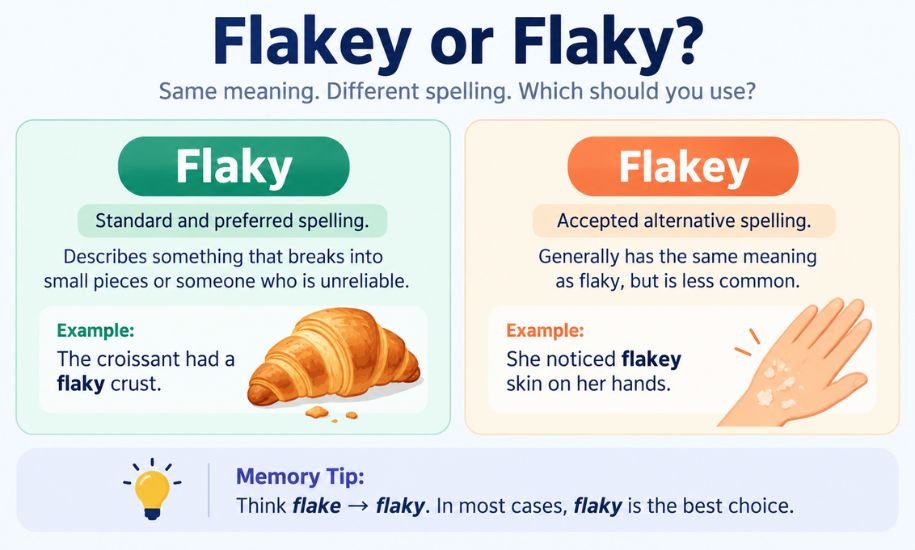
It is easy to hesitate over flakey or flaky, especially because both spellings look natural and are pronounced the same way. You may see the word used to describe dry skin, a delicate pastry, peeling paint, or even someone who is unreliable. So which spelling should you choose? In standard English, flaky is the usual and preferred spelling. However, flakey is also recognized as an alternative spelling in major dictionaries. The two forms generally have the same meaning, but flaky is the better choice for most everyday and formal writing.
Flaky is the standard and preferred spelling. Flakey is also an accepted variant, so it is not simply an invented or meaningless spelling. For formal, professional, and general-purpose writing, flaky is usually the safest choice.
Flaky vs. Flakey: The Quick Difference
The main difference is spelling rather than meaning.
| Feature | Flaky | Flakey |
|---|---|---|
| Standard spelling | Yes | Alternative spelling |
| Meaning | Breaks, peels, or comes off in flakes; can also mean unreliable | Generally the same |
| Part of speech | Adjective | Adjective |
| Pronunciation | Same | Same |
| Formal writing | Preferred | Less usual |
| Example | My skin is flaky. | My skin is flakey. |
If you are deciding which form to use, flaky is the straightforward choice.
What Does “Flaky” Mean?
Flaky is an adjective with several related meanings.
The most literal meaning describes something that breaks, peels, or comes away in small, thin pieces called flakes.
For example:
- The old paint has become flaky.
- His skin was dry and flaky.
- The pastry has a light, flaky texture.
- The dried surface became flaky after several days.
The word is particularly common when describing food, skin, paint, coatings, and other materials that separate into thin pieces or layers.
Flaky can also describe a person
In informal English, flaky can describe someone who is unreliable, unpredictable, eccentric, or not very dependable.
For example:
Sarah is a little flaky when it comes to remembering appointments.
Here, the word has nothing to do with physical flakes. It is an informal description of someone’s behavior.
The same adjective can also be used informally for something that is unreliable:
The office Wi-Fi has been flaky all morning.
The exact meaning therefore depends on context.
Is “Flakey” a Real Word?
Yes. This is where the comparison becomes slightly more interesting.
Flakey is recognized as an alternative spelling of flaky by major English dictionaries. It generally carries the same meanings. Therefore, saying that flakey is always an incorrect spelling would be too strong.
However, flaky is the more conventional form and is the spelling readers are most likely to expect in standard English.
Compare:
The child has flaky skin.
and
The child has flakey skin.
The first sentence uses the preferred spelling. The second can be understood and is supported as a variant spelling, but it is less conventional.
For schoolwork, professional documents, websites, and other situations where you want the most standard form, flaky is the better option.
Flakey or Flaky Skin: Which One Should You Use?
When describing skin that is dry and shedding small pieces, flaky skin is the usual expression.
Examples include:
- Cold weather can cause flaky skin.
- She noticed flaky skin around her hands.
- The cream is designed for dry, flaky skin.
- He had a flaky scalp during the winter.
You may encounter flakey skin, but there is generally no difference in meaning between the two spellings.
The same principle applies to related expressions:
- flaky scalp
- flaky skin
- flaky patches
- flaky surface
- flaky paint
If you are writing a formal description, flaky is the natural choice.
Why Are These Spellings Confused?
The confusion comes mainly from the fact that flakey looks like a plausible spelling.
English has many words ending in -ey, so writers may naturally assume that flake should produce flakey. However, the established spelling is flaky.
The pronunciation does not help much because both forms are normally pronounced the same way. That means someone hearing the word cannot tell which spelling the writer intends.
There is also a practical reason for seeing both forms: flakey is not merely a random typo in every context. It has dictionary recognition as a variant, although it is less common and less preferred than flaky.
Flaky in Different Contexts
Understanding the different uses makes it easier to recognize the word when you encounter it.
1. Food
Flaky commonly describes pastry or food that separates into thin, delicate layers.
The pie had a buttery, flaky crust.
I love the flaky layers of this pastry.
2. Skin and scalp
It can describe skin that is dry or shedding small pieces.
The lotion helped soothe her flaky skin.
He noticed a flaky scalp after the weather became colder.
3. Paint or other surfaces
It can describe a surface that is peeling or coming away in small pieces.
The building had flaky paint around the windows.
4. People
In informal usage, it can describe someone who is unreliable or unpredictable.
He is too flaky to make firm plans.
This meaning is informal, so a more precise word such as unreliable may be better in formal writing.
5. Systems and services
In some informal contexts, flaky can describe something that works inconsistently.
The printer has been flaky since yesterday.
Again, this is an informal use.
Correct and Incorrect Usage
Because flakey is recognized as a variant, it is better to distinguish preferred from non-preferred usage rather than simply labeling every occurrence of flakey as wrong.
Preferred
My hands are flaky after spending so much time outdoors.
The chef made a wonderfully flaky pastry.
The old flaky paint needs to be removed.
Less conventional
My hands are flakey after spending so much time outdoors.
The chef made a wonderfully flakey pastry.
These examples are understandable, and flakey can be found as an alternative spelling. Nevertheless, flaky is the conventional spelling to choose when you want standard English.
How to Remember the Spelling
A simple way to remember the preferred form is:
flake → flaky
Think of the final e in flake as disappearing before -y:
- flake → flaky
- cake → cakey
- smoke → smoky
The pattern is not perfectly predictable across English, but remembering flake → flaky is enough for this word.
If you are writing and hesitate between the two forms, choose flaky.
Common Mistakes to Avoid
1. Assuming “flakey” is always completely wrong
Because flakey is recognized as a variant, it is more accurate to call flaky the preferred or standard spelling rather than claiming that flakey has no legitimate use whatsoever.
2. Treating the two spellings as different meanings
In ordinary usage, flaky and flakey do not represent two separate concepts. The distinction is primarily one of spelling preference.
3. Using “flaky” only for skin
The word has a much broader range of uses. It can describe pastry, paint, surfaces, people, and unreliable things depending on context.
4. Assuming the informal meaning is always appropriate
Calling a person flaky can sound informal or critical. In professional writing, unreliable, inconsistent, or another more precise term may be preferable.
Which Spelling Should You Choose?
For most readers, the decision is simple:
Choose “flaky.”
It is the established, standard form and works naturally in formal and informal writing. Use it when describing:
- flaky skin
- flaky scalp
- flaky pastry
- flaky paint
- a flaky surface
- a flaky person
- a flaky internet connection
Flakey may appear in dictionaries and real-world writing as an alternative, but it is not usually the first spelling to choose when you have complete freedom over your wording.
FAQs
Is “flakey” spelled correctly?
Flakey is recognized as an alternative spelling of flaky by major dictionaries. However, flaky is the more standard and preferred form, particularly in formal and general-purpose writing.
Is it “flakey or flaky skin”?
The preferred expression is flaky skin. Flakey skin can also be understood because flakey is a recognized variant, but flaky is the conventional spelling.
What is the flakey or flaky spelling?
The standard spelling is flaky, with the ending -ky. Flakey, ending in -key, is an accepted alternative spelling but is less conventional.
Do “flaky” and “flakey” have the same meaning?
Generally, yes. Both forms can describe something that breaks or comes away in flakes, such as skin or pastry. They can also have the informal meaning of unreliable or eccentric when describing a person.
Is “flaky” formal English?
Yes. Flaky is a standard English adjective and can be used in formal writing when its meaning is appropriate. However, the informal meaning describing an unreliable person may be better replaced with a more precise term in formal contexts.
How can I remember whether to write “flaky” or “flakey”?
Remember the basic pattern flake → flaky. If you are unsure which version to use, flaky is the safest and most conventional choice.
The Bottom Line
Flaky is the preferred spelling in standard English, while flakey is recognized as an alternative spelling with essentially the same meanings. For expressions such as flaky skin, flaky pastry, and flaky paint, use flaky when you want the conventional form. For clear explanations of similar English spelling and usage questions, Grammarifyr follows the same principle: understand the distinction first, then choose the form that fits standard usage.
You may also Read : Seel or Seal: Meaning and Correct Usage