Apologize or Apologise? Spelling and Grammar Guide
Have you ever wondered whether to write apologize or apologise? Both spellings are correct, but the one you should choose depends mainly on the variety of English you are using. American English generally prefers apologize, while British English commonly uses apologise. The two words have exactly the same meaning: to express regret or say sorry for something you have done. Understanding this small spelling difference will help you write more naturally, avoid unnecessary corrections, and keep your writing consistent for your intended audience.
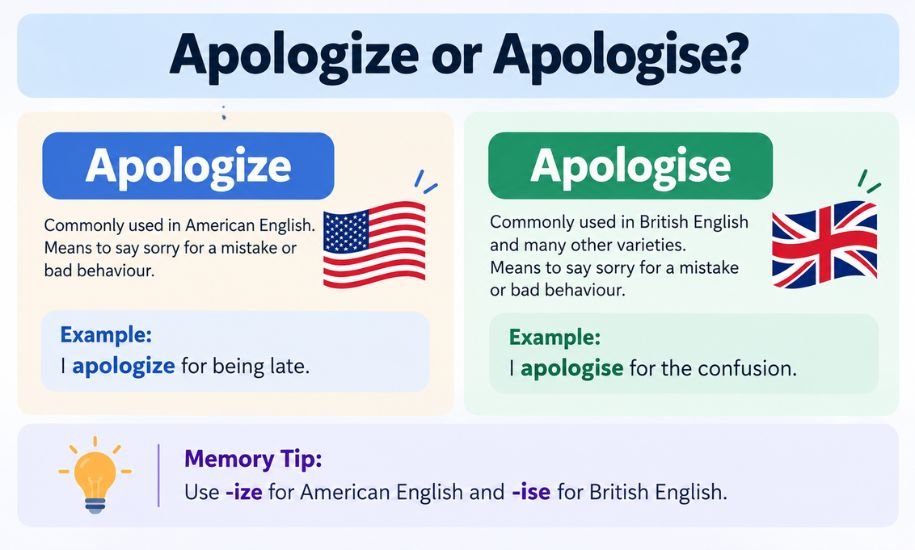
Both apologize and apologise are correct spellings. Apologize is the usual choice in American English, whereas apologise is commonly preferred in British English. Both mean to express regret or say sorry, so choose the spelling that matches your audience and remain consistent.
Apologize or Apologise: What’s the Difference?
The difference between these words is spelling, not meaning or pronunciation. They are alternative forms of the same verb, and neither is universally incorrect.
| Feature | Apologize | Apologise |
|---|---|---|
| Spelling | American English preference | British English preference |
| Meaning | To express regret or say sorry | To express regret or say sorry |
| Part of speech | Verb | Verb |
| Past tense | Apologized | Apologised |
| Present participle | Apologizing | Apologising |
| Example | I apologize for the delay. | I apologise for the delay. |
American English generally uses the -ize ending in words such as organize, realize, and recognize. British English commonly uses -ise in these words, although -ize spellings are also accepted in some British English styles.
The important point is that both spellings communicate the same message. Your choice depends on the spelling convention you follow.
What Does “Apologize” Mean?
Apologize is a verb meaning to express regret for something you have done or said, particularly when it has upset someone, caused a problem, or created an inconvenience.
It can be used in everyday conversations, professional emails, formal letters, and other situations where someone acknowledges a mistake or offence.
Here are some examples:
- I apologize for forgetting to call you yesterday.
- The manager apologized to the customer for the inconvenience.
- You should apologize if your comments hurt someone’s feelings.
- She apologized for arriving late to the meeting.
In each sentence, the verb describes the act of expressing regret.
When Should You Use “Apologize”?
Use this spelling when writing in American English or when following a style guide that prefers American spelling.
For example:
- I apologize for the misunderstanding.
- We apologize for any inconvenience caused.
- He apologized to his colleague after the disagreement.
If your website, school, employer, or publication follows American English conventions, apologize is generally the appropriate choice.
What Does “Apologise” Mean?
Apologise has the same meaning as apologize. It is the spelling commonly preferred in British English and is widely used in countries and publications that follow British spelling conventions.
For example:
- I apologise for keeping you waiting.
- She apologised to her friend for the mistake.
- We apologise for the delay in responding to your email.
- He decided to apologise after realizing that his words were unkind.
These sentences have exactly the same meanings as their American English equivalents. Only the spelling changes.
When Should You Use “Apologise”?
Choose this spelling when writing in British English, particularly for a UK audience or a publication that follows British spelling conventions.
It is also common in Australian and New Zealand English.
For example, a British customer service email might say, “We apologise for any inconvenience this may have caused.” An American company would typically write, “We apologize for any inconvenience this may have caused.”
Both sentences are correct.
Is “Apologise” Correct in the UK?
Yes. Apologise is a standard and widely used British English spelling.
However, it would be inaccurate to claim that apologize is always wrong in the United Kingdom. British English includes both -ise and -ize spellings, and some British dictionaries, publishers, and style guides accept or prefer the latter.
For everyday British writing, apologise is a safe and familiar choice. If you are writing for a particular newspaper, university, company, or publisher, follow its spelling guidelines.
The same principle applies to other words with similar endings:
- Organise / organize: Both spellings are accepted, with regional and stylistic preferences.
- Realise / realize: Both are correct variants.
- Recognise / recognize: Both are accepted spellings.
Remember that the spelling convention matters more than treating one version as universally right and the other as wrong.
How to Use the Word Correctly in a Sentence
Knowing which spelling to use is only part of writing correctly. It is also helpful to understand the common grammatical patterns involving this verb.
1. Apologize to someone
Use to when identifying the person who receives the apology.
Examples:
- I apologized to my sister for missing her birthday.
- The employee apologised to the manager.
- You should apologize to your friend for speaking harshly.
Both spellings work in all three examples. Choose the one that matches your preferred variety of English.
2. Apologize for something
Use for to identify the action, mistake, behaviour, or situation that caused regret.
Examples:
- I apologize for the confusion.
- She apologised for interrupting the conversation.
- They apologized for the damage to the property.
You can also combine both constructions in one sentence: “I apologise to my neighbour for the noise last night.”
3. Apologize directly
The verb can also appear without naming the person receiving the apology.
Examples:
- He finally apologized.
- You should apologise when you make a genuine mistake.
- The company issued a statement and apologized publicly.
These constructions are grammatically correct because the recipient does not always need to be stated.
What Is the Past Tense of Apologize or Apologise?
The past-tense forms follow the same American and British spelling distinction. Both use the regular -ed ending, but the final spelling differs.
| Verb form | American English | British English |
|---|---|---|
| Base form | Apologize | Apologise |
| Third-person singular | Apologizes | Apologises |
| Simple past | Apologized | Apologised |
| Past participle | Apologized | Apologised |
| Present participle | Apologizing | Apologising |
Examples:
Present tense
- I apologize for the error.
- I apologise for the error.
Past tense
- She apologized after the meeting.
- She apologised after the meeting.
Present perfect
- He has apologized for his behaviour.
- He has apologised for his behaviour.
Present continuous
- The company is apologizing to affected customers.
- The company is apologising to affected customers.
The same regional spelling pattern continues throughout the verb forms. Avoid mixing the two conventions within the same piece of writing unless there is a specific reason to reproduce another person’s spelling.
Apologize or Apologise: Examples in Everyday Writing
The following examples demonstrate how both spellings work in different situations.
| Situation | American English | British English |
|---|---|---|
| Late arrival | I apologize for being late. | I apologise for being late. |
| Workplace mistake | He apologized to his supervisor. | He apologised to his supervisor. |
| Customer service | We apologize for the inconvenience. | We apologise for the inconvenience. |
| Personal disagreement | She apologized for her words. | She apologised for her words. |
| Formal statement | The organization apologizes for the error. | The organisation apologises for the error. |
Notice that other words may change spelling in the same sentence. For example, organization is the usual American form, while organisation is commonly preferred in British English.
If you are writing an article, email, or report, choose one spelling system and apply it consistently.
How to Remember Which Spelling to Use
A simple way to remember the distinction is to associate the endings with the spelling conventions you are following:
- American English: Prefer apologize, apologized, and apologizing.
- British English: Commonly prefer apologise, apologised, and apologising.
If you already know whether your document uses American or British spelling, the decision becomes much easier.
For example, if you have written color, center, and organize, then apologize will generally fit your American English style. If you use colour, centre, and organise, then apologise will generally fit your British English style.
The goal is not to memorize every word separately but to recognize the spelling pattern used throughout your writing.
Frequently Asked Questions
1. Is it apologize or apologise?
Both spellings are correct. Apologize is generally preferred in American English, while apologise is commonly used in British English. They have the same meaning, so your choice should depend on your intended audience and the style guide you follow.
2. Is “apologize” wrong in British English?
No. Although apologise is a common British English preference, apologize is also accepted by some British dictionaries and style guides. Check your publication’s requirements if you need to follow a specific spelling standard.
3. What does apologise mean?
Apologise means to express regret for something you have done or said. For example, “I apologise for the mistake” means that the speaker acknowledges the mistake and expresses regret about it.
4. Do apologize and apologise have different pronunciations?
They are generally pronounced the same within a given English accent. The difference is in the written form, not the meaning. Minor accent differences may occur, but the alternative spellings do not normally indicate different pronunciations.
5. What is the past tense of apologise?
The British English past tense is apologised. The corresponding American English form is apologized. Both are regular past-tense forms of the same verb and express that someone said sorry or acknowledged a mistake in the past.
6. Should I use apologise in a formal email?
Yes. Apologise is appropriate in formal British English emails, letters, and professional documents. If you are writing in American English, use apologize instead. The level of formality does not determine the spelling; your chosen English convention does.
Final Verdict: Apologize or Apologise?
Both spellings are correct, and neither changes the meaning of the sentence. Use apologize when following American English conventions and apologise when following the usual British English preference. Keep your spelling consistent, especially in articles, professional emails, and formal documents. At Grammarifyr, the goal is simple: Know the Difference. Use the Right Words.
You may also Read : Diddo or Ditto? Learn the Correct Word and Its Meaning