Burnt or Burned: Meaning and Usage Explained
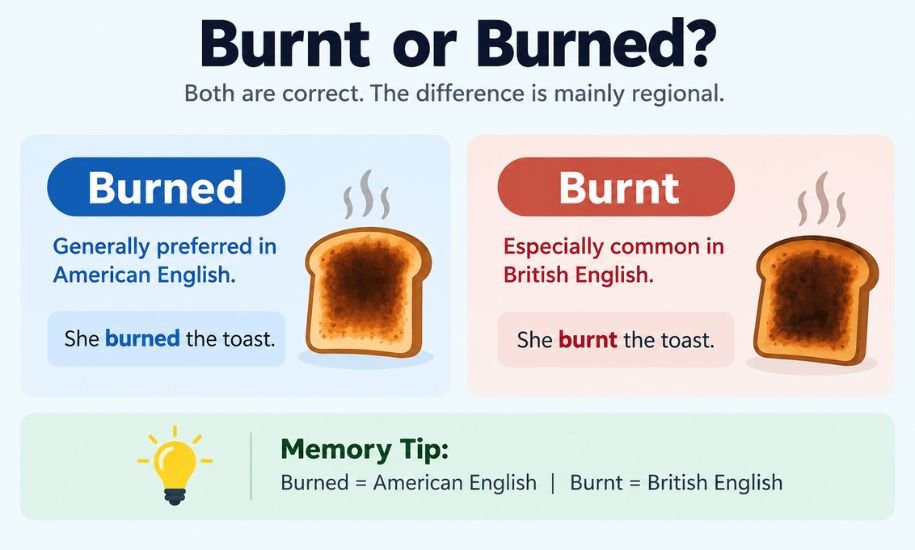
If you are unsure whether to write burnt or burned, you are not dealing with a simple right-versus-wrong spelling issue. Both forms are correct past forms of the verb burn. The main difference is regional preference: burned is more common in American English, while burnt is particularly common in British English. Both can also appear as adjectives, such as burnt toast or burned toast. The choice usually depends on the variety of English you are writing and the style you want to maintain.
Burned and burnt are both correct. “Burned” is generally preferred in American English, while “burnt” is especially common in British English. The same regional difference applies to expressions such as burned out and burnt out.
Burned vs. Burnt: The Key Difference
The simplest way to understand the difference is to think of regional English varieties rather than correctness.
| Form | Status | Typical preference | Example |
|---|---|---|---|
| burned | Correct | American English; also used in British English | She burned the toast. |
| burnt | Correct | Especially British English | She burnt the toast. |
| burn | Correct | Present/base form | Don’t burn the toast. |
Both burned and burnt can serve as the simple past and past participle of burn.
For example:
- I burned the cake yesterday.
- I burnt the cake yesterday.
- The cake was burned in the oven.
- The cake was burnt in the oven.
The meaning does not change simply because you choose one form instead of the other.
What Does “Burned” Mean?
Burned is the regular past tense and past participle of burn. It is particularly common in American English and is also completely acceptable in British English.
It can describe something being damaged by fire or heat, or a person experiencing an injury caused by heat.
Examples
- I burned my finger while cooking.
- The fire burned through the wooden door.
- She burned the vegetables by leaving them on the stove too long.
- The paper was burned before anyone could read it.
In American writing, burned is generally the most natural choice when you need the past form of burn.
What Does “Burnt” Mean?
Burnt is also a correct past tense and past participle of burn. It is especially associated with British English.
For example:
- I burnt my finger while cooking.
- He burnt the letter.
- The toast was burnt.
- They burnt the old branches in the garden.
These sentences have essentially the same meanings as their versions using burned.
One important point is that burnt is not a misspelling of burned. It is an established alternative form of the verb.
Why Are Both Forms Correct?
Burn is one of those English verbs that has two accepted past forms. Similar patterns occur with several other verbs, although the exact regional preferences vary.
The distinction between burned and burnt developed into a noticeable difference between varieties of English. Today, burned is strongly associated with American usage, whereas burnt is particularly familiar in British usage.
This does not mean British writers must use burnt or American writers can never use burnt. Real English usage is more flexible than that.
For formal writing, the most useful rule is simply to follow the variety of English you are using consistently.
Burn or Burnt: Which Form Should You Use?
The comparison becomes different when you put burn next to burnt.
These forms do not normally perform the same grammatical function.
Burn is the base or present form:
Be careful not to burn the bread.
Burnt is a past form:
I burnt the bread yesterday.
You can also use burned:
I burned the bread yesterday.
The basic verb forms can be shown like this:
| Verb form | Example |
|---|---|
| Base form | burn |
| Present | burn / burns |
| Past | burned / burnt |
| Past participle | burned / burnt |
| -ing form | burning |
So if you are asking whether burn or burnt is the past tense, the answer is burnt. However, burned is equally valid as the past form.
Is It Burned or Burnt in a Sentence?
If you are wondering, “is it burned or burnt?”, both can be correct.
Consider:
The chicken is burned.
and:
The chicken is burnt.
Both sentences can describe chicken that has been overcooked or damaged by excessive heat.
The same applies when the word follows was, were, has, had, or similar grammatical constructions:
- The paper was burned.
- The paper was burnt.
- The documents had been burned.
- The documents had been burnt.
The choice is primarily a matter of regional usage and style.
Burned Out or Burnt Out?
The same variation appears in the expression burned out / burnt out.
Both forms are correct, but regional preferences differ:
- burned out is especially common in American English.
- burnt out is especially common in British English.
The expression has more than one meaning.
Physically damaged by fire
The electrical motor burned out.
The electrical motor burnt out.
Here, the expression refers to something being damaged or ceasing to function because of excessive heat or use.
Extremely exhausted
Burned out and burnt out can also describe someone who is physically or emotionally exhausted after prolonged stress or work.
After months of overtime, Maya felt completely burned out.
In British English, you may equally see:
After months of overtime, Maya felt completely burnt out.
The meaning remains the same.
Burned-out and burnt-out before a noun
When the expression functions as a compound adjective before a noun, a hyphen is commonly used:
- a burned-out building
- a burnt-out building
- a burned-out employee
- a burnt-out worker
The spelling still follows the same regional pattern.
Burned or Burnt in American and British English
The regional distinction is probably the most useful thing to remember.
American English
American English generally favors burned as the past tense and past participle:
The fire burned the fence.
I burned my dinner.
He has burned the old papers.
Burned out is also a very familiar American form.
British English
British English frequently uses burnt:
The fire burnt the fence.
I burnt my dinner.
He has burnt the old papers.
Burnt out is likewise common.
However, burned is not incorrect in British English. It is an accepted form and can be used in appropriate contexts.
Examples of Correct Usage
Here are some examples showing how both forms work naturally.
Using “burned”
- I burned the toast this morning.
- The candle burned for several hours.
- She burned the old documents.
- The sunlight burned his skin.
- The building was badly burned in the fire.
Using “burnt”
- I burnt the toast this morning.
- The candle burnt for several hours.
- She burnt the old documents.
- The wood was completely burnt.
- The building was badly burnt in the fire.
The sentences above demonstrate why neither form should automatically be marked wrong.
Common Mistakes to Avoid
1. Treating “burnt” as a spelling mistake
Burnt is a legitimate English word. It should not automatically be corrected to burned.
2. Treating “burned” as incorrect British English
British English commonly uses burnt, but burned is also an accepted form.
3. Using “burnt” as the present form
Incorrect:
I always burnt the toast.
If you mean a present or habitual action, use burn:
I always burn the toast.
For a past action:
I burnt the toast yesterday.
4. Mixing forms unnecessarily
If you are writing consistently in American English, burned and burned out will usually fit better. In British English, burnt and burnt out may sound more natural.
Consistency matters more than trying to force one form into every sentence.
How to Remember the Difference
A simple memory rule is:
Burned = especially American
Burnt = especially British
But remember that this is a preference, not an absolute rule.
You can also remember the grammatical distinction:
burn → burned/burnt
The first is the base form, while the latter two are past forms.
For burn out:
burn out → burned out / burnt out
Again, both past forms are possible.
Which Form Should You Choose?
Choose according to your audience.
If you are writing primarily for an American audience, burned is usually the straightforward choice.
If you are writing primarily for a British audience, burnt will often sound more natural, although burned remains acceptable.
If your publication has a specific style guide, follow that guide. Most importantly, avoid switching between forms without a reason when you’re writing a single piece of formal content.
Quick rule
American English: burned
British English: burnt is especially common
Both varieties: burned is accepted
Both varieties: burnt is a real and established form
Frequently Asked Questions
Is “burnt” grammatically correct?
Yes. Burnt is a standard form of burn and can function as the past tense and past participle. It is particularly common in British English.
Is “burned” or “burnt” more common in American English?
Burned is generally the preferred form in American English. However, burnt can also appear, particularly in certain adjective expressions.
Is “burnt out” or “burned out” correct?
Both are correct. Burned out is especially common in American English, while burnt out is particularly common in British English. Both can refer to fire damage or extreme exhaustion.
Can I use “burned” in British English?
Yes. British English accepts burned as well as burnt. Burnt is simply a particularly familiar British form.
Is “burn” the past tense of “burn”?
No. Burn is the base form. The past tense can be burned or burnt.
Which form should I use in formal writing?
Use the form that matches your chosen variety of English and keep your usage consistent. For American English, burned is generally the safest choice; for British English, burnt is very common.
The Bottom Line
Burned and burnt are both correct. The main distinction is regional: burned is generally preferred in American English, while burnt is especially common in British English. The same pattern applies to burned out and burnt out. Once you remember that burn is the base form and burned/burnt are its accepted past forms, the choice becomes much easier. For more clear explanations of confusing English forms, Grammarifyr helps you know the difference and use the right words.
You may also Read : Peice or Piece: Meaning, Spelling and Examples
One Comment