Diddo or Ditto? Learn the Correct Word and Its Meaning
Have you ever written “diddo” when agreeing with someone or saying that you feel the same way? The two spellings look and sound similar, so it is easy to see why they can be confused. However, when you want to express agreement, refer to something already mentioned, or avoid repeating information, there is one standard spelling to remember. Understanding the meaning of the word and seeing it in everyday sentences will help you use it confidently in conversations, text messages, and written English.
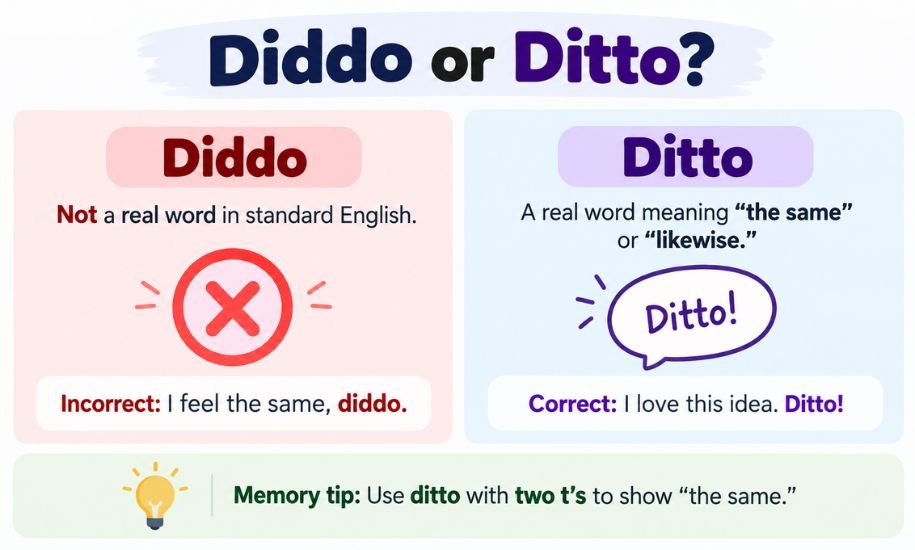
Ditto is the correct standard English spelling when you mean “the same,” “me too,” or “I agree.” Diddo is generally a misspelling of this word. For example, if a friend says, “I love this song,” you can reply, “Ditto!” to express the same feeling.
Diddo or Ditto: Which Is Correct?
Ditto is correct; diddo is generally incorrect when expressing agreement or repetition.
The word ditto is an established English word used to indicate that something is the same as what has already been said or written. It can also be a short, natural response when you agree with another person.
Diddo, on the other hand, is not a standard spelling variant of ditto in this meaning. Although it may appear in informal messages, online usernames, or personal names, you should use ditto in standard English writing.
Here is a quick comparison:
| Feature | Ditto | Diddo |
|---|---|---|
| Standard spelling | Correct | Generally incorrect for this meaning |
| Meaning | The same; me too; likewise | No standard equivalent meaning |
| Common use | Agreement and repetition | Usually a spelling error |
| Example | “I agree.” “Ditto!” | “I agree.” “Diddo!” |
Remember that the issue is not an American-versus-British spelling difference. Ditto is the standard spelling in both varieties of English.
What Does Ditto Mean?
Ditto means the same as something already mentioned, written, or understood. Depending on the context, it can express agreement, indicate a shared preference, or replace repeated information.
There are three particularly useful ways to understand the word.
1. Ditto means “me too”
In everyday conversation, ditto is often used to show that you share someone’s opinion, feeling, or experience.
For example:
- “I’m really looking forward to the holidays.” “Ditto!”
- “I love spending time outdoors.” “Ditto!”
- “That was an excellent performance.” “Ditto. The singer was amazing.”
In these examples, the response communicates that the speaker feels the same way. It is a convenient alternative to repeating the entire statement.
2. Ditto means “the same as above”
The word can also refer to information that matches an earlier entry. This use is particularly helpful in lists, records, and tables.
For example:
| Employee | Department |
|---|---|
| Sarah | Marketing |
| James | Ditto |
| Olivia | Finance |
In this illustrative table, ditto indicates that James belongs to the same department as the person listed immediately above him.
In ordinary modern documents, repeating the actual department name is often clearer. Nevertheless, the example demonstrates how the word can replace repeated information.
3. Ditto can mean “likewise”
Sometimes, the word communicates that a statement applies equally to another person or situation.
For example:
- “The first presentation was impressive, and ditto for the second.”
- “My colleagues enjoyed the workshop, and ditto for the visiting students.”
This use is understandable, although phrases such as “the same applies” or “likewise” may sound more natural in formal writing.
Is Diddo a Real Word?
Diddo is not the standard spelling of the English word used to mean “the same” or “me too.” If you are writing a sentence with that meaning, choose ditto instead.
However, it would be inaccurate to say that the letter sequence diddo can never appear legitimately. It could be used as a personal name, username, brand name, or other proper noun. Such uses do not make it an accepted alternative spelling of the ordinary English word.
Consider these examples:
Incorrect: “I enjoyed the meal.” “Diddo!”
Correct: “I enjoyed the meal.” “Ditto!”
Incorrect: “She agreed with my suggestion, and I diddo.”
Better: “She agreed with my suggestion, and I did too.”
The last example highlights another useful point: ditto and did too are different expressions. The phrase did too is grammatically correct in sentences where the auxiliary verb did and the adverb too express that someone also performed an action.
For example, “I did too enjoy the show” is possible, although it sounds emphatic. More naturally, you might write, “I enjoyed the show too.”
Why Do People Confuse the Two Spellings?
There are a few reasonable explanations for the confusion.
First, the words look similar. Both begin with d and contain two repeated consonant letters in their written forms, making the incorrect version appear plausible at a glance.
Second, pronunciation can contribute to spelling mistakes. In American English, the t in ditto may be pronounced with a quick tap of the tongue, which can sound similar to a d to some listeners. This does not change the accepted spelling.
Finally, people sometimes write words according to how they think they sound, especially in quick text messages or informal online conversations.
The best solution is to learn the standard spelling and recognize the meaning it communicates. Once you associate ditto with “the same,” choosing the correct form becomes easier.
How to Use Ditto in a Sentence
Seeing different examples is one of the easiest ways to understand the word’s meaning and usage.
Here are some natural sentences:
- Expressing agreement: “I think we should start earlier.” “Ditto.”
- Sharing a preference: “I prefer reading printed books.” “Ditto!”
- Sharing an emotion: “I’m excited about the trip.” “Ditto!”
- Avoiding repetition: “The first item costs £15, and ditto for the second.”
- Referring to a similar experience: “The first class was challenging, and ditto for the next one.”
The word can stand alone as a conversational response, as in “Ditto!” It can also appear within a longer sentence when referring to something similar or previously mentioned.
Punctuation depends on the sentence. When used as a standalone response, it is commonly followed by an exclamation mark or full stop, depending on the intended tone.
Correct and incorrect examples
| Incorrect | Correct |
|---|---|
| “I feel the same.” “Diddo!” | “I feel the same.” “Ditto!” |
| “Ditto means the same thing as diddo.” | “Ditto means the same thing as ‘the same.’” |
| “My answer is diddo.” | “My answer is ditto.” |
| “Diddo for me, too.” | “Ditto for me, too.” |
The corrected sentences use the established spelling and convey the intended meaning clearly.
Ditto vs. Similar Expressions
Although ditto is useful, it is not always the best choice. Several alternatives can communicate a similar idea.
| Expression | Meaning | Example |
|---|---|---|
| Ditto | The same; me too | “I enjoyed it.” “Ditto!” |
| Me too | The same applies to me | “I love coffee.” “Me too.” |
| Likewise | In the same way | “It was nice meeting you.” “Likewise.” |
| Same here | I feel or think the same | “I’m tired.” “Same here.” |
| I agree | I share your opinion | “We should leave early.” “I agree.” |
Ditto and me too often overlap in casual conversation. However, likewise may sound more polished in professional exchanges, while I agree is particularly clear when discussing opinions or decisions.
Choosing an alternative can make your writing more precise when the context requires a specific response rather than a general expression of sameness.
An Easy Way to Remember the Correct Spelling
Use this simple memory trick: Ditto has a “t” for “the same.”
When you want to say “the same,” “me too,” or “I agree,” remember the established word ditto. The middle consonant is t, not d.
You can also memorize this short example:
“My friend loves pizza. Ditto!”
The word communicates that you share your friend’s preference without repeating the entire sentence.
If you are uncertain while writing, replace the word temporarily with “the same” or “me too.” If that substitution makes sense, ditto may be the word you need.
Quick Quiz: Diddo or Ditto?
Test your understanding with these five questions.
1. Which spelling is correct when agreeing with someone?
A. Diddo
B. Ditto
2. Complete the sentence: “I love this movie.” “_____!”
A. Diddo
B. Ditto
3. What does ditto usually mean in conversation?
A. Never mind
B. The same or me too
C. Something different
4. Is diddo a standard alternative spelling of ditto?
A. Yes
B. No
5. Which sentence is correct?
A. “I enjoyed the concert.” “Diddo!”
B. “I enjoyed the concert.” “Ditto!”
Answers: 1. B; 2. B; 3. B; 4. B; 5. B.
If you answered all five correctly, you understand the main distinction. The key is to recognize that ditto is the accepted spelling for agreement and repetition.
Frequently Asked Questions
1. Is it diddo or ditto?
Ditto is the correct spelling when you mean “the same,” “me too,” or “I agree.” Diddo is generally a misspelling in this context and should be avoided in standard English writing.
2. What does ditto mean in a text message?
In a text message, ditto usually means “same here” or “me too.” For example, if someone writes, “I’m excited for tomorrow,” replying “Ditto!” means that you are excited as well.
3. How do you pronounce ditto?
In British English, it is commonly pronounced /ˈdɪt.əʊ/. In American English, it is commonly pronounced /ˈdɪt̬.oʊ/. The stress falls on the first syllable, and the spelling remains the same in both varieties.
4. Can I use ditto in formal writing?
Yes, although its suitability depends on the context. It can be useful in records or lists to indicate repeated information. In formal prose, expressions such as “the same applies” or “likewise” may communicate the intended meaning more clearly.
5. Is diddo ever acceptable?
It may appear as a personal name, username, or brand name, but it is not the standard spelling of ditto. When you want to express agreement or repetition, use ditto.
6. What is another word for ditto?
Depending on the context, alternatives include “me too,” “same here,” “likewise,” and “I agree.” If you are referring to repeated information in a document, “the same” may be clearer.
Final Verdict: Diddo or Ditto?
When expressing agreement, sharing a feeling, or indicating that information is the same as something already mentioned, ditto is the correct standard spelling. Diddo is generally a spelling mistake in this context, not an accepted alternative.
Remember the simple rule: when you mean “the same,” use ditto. With clear explanations and practical examples, Grammarifyr helps you understand confusing English words and choose the right spelling with confidence.
You may also Read : Analyze or Analyse: Correct Spelling and Usage