Ways to Say Thank You in Spanish: 20+ Natural Expressions for Every Situation
Knowing how to express gratitude in Spanish goes far beyond learning one word. While gracias is the standard way to say “thank you,” Spanish offers many other expressions that can sound warmer, more formal, more personal, or more casual depending on the situation.
If you’re learning Spanish, traveling to a Spanish-speaking country, writing a message, or simply looking for ways to say thank you in Spanish, choosing the right expression can make your communication feel much more natural.
The Most Common Way to Say Thank You in Spanish
Other Ways to Say “Thank You” in Spanish
Gracias is the basic Spanish expression for “thank you” or “thanks.” It is appropriate in almost every everyday situation.
Example:
“Gracias por tu ayuda.”
“Thank you for your help.”
You can use gracias with friends, family members, coworkers, strangers, teachers, service workers, and other people. Its simplicity is one of the reasons it is the first expression Spanish learners should know.
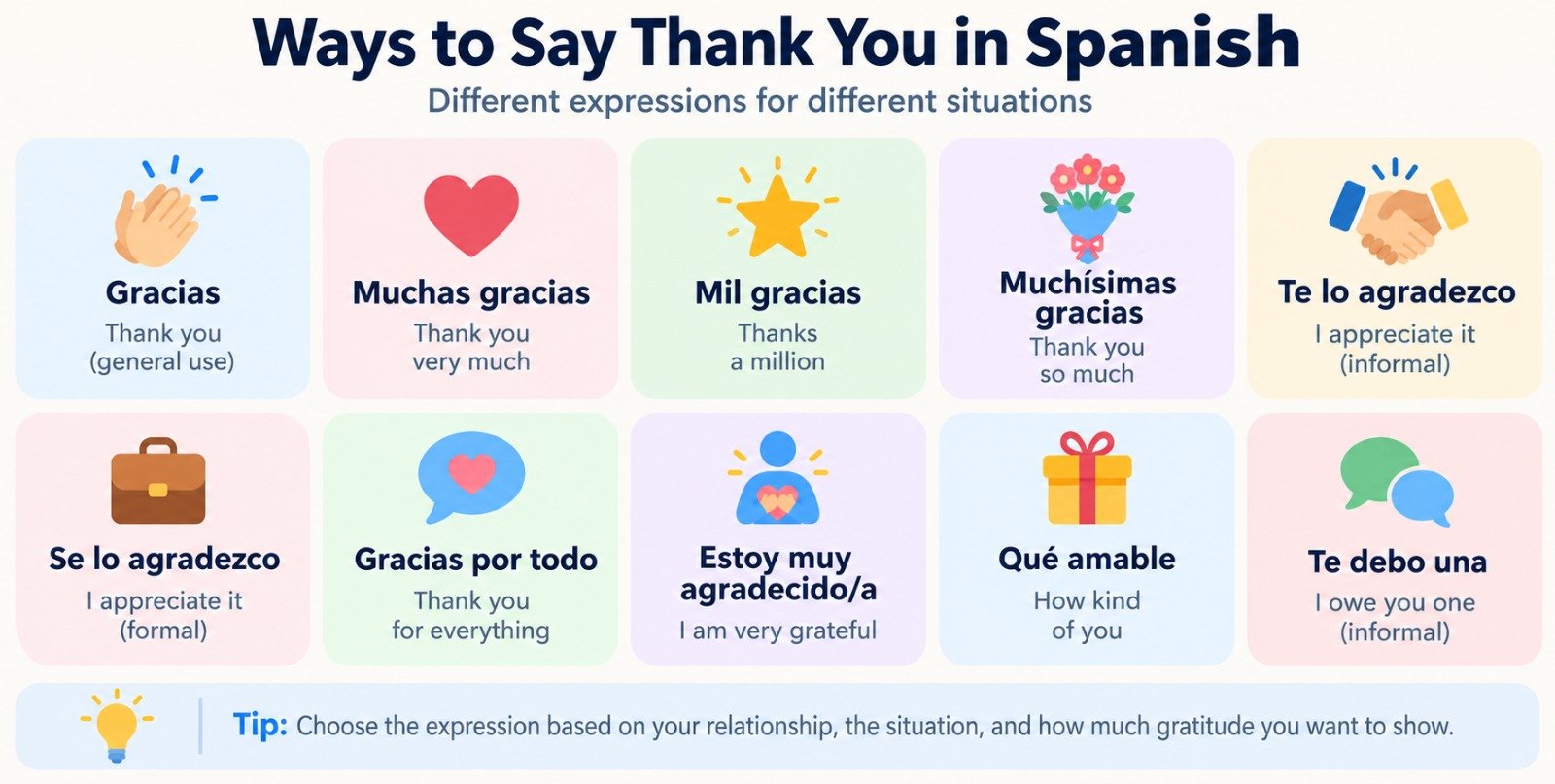
20+ Ways to Say Thank You in Spanish
The best expression depends on how much gratitude you want to show and who you’re speaking to.
| Spanish Expression | English Meaning | Tone | Best Use |
|---|---|---|---|
| Gracias | Thank you / Thanks | Neutral | Almost any situation |
| Muchas gracias | Thank you very much | Warm/neutral | Everyday and polite situations |
| Muchísimas gracias | Thank you so much | Very warm | Strong appreciation |
| Mil gracias | Thanks a million | Friendly | Friends and informal situations |
| Un millón de gracias | A million thanks | Enthusiastic | Strong, expressive gratitude |
| Gracias por todo | Thank you for everything | Warm | Significant help or support |
| Gracias por tu ayuda | Thank you for your help | Friendly | Informal situations |
| Gracias por su ayuda | Thank you for your help | Formal | Professional or respectful situations |
| Te lo agradezco | I appreciate it | Personal | Informal conversations |
| Se lo agradezco | I appreciate it | Formal | Professional or respectful settings |
| Te agradezco mucho | I really appreciate it | Warm | Friends or familiar people |
| Le agradezco mucho | I greatly appreciate it | Formal | Work and formal communication |
| Muy amable | Very kind of you | Polite | Responding to kindness |
| Qué amable | How kind | Warm | A kind gesture |
| Gracias de todo corazón | Thank you from the bottom of my heart | Heartfelt | Emotional or meaningful situations |
| Estoy muy agradecido/a | I am very grateful | Sincere | Deep appreciation |
| Realmente lo aprecio | I really appreciate it | Sincere | Personal or professional |
| Te debo una | I owe you one | Casual | Friends and favors |
| Gracias por todo lo que has hecho | Thank you for everything you’ve done | Deep/warm | Significant support |
| Se agradece | Much appreciated | Neutral/casual | Informal appreciation |
Not all of these are direct replacements for gracias. Some express a stronger emotion, identify what you’re thankful for, or change the level of formality.
Ways to Say Thank You Very Much in Spanish
Other Ways to Say “Thank You Very Much” in Spanish
If simple gracias doesn’t feel strong enough, there are several natural choices.
Muchas gracias is the most straightforward option. It means “thank you very much” and works in both casual and polite situations.
Example:
“Muchas gracias por venir.”
“Thank you very much for coming.”
For even greater emphasis, use muchísimas gracias.
Example:
“¡Muchísimas gracias por tu apoyo!”
“Thank you so much for your support!”
Another expressive option is mil gracias, which literally refers to “a thousand thanks” and is similar to “thanks a million” in English.
Example:
“Mil gracias por ayudarme con este proyecto.”
“Thanks a million for helping me with this project.”
Un millón de gracias is even more expressive and can work well in friendly messages or social situations.
Formal Ways to Say Thank You in Spanish
Other Ways to Say Thank You Formally in Spanish
When speaking to a client, supervisor, official, older person, or someone you don’t know well, Spanish provides more formal constructions.
Se lo agradezco means “I appreciate it” and is a respectful choice.
Example:
“Se lo agradezco mucho, señor.”
“I really appreciate it, sir.”
You can also say le agradezco mucho, particularly when identifying what you appreciate.
Example:
“Le agradezco mucho su tiempo.”
“I greatly appreciate your time.”
Other useful formal constructions include:
- Le agradezco su ayuda. — I appreciate your help.
- Le agradezco su tiempo. — I appreciate your time.
- Agradezco su atención. — I appreciate your attention.
- Muy amable de su parte. — Very kind of you.
These expressions are generally more suitable for professional correspondence than very casual expressions such as mil gracias or te debo una.
Casual Ways to Say Thank You in Spanish
Other Ways to Say Thank You Casually in Spanish
With friends and people you’re comfortable with, you can make your gratitude sound more relaxed.
Te lo agradezco is a natural way to say “I appreciate it.”
Example:
“Te lo agradezco mucho. Me ayudaste justo cuando lo necesitaba.”
“I really appreciate it. You helped me exactly when I needed it.”
Te debo una is more casual. It literally means “I owe you one” and is commonly used after someone does you a favor.
Example:
“Gracias por llevarme a casa. Te debo una.”
“Thanks for driving me home. I owe you one.”
Mil gracias is another friendly option when you want to sound enthusiastic without becoming overly formal.
Heartfelt Ways to Express Gratitude
Other Ways to Say Thank You From the Heart in Spanish
Sometimes gracias doesn’t fully capture how grateful you feel. In emotional or meaningful situations, a more heartfelt expression may be appropriate.
Gracias de todo corazón means “thank you from the bottom of my heart” and communicates sincere appreciation.
Example:
“Gracias de todo corazón por estar conmigo durante este momento difícil.”
“Thank you from the bottom of my heart for being there for me during this difficult time.”
You can also say:
Estoy muy agradecido/a.
“I am very grateful.”
The ending changes according to the speaker’s gender: agradecido is traditionally masculine and agradecida traditionally feminine.
For a particularly meaningful situation, you can be more specific:
Gracias por todo lo que has hecho por mí.
“Thank you for everything you’ve done for me.”
This is more personal than simply saying gracias because it recognizes someone’s continuing effort or support.
Ways to Say Thank You for Something Specific
Other Ways to Say Thank You for Your Help in Spanish
Spanish frequently uses gracias por followed by a noun or verb to explain what you’re thankful for.
Examples include:
- Gracias por tu ayuda. — Thank you for your help.
- Gracias por venir. — Thank you for coming.
- Gracias por escucharme. — Thank you for listening to me.
- Gracias por tu tiempo. — Thank you for your time.
- Gracias por todo. — Thank you for everything.
- Gracias por estar aquí. — Thank you for being here.
- Gracias por tu apoyo. — Thank you for your support.
The choice between tu and su matters. Tu is generally associated with informal relationships, while su is used when addressing someone formally or respectfully.
For example:
Gracias por tu ayuda.
Informal: “Thank you for your help.”
Gracias por su ayuda.
Formal/respectful: “Thank you for your help.”
Ways to Say “I Appreciate It” in Spanish
Other Ways to Say “I Appreciate It” in Spanish
English speakers often want a Spanish equivalent of “I appreciate it.” The most natural options depend on who you’re addressing.
Te lo agradezco is informal.
Se lo agradezco is formal.
You may also hear lo aprecio, which can literally convey “I appreciate it,” although agradecer is often the more natural choice when directly expressing thanks.
For example:
“Te lo agradezco mucho.”
“I really appreciate it.”
“Se lo agradezco sinceramente.”
“I sincerely appreciate it.”
These expressions are not simply fancy replacements for gracias. They can sound more personal or deliberate, so they’re especially useful when you want to emphasize appreciation.
Polite Expressions for Everyday Situations
Other Ways to Say Thank You Politely in Spanish
Sometimes you’re thanking someone for a small act of kindness rather than a major favor.
In those situations, muy amable and qué amable are useful.
Muy amable can mean “very kind of you.”
Example:
“Muchas gracias por ayudarme.”
“Muy amable.”
Qué amable means “how kind” and acknowledges someone’s thoughtful behavior.
Example:
“Qué amable por traerme esto.”
“How kind of you to bring me this.”
These expressions are especially useful when someone offers assistance, gives you something, or goes out of their way to help.
How to Say Thank You to Friends
Other Ways to Say Thank You to a Friend in Spanish
With close friends, you don’t always need a formal expression. Natural choices include:
- Gracias, amigo/amiga. — Thanks, friend.
- Mil gracias. — Thanks a million.
- Te lo agradezco mucho. — I really appreciate it.
- Te debo una. — I owe you one.
- Gracias por estar ahí. — Thanks for being there.
- Gracias por todo. — Thanks for everything.
The relationship matters here. Te debo una can sound friendly and relaxed, whereas gracias de todo corazón carries considerably more emotional weight.
How to Respond to “Gracias” in Spanish
Knowing what to say after someone thanks you is just as useful as knowing how to express gratitude.
Other Ways to Say “You’re Welcome” in Spanish
De nada is the standard and most widely useful response. It means “you’re welcome.”
Other possibilities include:
- No hay de qué. — Don’t mention it.
- Por nada. — You’re welcome.
- Con gusto. — My pleasure / Gladly.
- A la orden. — At your service / You’re welcome.
Regional preferences can vary, so de nada is the safest choice for Spanish learners because it is broadly understood.
Regional Differences in Saying Gracias
Spanish is spoken across Spain and much of Latin America, so pronunciation and conversational habits can vary by region.
One notable difference involves the pronunciation of gracias. In much of Latin America, the “c” sound in gracias is generally pronounced like an s. In much of Spain, particularly in central and northern areas, it commonly has the “th” sound heard in English think.
The spelling remains gracias, but the pronunciation differs.
For learners, this means you don’t need to worry if you hear gracias pronounced differently by Spanish speakers from different countries.
Which Spanish Thank-You Expression Should You Choose?
A simple rule is to consider relationship + formality + strength of gratitude.
For everyday situations, gracias is almost always safe.
For stronger appreciation, choose muchas gracias, muchísimas gracias, or mil gracias.
For formal communication, se lo agradezco, le agradezco mucho, or gracias por su ayuda are better choices.
For friends, te lo agradezco or te debo una can sound natural.
For deeply meaningful situations, gracias de todo corazón or gracias por todo lo que has hecho por mí can communicate more emotion.
The key is not to treat every expression as an interchangeable synonym. A phrase like te debo una has a casual, idiomatic feel, while se lo agradezco has a respectful tone. The right choice depends on the relationship and situation.
Common Mistakes When Saying Thank You in Spanish
Other Ways to Say Thank You in Spanish Without Sounding Awkward
A few simple distinctions can help you sound more natural.
1. Don’t use formal and informal pronouns randomly.
Tu is informal, while su generally signals formal or respectful address.
2. Don’t assume stronger always means better.
You don’t need muchísimas gracias every time someone hands you a pen. Simple gracias is perfectly natural for small everyday interactions.
3. Use context-specific expressions appropriately.
Te debo una works well after a favor from a friend but would be unusual in a formal business email.
4. Be specific when the situation calls for it.
Instead of simply saying gracias, saying gracias por tu ayuda makes the reason for your gratitude clear.
Frequently Asked Questions
What is the most common way to say thank you in Spanish?
Gracias is the most common and versatile way to say “thank you” in Spanish. It can be used in casual, everyday, and many polite situations.
What is another way to say thank you in Spanish?
You can say muchas gracias, mil gracias, te lo agradezco, muy amable, or gracias por todo, depending on the situation. These expressions differ in tone and formality.
How do you say “thank you very much” in Spanish?
The most natural translation is muchas gracias. For stronger emphasis, you can say muchísimas gracias.
How do you say “I appreciate it” in Spanish?
Te lo agradezco is a natural informal option, while se lo agradezco is appropriate when speaking formally or respectfully.
How do you say thank you formally in Spanish?
Useful formal expressions include se lo agradezco, le agradezco mucho, gracias por su ayuda, and le agradezco su tiempo.
What does “mil gracias” mean in Spanish?
Mil gracias literally means “a thousand thanks,” but its natural English equivalent is “thanks a million” or simply “many thanks.” It sounds warm and enthusiastic.
What does “te debo una” mean?
Te debo una literally means “I owe you one.” It is a casual expression used when someone does you a favor. It is best suited to friends or informal relationships.
How do you respond to “gracias” in Spanish?
De nada is the standard response and means “you’re welcome.” Other options include no hay de qué, por nada, and con gusto.
Is “muchas gracias” more polite than “gracias”?
Not necessarily. Muchas gracias expresses stronger gratitude, but gracias itself is perfectly polite in most everyday situations. The appropriate choice depends more on context and the amount of appreciation you want to express.
Conclusion
There are plenty of natural ways to say thank you in Spanish, but you don’t need to memorize every expression at once. Start with gracias and muchas gracias, then add expressions such as te lo agradezco, mil gracias, and se lo agradezco as you become more comfortable with different social situations.
The most important lesson is to consider who you’re speaking to and how much warmth or formality the moment requires. That small distinction can make your Spanish sound much more natural. Grammarifyr is here to make those subtle differences easier to understand so you can choose the right words with confidence.
You may also Read : Creative Ways to Say Thank You: Funny, Unique & Heartfelt Expressions