Lifes or Lives: Spelling Rules and Examples Explained
Have you ever wondered whether to write lifes or lives when talking about more than one life? The two forms look similar, but only one is generally correct in standard English. The plural of life is lives, and it appears in everyday expressions such as “saving lives,” “our lives,” and “changing lives.” The confusion often comes from the way English forms plurals, since many nouns simply add -s or -es. However, life follows a different spelling pattern. Understanding this rule will help you write more accurately and avoid a common grammatical mistake.
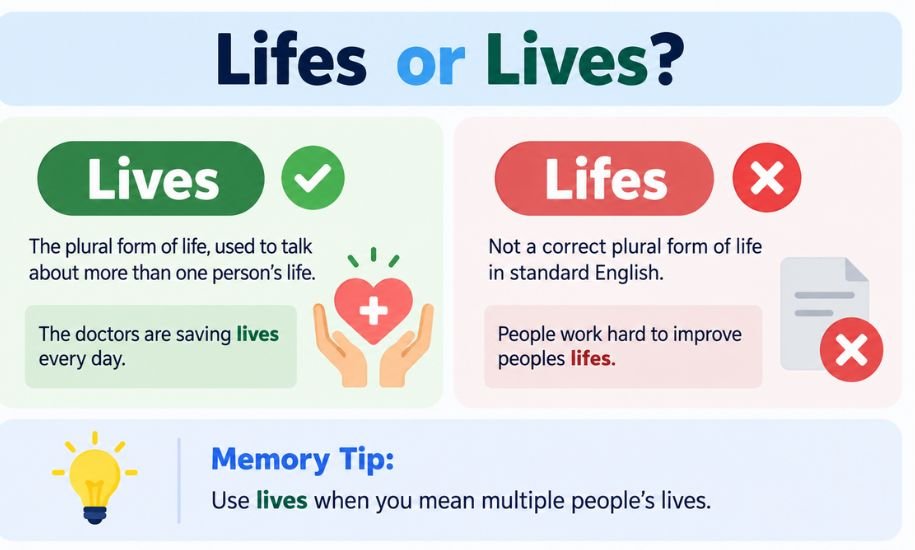
**Lives** is the correct plural of *life*. For example, write “The rescue workers saved three lives,” not “The rescue workers saved three lifes.” The word *lives* can also be a verb, as in “She lives in London.”
Lifes or Lives: Which Spelling Is Correct?
Lives is the correct spelling when referring to more than one life. Lifes is generally a misspelling when used as the ordinary plural of life.
The distinction is important because life refers to an individual existence, while lives refers to multiple existences or the experiences of several people.
| Feature | Life | Lives | Lifes |
|---|---|---|---|
| Grammatical role | Singular noun | Plural noun or verb | Generally incorrect as a plural |
| Meaning | One existence | Multiple existences or experiences | Not the standard plural of life |
| Example | Her life is peaceful. | Their lives are different. | Their lifes are different. |
| Correct usage | Yes | Yes | Generally no |
Examples:
- Correct: The firefighters saved several lives.
- Incorrect: The firefighters saved several lifes.
- Correct: Our lives have changed significantly.
- Incorrect: Our lifes have changed significantly.
Remember that lives can have different grammatical functions, but lifes is not the normal plural form of the noun life.
What Does “Life” Mean?
Life is a noun that describes the state of being alive, the period during which someone or something exists, or the experiences that make up an individual’s existence.
The word can be used in several contexts. It may refer to a person’s everyday experiences, the time between birth and death, or the useful period of an object.
Examples of “life” in sentences:
- She wants to live a peaceful life in the countryside.
- His life changed after he moved to another country.
- The battery has a longer life than the previous model.
- Regular exercise can improve your quality of life.
In each sentence, life refers to one existence, period, or general concept. When you need to refer to multiple lives, you usually change the word to lives.
Why Is the Plural of Life “Lives”?
English has several irregular plural forms. Although many nouns form their plurals by adding -s or -es, certain nouns ending in -f or -fe change that ending to -ves.
For example:
| Singular | Plural |
|---|---|
| Life | Lives |
| Wife | Wives |
| Knife | Knives |
| Wolf | Wolves |
| Leaf | Leaves |
| Calf | Calves |
This spelling pattern explains why lives is correct instead of lifes.
However, the pattern does not apply to every noun ending in -f. For example, the usual plural of roof is roofs, not rooves in ordinary modern usage.
For this reason, it is helpful to learn the established plural form of each word rather than assuming that every noun follows the same rule.
What Does “Lives” Mean?
The word lives has two common uses: it can be the plural form of the noun life, or it can be the present-tense form of the verb live used with a third-person singular subject.
1. Lives as a plural noun
As a noun, lives refers to multiple existences, personal experiences, or individual circumstances.
Examples:
- The doctors worked tirelessly to save lives.
- Their lives became easier after the move.
- The book explores the lives of ordinary people.
- Education can transform young people’s lives.
In these sentences, the word refers to more than one life or the experiences of multiple people.
2. Lives as a verb
As a verb, lives means that someone or something resides in a place or continues to exist. It is used with subjects such as he, she, and it, as well as singular names.
Examples:
- She lives near the city centre.
- My brother lives with his family.
- The animal lives in a forest.
- Daniel lives in a small apartment.
Compare these sentences:
- Their lives are busy. Here, lives is a plural noun.
- She lives nearby. Here, lives is a verb.
The surrounding sentence makes the meaning clear.
Correct Usage Examples
The easiest way to understand the spelling is to see how it works in natural sentences.
| Incorrect sentence | Correct sentence |
|---|---|
| The accident cost two lifes. | The accident cost two lives. |
| We all have different lifes. | We all have different lives. |
| The organisation saves lifes. | The organisation saves lives. |
| Our lifes are changing. | Our lives are changing. |
| They shared their lifes with us. | They shared their lives with us. |
| The film tells the story of three lifes. | The film tells the story of three lives. |
Here are additional examples of correct expressions:
- Saving lives is an important part of emergency work.
- The experience changed both their lives.
- Everyone deserves the opportunity to improve their lives.
- Technology has changed our daily lives.
- The charity works to improve the lives of children.
- Their lives took different directions after graduation.
Notice that lives works naturally in expressions involving personal experiences, relationships, communities, and survival.
“Our Life” or “Our Lives”: Which Should You Use?
Both our life and our lives can be correct. The choice depends on whether you want to emphasize a shared existence or multiple individual lives.
Use our lives when referring to the separate experiences, circumstances, or existences of multiple people.
Examples:
- Our lives changed after we moved abroad.
- We have built successful lives in different cities.
- Our lives are shaped by the choices we make.
Use our life when describing a shared way of living or a common existence, particularly when speaking about a couple or household.
Examples:
- Our life together has been full of adventure.
- We enjoy our quiet life in the countryside.
- Our life as a family revolves around spending time together.
The distinction is not simply about how many people are involved. Two people can share one way of life while still having separate lives and experiences.
“Lives” vs. “Life’s” vs. “Lifes”
These three forms can be confusing because they look similar, but they serve different purposes.
Life is the singular noun.
Example: Her life is full of interesting experiences.
Lives is the plural noun or a verb.
Examples: Their lives are different. She lives in Manchester.
Life’s is the possessive form of life or a contraction of life is.
Examples:
- Life’s challenges can teach us valuable lessons.
- Life’s purpose is understood differently by different people.
- Life’s too short to spend every day worrying.
In the first two examples, life’s indicates possession or association. In the third, it means life is.
There is also a special exception in art terminology: still lifes is the standard plural of still life, referring to artworks that depict objects such as flowers, fruit, or household items.
Example: The gallery displayed several beautiful still lifes.
This exception does not mean that lifes is correct as the ordinary plural of life.
Easy Ways to Remember the Correct Form
A simple way to remember the spelling is to connect life with other nouns that change their endings in the plural.
Think of these pairs:
- Life → Lives
- Wife → Wives
- Knife → Knives
The words share a similar spelling pattern, making them easier to remember together.
You can also use a quick sentence test. If you are talking about more than one person’s existence or experience, try replacing the word with individual lives. If that meaning fits, lives is probably the form you need.
For example:
“Education improves people’s ___.”
The correct answer is lives because the sentence refers to the experiences and circumstances of multiple people.
For a final check, remember the familiar expression “saving lives.” The same plural spelling applies in phrases such as “changing lives,” “improving lives,” and “protecting lives.”
Frequently Asked Questions
1. Is “lifes” ever correct in English?
Lifes is not the standard plural of life. However, still lifes is a correct plural expression in art terminology. In ordinary writing about people, animals, or multiple existences, use lives.
2. What is the plural of life?
The plural of life is lives. For example, “The volunteers helped save several lives.” The spelling changes from -fe to -ves, following an established irregular plural pattern.
3. Should I write “saving lives” or “saving lifes”?
Write saving lives. This is the correct expression when referring to protecting or rescuing more than one person. The same rule applies to phrases such as “risking lives” and “changing lives.”
4. Is “lives” a noun or a verb?
It can be either. As a noun, lives is the plural of life, as in “Their lives are different.” As a verb, it is the third-person singular form of live, as in “She lives nearby.”
5. Is it “people’s lives” or “people’s life’s”?
Use people’s lives when referring to the lives of several people. The apostrophe in people’s indicates possession, while lives is the plural noun. The expression people’s life’s does not convey this meaning correctly.
6. Is “our lives” grammatically correct?
Yes. Our lives is correct when referring to multiple individual lives or experiences. For example, “Our lives have changed over the years.” The expression our life can also be correct when referring to a shared existence or lifestyle.
Final Verdict: Lives Is the Correct Plural
When choosing between these spellings, remember that life becomes lives in the plural. Use lives when discussing multiple people, their experiences, or their existence, and when using the verb lives to describe where someone resides. Avoid lifes in ordinary writing, except in the established expression still lifes. With this simple distinction, you can write more confidently and choose the right words. Grammarifyr is here to help you understand English grammar clearly and use the right forms in everyday writing.
You may also Read : Effective or Affective: Correct Meaning and Usage