Repast or Repass: Meaning, Difference and Usage
The words repast and repass look and sound similar, but they have different meanings in standard English. The distinction becomes especially important when discussing funeral traditions, where both words may appear in conversations about a meal held after a service. Repast is the established word for a meal, while repass generally means to pass again or go through something another time. However, repass is also used in some communities to refer to a post-funeral meal or gathering. Understanding these differences will help you choose the appropriate word for your sentence and audience.
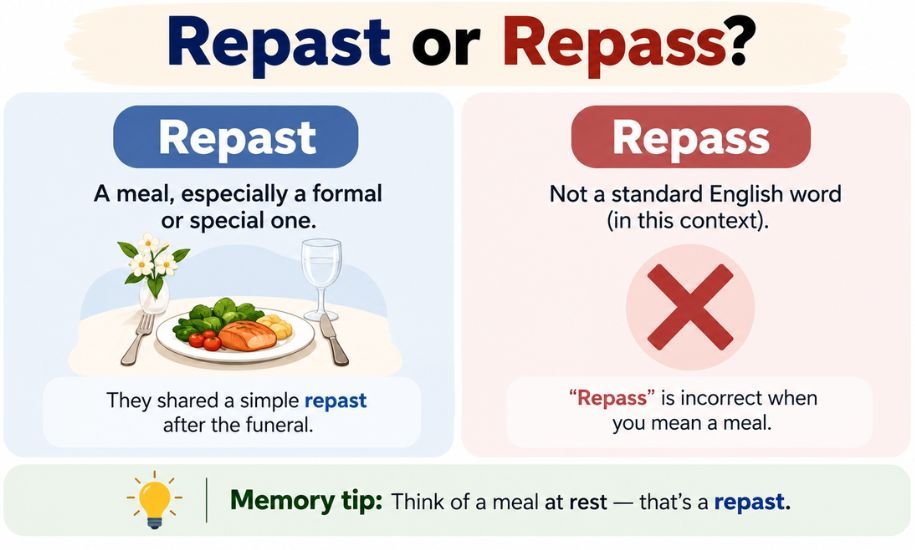
Both repast and repass are valid English words, but they have different standard meanings. Repast means a meal and is the preferred term for a meal after a funeral. Repass usually means to pass again, although some communities use it as a name for a funeral meal or gathering.
Repast or Repass: What’s the Difference?
The main difference lies in how each word is used. Repast is a noun referring to food served as a meal. Repass is primarily a verb describing the action of passing something again.
| Feature | Repast | Repass |
|---|---|---|
| Standard meaning | A meal | To pass again |
| Part of speech | Noun | Verb |
| Funeral context | Established term for a meal after a service | Used as a noun in some communities |
| Formal writing | Appropriate when referring to a meal | Appropriate when meaning to pass again |
| Example | We attended the repast after the funeral. | We had to repass the same road. |
If you are writing a formal invitation, obituary, or announcement about food served after a funeral, repast is generally the safest choice. If you are describing someone passing through a place again, use repass.
What Does Repast Mean?
Repast is a noun that means a meal or the food eaten at one sitting. It is a somewhat formal or literary word, so people may use meal, lunch, or dinner more often in everyday conversation.
The word can describe an ordinary meal, but it is particularly familiar in expressions such as funeral repast, where it refers to a gathering with food following a funeral or memorial service.
Examples of Repast in Sentences
- The family prepared a repast for relatives who had traveled to attend the funeral.
- We enjoyed a simple repast after the afternoon meeting.
- The church hall was arranged for the repast following the memorial service.
- After the long journey, the travelers stopped for a warm repast.
In each example, the word refers to food or a meal. It does not describe the act of passing through a place.
Is Repast a Formal Word?
Yes. Although repast is a correct English word, it often sounds more formal than meal. It is suitable for funeral announcements, memorial programs, traditional writing, and situations where a respectful tone is appropriate.
For example, “A repast will follow the service” is a concise and considerate way to inform guests that food will be served after a ceremony.
What Does Repass Mean?
Repass is a verb that generally means to pass again, return along a route, or go through a place another time. Its meaning depends on the context.
The word is grammatically valid, but it does not ordinarily mean a meal in standard English. Its use as a noun for a funeral gathering is a regional or community-specific usage.
Examples of Repass in Sentences
- The driver had to repass the entrance after missing the turn.
- We will repass the same street on our way home.
- The travelers decided to repass the checkpoint before continuing their journey.
These examples illustrate the standard verbal meaning: passing again.
Can Repass Mean a Funeral Meal?
Yes, in some communities, particularly in parts of the United States, repass is used as a noun for a meal or gathering held after a funeral. Families may use the term on invitations or in conversation.
This usage is important to recognize because language also reflects local customs and community traditions. Calling it a funeral repass may be perfectly understandable within a particular community.
However, if you want wording that is widely recognized in formal English, funeral repast is generally the more established expression. It is better to explain the difference than to dismiss every use of repass in this context as a spelling mistake.
What Is a Repast for a Funeral?
A funeral repast is a meal or gathering held after a funeral, burial, memorial service, or homegoing service. Family members, friends, and other guests come together to share food, remember the person who died, and offer comfort to those who are grieving.
The gathering may take place at a family home, church hall, community center, restaurant, or another suitable venue. Some families arrange a catered meal, while others organize a potluck or serve simple refreshments.
A repast is not necessarily a large or formal event. Its purpose is to give people an opportunity to spend time together after the service.
What Food Is Served at a Funeral Repast?
There is no single menu for a funeral repast. Food choices depend on family preferences, cultural traditions, religious customs, budget, and the number of guests.
A menu might include:
- Sandwiches, rolls, and light refreshments
- Chicken, rice, vegetables, or other main dishes
- Salads, casseroles, and side dishes
- Cakes, cookies, fruit, and other desserts
- Tea, coffee, water, juice, and other beverages
Some families choose familiar dishes associated with the person who died. Others keep the meal simple so that guests can gather without placing extra pressure on the family.
How Do You Write a Repast Invitation?
A repast invitation should communicate the essential details clearly and respectfully. Include the name of the person being remembered, the date and time, the venue, and any relevant instructions for guests.
For example:
“Family and friends are invited to join us for a repast following the funeral service at the church fellowship hall. We welcome everyone who wishes to gather, share memories, and offer support to the family.”
If your community traditionally uses repass, you may choose that term instead. The most important consideration is that the invitation feels natural and is understood by its intended audience.
Repast vs. Wake: What Is the Difference?
A repast and a wake are related to funeral traditions, but they generally refer to different parts of the process.
A wake is a gathering to pay respects to someone who has died. Depending on the cultural or religious tradition, it may take place before the funeral and may involve viewing the body, prayers, conversation, or remembrance.
A repast is primarily a meal or gathering where food is served, often after the funeral or memorial service.
For example, a family might hold a wake the evening before the funeral and arrange a repast afterward. However, funeral customs differ between communities, so the timing and format are not universal.
Why Are These Words Confused?
There are several reasons readers may confuse the two words.
First, their spellings differ by only one letter at the end: repast ends in -st, while repass ends in -ss. This makes them easy to mix up when typing or reading quickly.
Second, both words may appear in conversations about funeral gatherings. Someone who has heard the term repass used by relatives or community members may reasonably wonder whether it is the correct spelling of the word for a meal.
Finally, the standard meanings of the words are not interchangeable. Knowing the context helps distinguish them: a meal is a repast, while passing again is to repass.
How to Remember the Difference
A simple way to remember the standard meanings is to connect repast with a plate of food and repass with passing again.
Think of the final t in repast as the end of a word associated with eating at a table. This is only a memory aid, not an explanation of the word’s historical origin.
When discussing funeral traditions, remember that repast is the broadly established term for the meal. If you hear repass used locally, consider the speaker’s community and intended meaning before correcting them.
Common Mistakes to Avoid
1. Assuming repass is always a misspelling
Repass is a real word with a standard verbal meaning. It is also used as a noun for a funeral meal in some communities. Context matters.
2. Treating repast and repass as interchangeable in every sentence
The words do not have the same general meaning. You cannot replace repast with repass when describing an ordinary meal without changing the intended meaning or relying on a particular community’s usage.
3. Using repast when you mean to pass again
If someone needs to cross a road or travel through a location a second time, repass is the appropriate verb.
4. Assuming every funeral invitation follows the same terminology
Some families use repast, while others use repass or simply say “meal after the service.” Follow the family’s preferred wording when preparing an invitation or announcement.
Frequently Asked Questions
Is repast or repass correct?
Both are correct words, but they have different standard meanings. Repast means a meal, while repass means to pass again. In some communities, repass is also used for a funeral meal, but repast is generally the more widely established term for that purpose.
Is a funeral repass grammatically incorrect?
Not necessarily. Although repast is the standard term for a meal, repass is used as a noun for a post-funeral gathering in some communities. It is best to consider local usage and the intended audience rather than automatically treating the expression as an error.
How do you pronounce repast?
In American English, repast is commonly pronounced approximately as “rih-PAST,” with the stress on the second syllable. The vowel in the final syllable differs between American and British pronunciations. A dictionary audio recording can help you hear the distinction.
Is a repast the same as a wake?
No. A repast is primarily a meal, often served after a funeral or memorial service. A wake is a gathering to pay respects to the deceased and may take place before the funeral. The details vary according to family, religious, and cultural traditions.
What is another word for a funeral repast?
Depending on the context, you can use “memorial meal,” “meal after the funeral,” “post-funeral gathering,” or “reception following the service.” These expressions may be clearer for readers who are unfamiliar with the word repast.
What is the plural of repast?
The plural is repasts. For example, “The community center has hosted several repasts for local families.” The word follows the regular English rule for forming the plural of a noun ending in a consonant followed by t.
Final Verdict: Which Word Should You Use?
Choose repast when you mean a meal, especially one served after a funeral or memorial service. Use repass when you mean to pass again, while recognizing that some communities use it to describe a funeral gathering. The context and intended audience should guide your choice. At Grammarifyr, our goal is to help readers understand these distinctions so they can know the difference and use the right words.
You may also Read : Diner or Dinner: Definitions and Correct Usage