Led or Lead: Meaning, Grammar Rules, and Examples
The words led and lead are easy to confuse because they have similar spellings but different meanings, pronunciations, and grammatical uses. Both are correct English words, but choosing the right one depends on the context. If you are describing something that happened in the past, led is usually the correct form. However, lead is used for present actions, future actions, and several noun meanings. Understanding the difference will help you avoid common grammar mistakes in writing, emails, and everyday communication.
Quick Answer
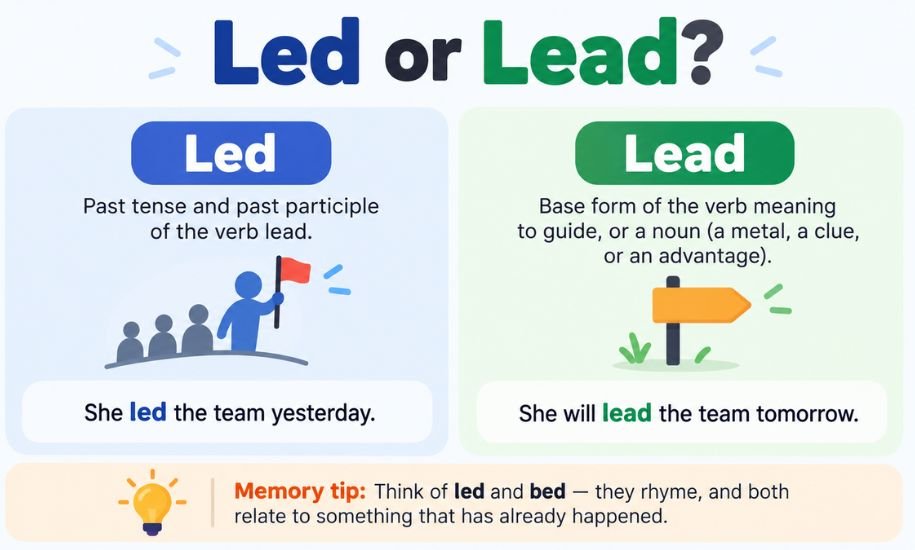
Led is the past tense and past participle of the verb lead, meaning to guide, direct, or be in charge. Lead is the base form of the verb, as in “I lead the team,” and can also refer to a metal, a clue, or a position of advantage. For example, “She led the team yesterday” is correct, while “She lead the team yesterday” is incorrect.
Led or Lead: What’s the Difference?
The main difference is grammatical. Lead is the base form of an irregular verb, while led is its past tense and past participle. The word lead can also function as a noun, with meanings that are unrelated to the act of guiding someone.
| Feature | Led | Lead |
|---|---|---|
| Correct word? | Yes | Yes |
| Part of speech | Verb form | Verb or noun |
| Verb meaning | Guided or directed in the past | To guide or direct |
| Tense | Past tense | Base form |
| Past participle | Yes | No |
| Pronunciation | Rhymes with “bed” | Verb rhymes with “need” |
| Example | She led the group. | She will lead the group. |
The simplest rule is to use led for a completed past action and lead when referring to the base form of the verb.
What Does “Led” Mean?
Led is the past tense and past participle of lead. It describes an action in which someone guided, directed, managed, or influenced others in the past.
It is an irregular verb form, meaning it does not follow the usual pattern of adding -ed to form the past tense. Although lead becomes led, it does not become leaded when referring to guiding or directing.
Examples of led in sentences:
- The manager led the team through a challenging project.
- She led the discussion during yesterday’s meeting.
- The guide led the tourists to the historic castle.
- His decision led to several unexpected changes.
- They have led the organisation for more than a decade.
In these examples, the word describes an action that has already happened or an action viewed as completed in relation to another event.
Led as a Past Participle
The word led also works as a past participle. It is commonly used with auxiliary verbs such as has, have, and had to form perfect tenses.
For example:
- She has led several successful campaigns.
- The coach had led the team to victory before retiring.
- His actions have led to a better understanding of the issue.
This is why “This has led” is correct, rather than “This has lead,” when lead means to guide or cause.
What Does “Lead” Mean?
Lead has several meanings depending on how it is used. As a verb, it means to guide, direct, influence, or take responsibility for something. As a noun, it can refer to a clue, an advantage, or a chemical element.
Lead as a Verb
When used as a verb, lead is the base form of the word. It is used with subjects in the present tense, after modal verbs such as will and can, and after to in infinitive constructions.
Examples:
- I lead a small team of designers.
- She will lead the next training session.
- Good communication can lead to better results.
- They want to lead the project together.
The verb also changes form according to the sentence:
- Present: He leads the department.
- Continuous: He is leading the department.
- Past: He led the department.
- Past participle: He has led the department.
Lead as a Noun
As a noun, lead has several distinct meanings.
- A clue: The detective received a new lead in the investigation.
- An advantage: The home team has a two-point lead.
- A position of leadership: She took the lead during the negotiations.
- A metal: The building’s old pipes were made of lead.
When lead refers to the metal, it is pronounced differently from the verb. The metal’s name rhymes with bed, while the verb rhymes with need.
What Is the Past Tense of Lead?
The past tense of lead is led. It is an irregular verb, so its past form does not follow the standard pattern used by regular verbs.
| Verb form | Word | Example |
|---|---|---|
| Base form | Lead | I lead the team. |
| Third-person singular | Leads | She leads the team. |
| Present participle | Leading | He is leading the team. |
| Past tense | Led | She led the team. |
| Past participle | Led | She has led the team. |
For example, if someone is currently responsible for a group, you might say, “He leads the team.” If the action took place yesterday, you would say, “He led the team yesterday.”
Remember that leaded is not the standard past tense of lead when it means to guide. Leaded does exist in specialised contexts, such as describing something treated or covered with lead, but it is not a substitute for led.
Led or Lead in British and American English
There is no spelling difference between British and American English when using these words as verbs. Both varieties use led as the past tense and past participle of lead.
| Context | British English | American English |
|---|---|---|
| Past action | She led the team. | She led the team. |
| Present action | She leads the team. | She leads the team. |
| Future action | She will lead the team. | She will lead the team. |
| Past participle | He has led the group. | He has led the group. |
The same rules apply in formal writing, academic work, professional communication, and everyday conversation in both countries.
Led or Lead to Believe: Which Is Correct?
Both forms can be correct in the phrase lead to believe, depending on the tense and structure of the sentence.
Use led to believe when describing a past action or influence.
Examples:
- The available evidence led me to believe that the report was accurate.
- His explanation led her to believe that the meeting had been cancelled.
- Their behaviour led us to believe something was wrong.
Use lead to believe when referring to a present, future, or possible action.
Examples:
- These findings may lead people to believe the claim.
- Do not let misleading information lead you to believe something untrue.
- Her comments could lead the audience to believe that the project is complete.
When the phrase follows has, have, or had, use led:
- The conversation has led me to believe that we need a new plan.
- The announcement had led them to believe that changes were coming.
If You Feel Led or Lead
The correct choice depends on the intended meaning and sentence structure. When feel describes being guided or influenced, led is generally correct if the sentence uses a past participle.
Examples:
- If you feel led to help others, consider volunteering.
- She felt led to change her career.
- I have always felt led to support my community.
In the expression “feel led to,” led describes a sense of being guided or directed. It is often used in personal, spiritual, or reflective contexts.
However, lead is correct when it is the main verb in a different construction:
- I feel that I can lead the team effectively.
- She feels ready to lead the discussion.
Common Mistakes When Using These Words
Even though both spellings are correct, they are not interchangeable when used as verbs.
| Incorrect | Correct | Explanation |
|---|---|---|
| She lead the team yesterday. | She led the team yesterday. | Use the past tense for a completed action. |
| He has lead many projects. | He has led many projects. | Use the past participle after has. |
| They lead the group last year. | They led the group last year. | A past event requires led. |
| She will led the meeting. | She will lead the meeting. | Use the base form after will. |
| This has lead to confusion. | This has led to confusion. | Use the past participle after has. |
A useful way to avoid these mistakes is to identify the tense before choosing the word. If the sentence describes a completed action, led is generally the correct form. If it uses a modal verb such as will, can, or should, use lead.
Easy Way to Remember the Difference
A simple memory trick is to associate led with bed. Both words have the same vowel sound, and led is the form you use for an action that has already happened.
Remember these examples:
- Today: I lead the team.
- Yesterday: I led the team.
- Tomorrow: I will lead the team.
- Over several years: I have led the team.
You can also remember that lead is the dictionary form of the verb, while led is the form used for the past tense and past participle.
Frequently Asked Questions
Is “led” always the past tense of “lead”?
When lead is used as a verb meaning to guide, direct, or influence, led is its past tense and past participle. However, lead can also be a noun, referring to a metal, clue, or advantage, so its use is not limited to verb tenses.
Is “this has led” or “this has lead” correct?
“This has led” is correct when describing something that has caused a result or guided an outcome. The auxiliary verb has requires the past participle, which is led in this case. For example, “The new policy has led to significant changes.”
Is “lead” ever correct when talking about the past?
Yes, when lead is a noun in a sentence about the past. For example, “The detective found a promising lead yesterday.” However, when describing someone who guided or directed others in the past, use led.
Is “led” pronounced the same as “lead”?
Led is pronounced like bed. The verb lead, meaning to guide, rhymes with need. However, lead when referring to the metal is pronounced like led. The pronunciation therefore depends on the meaning of the word.
What is the past participle of “lead”?
The past participle of lead is led. It is used with auxiliary verbs to form perfect tenses, as in “She has led the organisation for five years” or “They had led the team before the merger.”
Is “leaded” ever grammatically correct?
Yes, leaded is used in certain contexts, particularly when describing something that contains or has been treated with lead, such as leaded glass or leaded petrol. However, it is not the standard past tense of the verb lead meaning to guide. In that context, led is correct.
The Bottom Line
Both led and lead are correct English words, but they serve different grammatical purposes. Use led as the past tense and past participle of the verb meaning to guide or direct. Use lead for the base form of that verb or as a noun referring to a metal, clue, or advantage. Once you understand the verb forms and pay attention to the sentence’s tense, choosing the right word becomes much easier. Grammarifyr helps make these distinctions clear so you can write accurately and confidently.
You may also Read : Hi vs. High: Meaning, Differences, and Examples



One Comment