Dyeing or Dying: Meaning, Spelling and Examples
It’s easy to confuse dyeing and dying because they look and sound remarkably similar. Yet they come from two different verbs and have completely different meanings. Dyeing is about changing the color of something, such as hair, clothing, or fabric. Dying refers to approaching death, ending, fading away, or sometimes becoming less functional. There is also a third form, dieing, which is generally not the spelling you want when talking about death. Understanding the base verbs makes the difference much easier to remember.
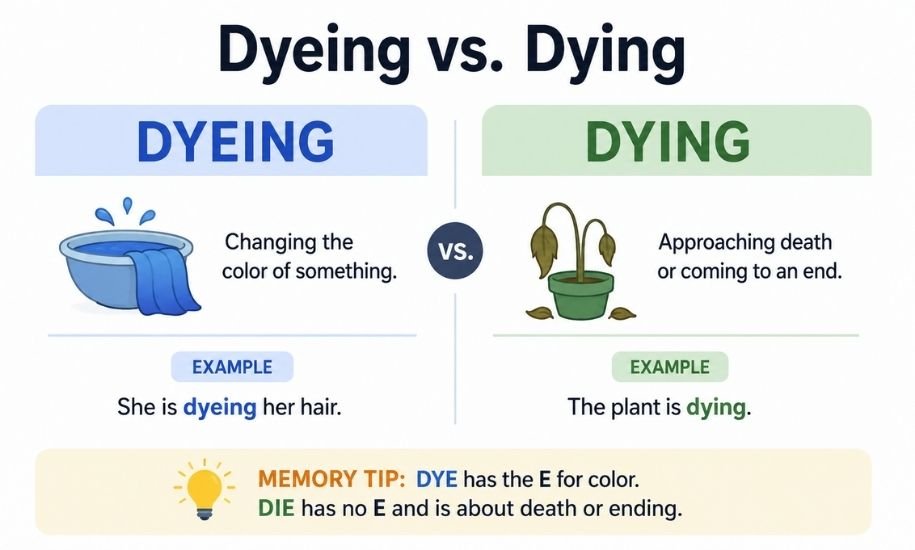
Dyeing means changing the color of something, while dying means approaching death or coming to an end. So, “She is dyeing her hair” is correct when she is changing its color. “The plant is dying” is correct when the plant is losing its life.
Dyeing or Dying: Which Is Correct?
Both dyeing and dying are correct English words. The right choice depends entirely on what you mean.
| Word | Base verb | Meaning | Example |
|---|---|---|---|
| dyeing | dye | Changing color | She is dyeing her hair. |
| dying | die | Approaching death or ending | The flowers are dying. |
| dieing | die | Usually an incorrect spelling for dying | The plant is dieing. ❌ |
The easiest rule is:
Dyeing = color
Dying = death, decline, or ending
This distinction applies whether you’re talking about hair, fabric, plants, animals, machines, or figurative ideas such as traditions.
What Does “Dyeing” Mean?
Dyeing is the present participle of the verb dye. To dye something means to change its color by applying a dye or coloring substance.
The word is commonly used when discussing:
- Hair
- Clothes
- Fabric
- Yarn
- Textiles
- Easter eggs
- Other materials being colored
Examples of “dyeing”
- Maria is dyeing her hair dark brown.
- They are dyeing the fabric a deep blue.
- We spent the afternoon dyeing eggs for Easter.
- The company specializes in dyeing textiles.
- I’m thinking about dyeing my jacket black.
Notice that the extra e in dyeing connects the word to dye.
Why “dyeing” has an extra e
The spelling comes directly from the base verb:
dye + ing = dyeing
This helps distinguish it from die + ing, whose standard present participle is dying.
So if the action involves color, think dye → dyeing.
What Does “Dying” Mean?
Dying is the present participle of die. In its literal sense, it means being in the process of losing one’s life.
For example:
- The injured bird is dying.
- The old tree is dying.
- The patient was dying from the illness.
However, dying isn’t limited to literal death. It can also describe something that is gradually disappearing, weakening, or stopping.
For example:
- The old tradition is dying.
- The industry is dying.
- My phone battery is dying.
- The flowers are dying without water.
It can also appear in informal expressions such as “dying to”, meaning that someone wants something very much:
I’m dying to see the new movie.
In that sentence, dying obviously doesn’t mean literal death.
Dye or Die: What’s the Difference?
The difference between dye and die is the foundation for understanding their longer forms.
Dye
Dye is a verb meaning to change the color of something.
I want to dye my shirt green.
It can also be a noun referring to a substance used to give something color:
This natural dye produces a rich red color.
Die
Die is a verb meaning to stop living. It can also refer to something ending or ceasing to function.
Plants can die without sunlight.
My old laptop may die at any moment.
Although dye and die sound alike, their meanings are completely different.
A useful memory aid is:
DYE = COLOR
DIE = LIFE ENDS
Dyes or Dies: Which One Should You Use?
Both dyes and dies are legitimate words, but they are forms of different verbs.
“Dyes”
Dyes is the third-person singular form of dye.
She dyes her hair every few months.
This chemical dyes the fabric quickly.
“Dies”
Dies is the third-person singular form of die.
The plant dies without enough water.
The battery dies after several hours.
Compare these:
- She dyes her hair.
- Her phone dies after a long day.
The pronunciation may cause confusion, but the meanings are unrelated.
Is It Dyeing or Dying Hair?
When you’re talking about changing hair color, the correct expression is dyeing your hair.
She is dyeing her hair blonde. ✅
Not:
She is dying her hair blonde. ❌
Why? Because the underlying verb is dye, not die.
The same distinction applies to other things being colored:
- dyeing clothes
- dyeing fabric
- dyeing yarn
- dyeing eggs
- dyeing leather
So both “is it dyeing or dying hair” and “is it dying or dyeing hair” have the same answer: dyeing is correct when you mean changing the hair’s color.
Dying or Dyeing: Examples in Sentences
Seeing the two words side by side makes the difference clearer.
Use “dyeing” for color
I’m dyeing my shoes a darker shade.
She spent Saturday dyeing her hair.
They are dyeing wool for the new collection.
We are dyeing the curtains to match the room.
Use “dying” for death or decline
The flowers are dying because nobody watered them.
The injured animal was dying.
The battery is dying.
That old custom is slowly dying out.
Compare the meanings
She is dyeing her hair.
She is changing its color.
Her hair is dying.
This would normally suggest that the hair itself is becoming unhealthy or losing vitality, not that she is coloring it.
The context can therefore completely change the meaning.
Is “Dieing” Correct?
If you’re trying to write the present participle of die, the standard spelling is dying, not dieing.
The plant is dying. ✅
The plant is dieing. ❌
The spelling can seem surprising because many English verbs simply take -ing. But die changes its spelling before the suffix:
die → dying
This is similar to other spelling changes that occur when English words take grammatical endings.
There is one technical exception worth knowing: dieing can occur as a specialized term related to manufacturing processes involving a die, a tool used to cut, shape, stamp, or form material. That technical use is uncommon in ordinary writing.
Therefore, if you are talking about someone or something approaching death, use dying.
Why Are These Words So Easy to Confuse?
There are several reasons.
First, dye and die are pronounced the same in standard English. They are homophones: words that sound alike but have different meanings and spellings.
Second, their -ing forms look almost identical:
- dyeing
- dying
The only visible difference is the extra e.
Third, dieing may seem like the obvious spelling of die + ing. That assumption leads writers to create a form that is normally incorrect when they mean dying.
The best solution is not to memorize every form separately. Instead, identify the base verb first:
Is the action about color? → dye → dyeing
Is the action about death or ending? → die → dying
Common Mistakes to Avoid
1. “Dying my hair”
If you mean changing your hair color, write:
I am dyeing my hair.
Not:
I am dying my hair.
2. “Dieing” for approaching death
Use:
The flowers are dying.
Not:
The flowers are dieing.
3. Confusing “dyes” and “dies”
Remember that dyes relates to color:
She dyes fabric.
While dies relates to death or stopping:
The plant dies without water.
4. Assuming “dying” always means literal death
The word can also describe decline or disappearance:
The tradition is dying out.
My phone is dying.
So context matters.
An Easy Way to Remember the Difference
Use this simple two-word association:
DYE = COLOR
DIE = DEATH
Then build the forms from those verbs:
- dye → dyed → dyeing
- die → died → dying
If you see hair, fabric, clothes, yarn, or another coloring process, choose dyeing.
If you see death, decline, disappearance, or something stopping, choose dying.
One especially useful memory sentence is:
You dye your hair, but you die when your life ends.
Frequently Asked Questions
Is “dyeing” a correct word?
Yes. Dyeing is the present participle of dye, meaning to change the color of something. For example, “She is dyeing her hair red” is grammatically correct.
Is it “dyeing” or “dying” hair?
It is dyeing hair when you mean changing its color. The phrase “dying hair” would normally suggest something entirely different because dying comes from the verb die.
Is “dieing” ever correct?
In ordinary English, dieing is not the standard spelling for the present participle of die. The correct form is dying. However, dieing can appear as a specialized manufacturing term connected with the use of a die.
What is the difference between “dye” and “die”?
Dye means to change the color of something, while die means to stop living. They sound alike but have different spellings and meanings.
What is the difference between “dyes” and “dies”?
Dyes is the third-person singular form of dye, while dies is the third-person singular form of die. For example, “She dyes fabric” and “The plant dies without water.”
How can I remember “dying” versus “dyeing”?
Think of dye = color. Because dye contains an e, its -ing form is dyeing. Dying comes from die and refers to death, decline, or ending.
Final Verdict: Dyeing or Dying?
Choose dyeing when something is being given a new color: dyeing hair, dyeing clothes, or dyeing fabric. Choose dying when someone or something is approaching death, declining, disappearing, or stopping. And when you mean death, avoid dieing in standard English.
The quickest rule to remember is “dyeing is about color; dying is about death or decline.” For more clear explanations of easily confused English words, Grammarify helps you know the difference and use the right words.
You may also Read : Scarves or Scarfs: Correct Usage Explained