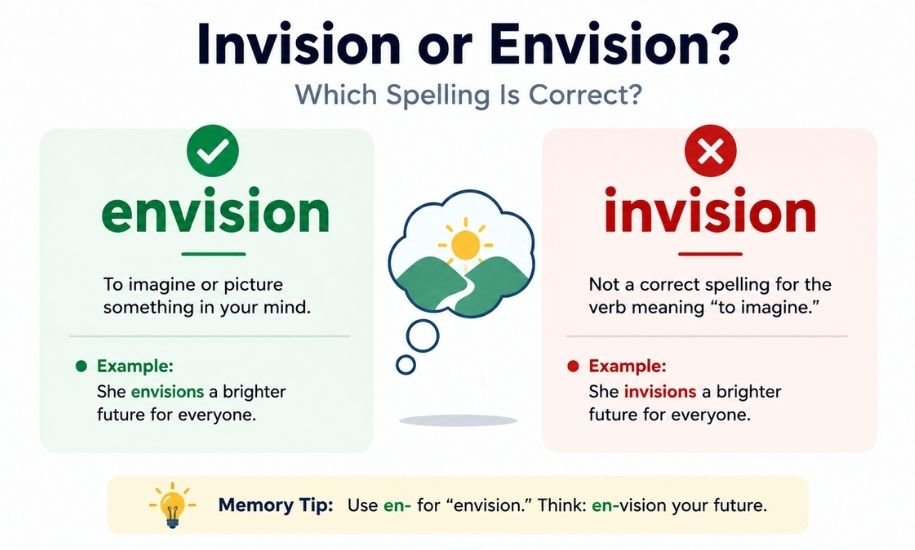
Invision or Envision: Which Spelling Is Correct?
If you are unsure whether to write invision or envision, you are not alone. The two forms look and sound similar, and the word vision makes invision seem like a logical spelling. However, when you mean “to imagine,” “to picture,” or “to visualize something,” there is a clear standard form. There is also an important exception: InVision can appear as a proper name or brand. So, which one should you use in ordinary English?
Envision is the correct spelling when you mean “to imagine, picture, or visualize something.” Invision is generally a misspelling of envision. However, InVision may be correct when referring to a proper name or brand.
Envision or Invision: What’s the Difference?
The main distinction is straightforward:
| Form | Correct in standard English? | Meaning or use |
|---|---|---|
| envision | Yes | To imagine, picture, or visualize something |
| invision | No, in ordinary usage | Usually a misspelling of envision |
| InVision | Yes, in the appropriate context | A proper name/brand |
So, if you are writing a sentence such as “I can ___ a better future,” the correct choice is envision:
I can envision a better future for the community.
Not:
I can invision a better future for the community.
The capitalized form InVision is a separate matter because proper names do not follow the same spelling question.
What Does “Envision” Mean?
Envision is a verb meaning to imagine or form a mental picture of something, especially something that could happen or exist in the future.
It is often used when talking about:
- future plans
- goals and ambitions
- possible outcomes
- designs and projects
- personal aspirations
- imagined situations
For example:
She envisions herself running her own company one day.
The architect envisioned a spacious home filled with natural light.
We envision a future with cleaner sources of energy.
They are envisioning several possible solutions.
The word can be similar to imagine or visualize, but envision often has a stronger connection with deliberately picturing a particular possibility or future situation.
The main grammatical forms
Because envision is a regular verb, its common forms are easy to build:
- Base form: envision
- Third-person singular: envisions
- Past tense: envisioned
- Present participle: envisioning
Examples:
I envision a successful outcome.
She envisions a different approach.
He envisioned the project several years ago.
We are envisioning a larger facility.
Is “Invision” a Real Word?
In ordinary standard English, invision should not be used as the spelling of the verb meaning “to imagine” or “visualize.”
If you write:
I invision myself succeeding.
you should change it to:
I envision myself succeeding.
The confusion is understandable because invision looks as though it could be formed from in + vision. However, that does not make it the standard spelling of the verb.
There is one important qualification: InVision, with a capital I, can refer to a proper name or brand. That does not make lowercase invision an alternative spelling of envision.
Why Do People Confuse These Spellings?
There are a few natural reasons the mistake occurs.
First, the pronunciation of envision can make the opening sound seem closer to in- than en-. Someone who learns the word primarily by hearing it may therefore spell it phonetically.
Second, the word contains vision, so invision looks visually plausible. English has many words beginning with in-, which can make the incorrect form feel intuitive.
Finally, people may encounter the name InVision and assume that invision is simply another spelling of the ordinary verb. It is not.
The safest approach is to remember that the verb is spelled envision.
How to Use “Envision” in a Sentence
The verb works naturally in several different contexts.
Talking about the future
I envision a future where public transportation is more accessible.
Describing a personal ambition
She envisions herself becoming a published author.
Discussing a plan
The team envisioned a simpler way to organize the information.
Describing an imagined result
We can envision several possible outcomes.
Talking about design
The designer envisioned a clean and practical workspace.
A useful construction is envision + noun phrase:
They envision a better system.
You can also use envision + -ing form:
She envisions building her own business.
And envision + oneself + -ing is common when discussing personal goals:
He envisions himself working overseas.
Envision or Invision Using: Which One Should You Choose?
If you are deciding which spelling to use in your own writing, choose envision whenever the meaning is “imagine,” “picture,” or “visualize.”
Correct
I envision a peaceful future.
She envisioned a completely different solution.
They are envisioning a new way to approach the problem.
Incorrect in ordinary English
I invision a peaceful future.
She invisioned a completely different solution.
They are invisioning a new way to approach the problem.
Notice that the spelling remains en- in every form: envision, envisioned, envisioning, and envisions.
Envision vs. Imagine vs. Visualize
These words overlap, but they are not always interchangeable.
Imagine is the broadest term. It can refer to forming an idea or mental picture of almost anything:
Imagine living beside the ocean.
Visualize emphasizes forming a mental image:
Visualize the finished room before you begin painting.
Envision often suggests imagining a particular possibility, plan, or future:
She envisions a career in environmental science.
There is no rule that says you must use envision whenever something involves the future. It is simply a particularly natural choice when someone is mentally picturing what they want, expect, or believe could happen.
Envision vs. Envisage
Another word worth knowing is envisage.
Envisage is a legitimate English verb with a meaning very similar to envision. It is particularly common in British English and other varieties influenced by British usage.
For example:
The government envisages major changes to the system.
In American English, envision is generally the more familiar choice:
The company envisions major changes to the system.
This is different from invision. Envisage is a legitimate variant in English; invision is not simply a British spelling of envision.
Common Mistakes to Avoid
1. Writing “invision” as the verb
Incorrect:
We invision a brighter future.
Correct:
We envision a brighter future.
2. Carrying the mistake into other forms
Incorrect:
She invisioned herself becoming a doctor.
Correct:
She envisioned herself becoming a doctor.
3. Treating “InVision” as an ordinary spelling
If you encounter InVision as a proper name, its capitalization and context matter. Do not assume that the brand name establishes invision as a standard English verb.
4. Assuming “invision” is the British version
It is not. Envision and envisage are the relevant standard forms, depending partly on regional preference.
An Easy Way to Remember the Correct Spelling
Think of the phrase:
“Envision your future.”
The phrase pairs naturally because envision often describes mentally picturing something that may happen.
If you are using the verb to mean imagine or visualize, start it with en-:
envision → envisioned → envisioning → envisions
Not invision → invisioned → invisioning.
Frequently Asked Questions
Is it envision or invision?
Envision is the correct standard spelling when the verb means “to imagine,” “to picture,” or “to visualize.” Invision is generally a misspelling. InVision may be correct when it is used as a proper name or brand.
Is “invision” ever correct?
Not as the ordinary English verb meaning “to imagine.” However, InVision may be correct as a proper name. Capitalization and context therefore matter when you encounter the form outside ordinary prose.
Is envision an American or British spelling?
Envision is used in both American and British English. British English also commonly uses envisage, which has a similar meaning. Invision is not simply a British spelling of envision.
How do you use envision in a sentence?
You can use it to describe imagining a possibility, plan, or future situation. For example: “She envisions a career in medicine” or “The designers envisioned a more efficient workspace.”
What is the past tense of envision?
The past tense is envisioned. For example: “They envisioned a different approach.” The verb is regular, so it takes -ed in the past tense.
Is “envisioning” correct?
Yes. Envisioning is the present participle or gerund form of envision. For example: “We are envisioning a new approach to the project.”
Final Verdict: Invision or Envision?
When you mean “to imagine, picture, or visualize,” choose envision. Forms such as envisions, envisioned, and envisioning follow the same spelling pattern. Invision is generally a misspelling, although InVision can be correct when used as a proper name. For more straightforward answers to confusing-word questions, Grammarify helps you know the difference and use the right words.
You may also Read : Fourth or Forth: Meaning, Usage and Examples
One Comment