Thru or Through: Meaning, Usage, and Examples
It is easy to hesitate between thru and through, especially when you see both forms in everyday life. You might write “walk through the door” in one context and see “drive-thru” on a restaurant sign in another. The two forms are related, but they do not have exactly the same status in standard English. Through is the normal spelling for general writing, while thru is a shortened, informal variant that appears in particular contexts, especially signs, advertising, and compounds such as drive-thru.
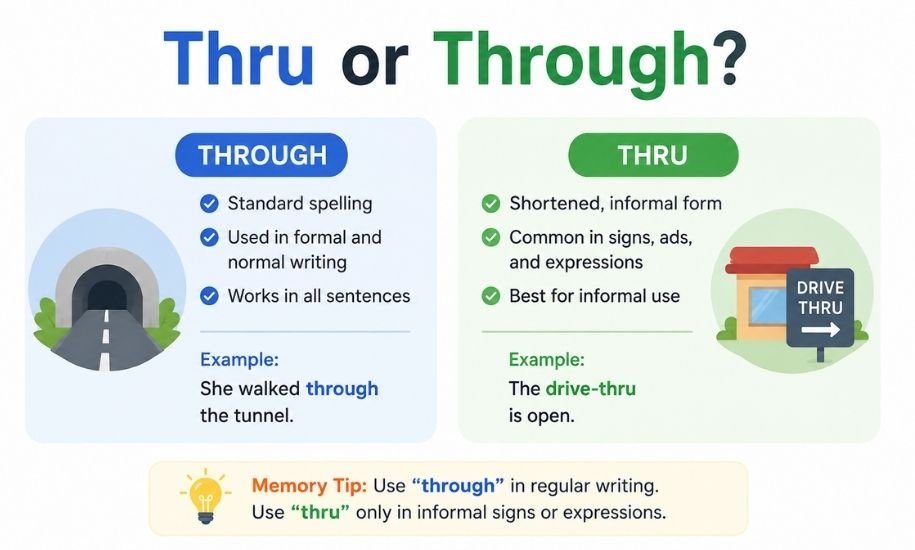
Through is the standard spelling and should be your choice in formal and general writing. Thru is an accepted informal shortening, commonly seen in signs, advertising, and expressions such as drive-thru. It is not normally the best choice in formal prose.
Through vs. Thru: The Quick Difference
| Feature | Through | Thru |
|---|---|---|
| Standard spelling | Yes | Informal variant |
| Meaning | Across, from one side to another, during, by means of, etc. | Same basic meaning in contexts where it is used |
| Formal writing | Preferred | Usually avoid |
| Informal writing | Preferred | Sometimes acceptable |
| Signs and advertising | Common | Very common |
| Compound expression | drive-through | drive-thru |
| Example | “She walked through the gate.” | “The drive-thru is open.” |
The important point is that thru is not simply a spelling error. It is a recognized shortened form of through. However, its appropriate use depends heavily on context.
What Does “Through” Mean?
Through is a standard English word with several related uses. It can function as a preposition, adverb, adjective, and, in some constructions, part of a larger expression.
One common meaning is movement from one side or point to another:
- We walked through the forest.
- The train passed through the tunnel.
- Light came through the window.
It can also describe movement across a period:
- She worked through the night.
- The store remains open through Friday.
Another use indicates a means or method:
- I heard about the opportunity through a friend.
- They solved the problem through careful planning.
Because through works naturally in so many grammatical contexts, it is the form you should normally use when writing standard English.
Is “Thru” a Real Word?
Yes. Thru is a real, recognized variant of through, but it is generally associated with informal or abbreviated usage.
You may encounter it in:
- Road and business signs
- Advertising
- Restaurant terminology
- Informal messages
- Brand names
- Shortened compound expressions
For example:
“The drive-thru closes at midnight.”
The spelling thru is especially familiar in drive-thru, but that does not mean it should replace through throughout your writing.
In a school essay, formal report, professional letter, or carefully edited article, through is usually the better choice.
Why Are “Thru” and “Through” Confused?
The confusion is understandable because the two forms represent the same basic word and meaning. The difference is primarily one of spelling convention and register rather than meaning.
Thru is shorter and visually simpler, which makes it useful when space is limited. A sign saying DRIVE-THRU is compact and immediately recognizable.
That same advantage does not necessarily apply to formal prose. In ordinary sentences, the established standard spelling remains through.
So you can think of the distinction this way:
Through = standard written form
Thru = shortened informal form
When Should You Use “Thru” or “Through”?
If you are unsure which one to choose, use through.
Use “through” in standard writing
Choose through for:
- Essays
- Articles
- Reports
- Business correspondence
- Academic writing
- Formal applications
- Most edited content
Examples:
- “The package was sent through the postal service.”
- “We drove through the mountains.”
- “She stayed awake through the night.”
- “The information was obtained through official channels.”
“Thru” works in informal or established contexts
Thru can be appropriate when it is part of a familiar informal expression or when a shorter form is deliberately used for a sign or advertisement.
For example:
- Drive-thru
- Walk-thru in some informal contexts
- Thruway in certain proper names or established usage
The choice is therefore not simply “correct versus incorrect.” It is often standard versus informal.
Drive Thru or Drive Through?
This is where the distinction becomes particularly useful.
Both drive-through and drive-thru are established forms. Major dictionaries recognize drive-through, while drive-thru is widely used as an informal variant.
Compare:
- “The restaurant has a drive-through window.”
- “The restaurant has a drive-thru window.”
Both communicate the same idea.
For formal or neutral writing, drive-through is generally the safer choice. Drive-thru is extremely familiar in everyday American usage and is particularly common in restaurant signs, menus, and branding.
What about “drive through”?
There is another form that should not be confused with the compound noun:
“We will drive through the city.”
Here, drive is the verb and through is part of the verb phrase.
But:
“The drive-through is open.”
Here, drive-through functions as a compound noun.
This distinction matters because the words can look similar while performing different grammatical jobs.
Drive Through vs. Drive-Thru: Examples
Consider these sentences:
Verb phrase:
“We decided to drive through the countryside.”
The sentence describes the action of driving through an area.
Compound noun:
“We stopped at the drive-through for lunch.”
Here, drive-through refers to a service facility or lane.
Informal compound variant:
“The drive-thru was crowded after work.”
Here, drive-thru has the same basic meaning as drive-through, but uses the shorter spelling.
This is why the answer to “is it drive thru or drive through?” depends partly on what you are trying to write. If you mean the facility, drive-through is the standard compound spelling, while drive-thru is an accepted informal alternative. If you mean the action of driving through something, use the separate words drive through.
Correct and Incorrect Examples
Here are some practical examples:
Standard:
“We walked through the museum.”
Informal variant:
“The restaurant has a drive-thru.”
Standard compound:
“The restaurant has a drive-through.”
Different grammatical construction:
“We had to drive through the city.”
For formal writing, avoid replacing ordinary instances of through with thru merely to make the sentence shorter.
For example:
❌ “She walked thru the doorway.”
✅ “She walked through the doorway.”
The shortened spelling may be understood perfectly, but it is less appropriate for polished standard writing.
Common Mistakes to Avoid
1. Treating “thru” as always wrong
It is more accurate to call thru an informal variant rather than a universal misspelling. It has established uses, particularly in expressions such as drive-thru.
2. Using “thru” in formal prose
Even though readers understand it, thru can make formal writing look unnecessarily casual.
Prefer:
“The documents were reviewed through the appropriate process.”
rather than:
“The documents were reviewed thru the appropriate process.”
3. Confusing “drive through” with “drive-through”
These forms can have different grammatical functions.
- drive through = verb phrase
- drive-through = compound noun/adjective
- drive-thru = informal compound variant
4. Assuming “drive-thru” is the only correct form
Restaurant signs may strongly favor drive-thru, but drive-through remains a standard spelling and is often preferable in formal writing.
An Easy Way to Remember the Difference
Use a simple rule:
If you are writing an ordinary sentence, choose “through.”
If you see thru, think shortened or informal.
For the restaurant expression, remember:
drive-through = standard compound
drive-thru = informal variant
And don’t forget the separate verb phrase:
drive through = an action
For example:
“We drive through the town and stop at the drive-through.”
That single sentence demonstrates all the forms clearly.
Frequently Asked Questions
Is “thru” or “through” correct?
Through is the standard spelling used in formal and general English. Thru is also a recognized shortened variant, but it is more informal and is particularly common in signs, advertising, and compounds such as drive-thru.
Is “thru” acceptable in formal writing?
Usually, no. In formal, academic, professional, or carefully edited writing, use through. Thru is better reserved for informal contexts or established names and expressions where the shortened spelling is intentional.
Is it “drive thru” or “drive through”?
Both forms can be correct depending on the construction. Drive-through is the standard compound spelling, while drive-thru is an accepted informal variant. Drive through is used when drive and through form a verb phrase, as in “We drove through town.”
Is “drive-thru” grammatically correct?
Yes. Drive-thru is an established informal variant of drive-through, particularly common in American English. It is not necessary to “correct” a restaurant sign using drive-thru, although drive-through is the more traditional standard compound form.
When should I use “thru”?
Use thru when the context specifically favors the shortened form, such as informal communication, signage, advertising, or established expressions. If you are writing a normal sentence and have no particular reason to shorten the word, through is the better choice.
Final Verdict: Thru or Through?
For almost all ordinary writing, choose through. It is the standard spelling and works naturally in formal and informal sentences alike. Thru is a legitimate shortened variant, but its use is more limited and informal. When discussing restaurants, drive-through and drive-thru are both recognized, while drive through is used separately when describing the action. When in doubt, Grammarify’s rule is simple: know the context, then choose the form that fits it.
You may also Read : Truely or Truly: Meaning, Spelling and Examples
One Comment