Therefor or Therefore: Meaning and Usage Explained
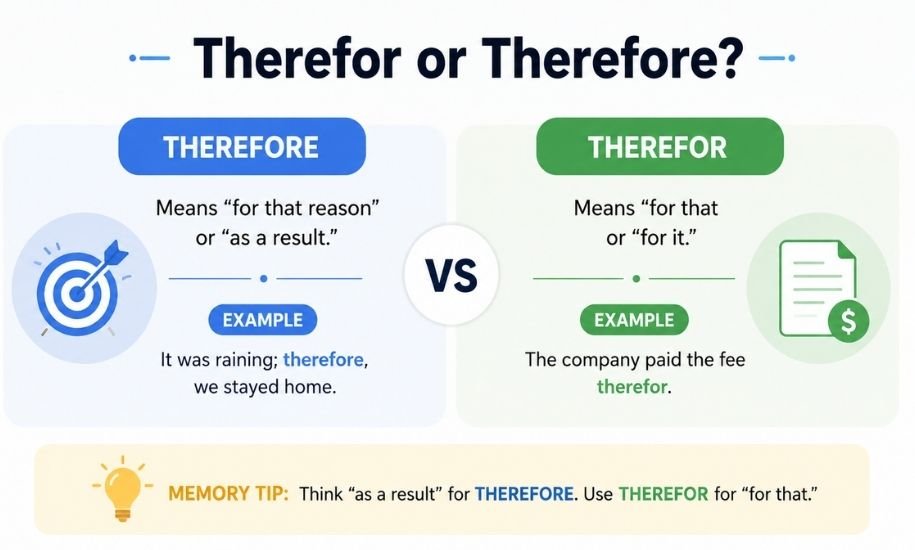
“Therefor” and “therefore” look almost identical, so it is easy to type one when you mean the other. However, they are not simply two spellings of the same word. Therefore is the familiar word used to mean “for that reason” or “as a result,” while therefor is a separate, much rarer word meaning “for that” or “for it.” Knowing what you want the sentence to mean is the easiest way to choose the correct form.
Therefore is correct when you mean “for that reason,” “as a result,” or “consequently.” Therefor is also a real word, but it has a different meaning: “for that” or “for it,” and it is mainly found in formal or legal writing. In ordinary English, therefore is almost always the form you need.
Therefor vs. Therefore: What’s the Difference?
The key difference is meaning, not spelling style.
| Word | Meaning | Typical use | Example |
|---|---|---|---|
| Therefore | For that reason; as a result | General and formal English | It was raining; therefore, we stayed home. |
| Therefor | For that; for it; in return for that | Rare, formal, or legal writing | The company received payment therefor. |
Therefore connects a reason with a conclusion or result.
The road was closed; therefore, we took another route.
Therefor refers back to something already mentioned and essentially means “for that” or “for it.”
The contract specifies the services and the payment therefor.
In everyday writing, you will use therefore far more often.
What Does “Therefore” Mean?
Therefore is an adverb meaning “for that reason,” “because of that,” or “as a result.” It introduces or emphasizes a conclusion that follows from something previously stated.
For example:
- The store was closed; therefore, we went somewhere else.
- She had prepared carefully; therefore, the presentation went smoothly.
- The evidence was incomplete, and therefore the decision was postponed.
- He missed the train and therefore arrived late.
A simple way to test the word is to replace it with “as a result.”
The weather was dangerous; therefore, the flight was canceled.
Becomes:
The weather was dangerous; as a result, the flight was canceled.
If “as a result” fits, therefore is almost certainly the word you need.
What Does “Therefor” Mean?
Therefor is a legitimate English word, but it is uncommon. It means “for that,” “for it,” or “in return for that.”
It is most likely to appear in legal, contractual, or highly formal language.
Examples include:
- The buyer agreed to pay the stated fee and any taxes therefor.
- The services and compensation therefor are described in the agreement.
- The company accepted the goods and issued payment therefor.
Although these sentences are grammatically valid, they sound formal. In ordinary English, a writer would usually choose a clearer phrase such as “for it,” “for that,” “for those services,” or “for the goods.”
For example:
The company issued payment therefor.
More naturally:
The company issued payment for it.
This is why therefor can look like a spelling error even when it is technically being used correctly.
When Should You Use Each One?
The easiest approach is to focus on the meaning.
Use “therefore” for a result
Use therefore when one statement leads logically to another.
The deadline had passed; therefore, the application was rejected.
Here, the rejection is a result of the missed deadline.
Use “therefor” for “for that” or “for it”
Use therefor only when it can naturally stand for “for that” or “for it,” particularly in formal language.
The agreement provides for the delivery of the equipment and payment therefor.
This means payment for the equipment.
If you mean “as a result,” do not use therefor.
The equipment was unavailable; therefore, delivery was delayed. ✓
The equipment was unavailable; therefor, delivery was delayed. ✗
Examples: Correct and Incorrect Usage
Seeing the words side by side makes the distinction easier.
When you mean “as a result”
Correct:
The restaurant was full; therefore, we found another place to eat.
Incorrect:
The restaurant was full; therefor, we found another place to eat.
The second sentence needs therefore because it expresses a consequence.
When you mean “for it”
Correct:
The customer received the product and later made payment therefor.
Here, therefor means “for it.”
When “there for” should be two words
Do not confuse therefor with there for.
I was there for the entire meeting.
Here, there refers to a place or situation, while for introduces the purpose or duration. The two words should remain separate.
Comma Before or After “Therefore”
There is no single rule saying that therefore must always have a comma before or after it. Punctuation depends on where the word appears and how the sentence is constructed.
At the beginning of a sentence
A comma commonly follows therefore:
Therefore, we decided to postpone the meeting.
Therefore, the proposal needs further review.
Between independent clauses
When therefore connects two complete clauses, a semicolon before it is often the clearest construction:
The roads were flooded; therefore, the event was canceled.
The semicolon separates the two independent clauses, while the comma follows therefore.
In the middle of a sentence
When therefore functions as an interrupting word, commas can set it off:
The results, therefore, were not surprising.
However, punctuation should follow the sentence’s structure rather than an assumption that the word always requires commas.
Therefore or Thus?
Therefore and thus can sometimes express the same idea, particularly when they introduce a conclusion.
Compare:
The evidence was insufficient; therefore, the case was dismissed.
The evidence was insufficient; thus, the case was dismissed.
Both sentences express a result.
However, thus has another meaning that therefore does not: “in this way” or “in this manner.”
For example:
Hold the handle thus.
Here, thus means “in this way,” so therefore would not work.
A useful distinction is:
- Therefore = for that reason
- Thus = in this way, or consequently
Therefore or Thereby?
These words can also be confused because their spellings are similar, but they serve different purposes.
Therefore introduces a reasoned result:
The machine was damaged; therefore, production stopped.
Thereby means “by that means” or describes an action that produces a particular result:
The company reduced waste, thereby lowering its operating costs.
Think of the difference this way:
Therefore → conclusion or consequence
Thereby → means by which something happens
They may appear in sentences about results, but they do not perform the same grammatical job.
“A or B, Not A, Therefore B”: How “Therefore” Works in Logic
The word therefore is also commonly used to signal a conclusion in logical reasoning.
For example:
All birds have certain biological characteristics.
A robin is a bird.
Therefore, a robin has those characteristics.
In a simpler symbolic structure:
A is true.
A implies B.
Therefore, B follows.
The important point is that therefore signals the conclusion; it does not independently prove it. The preceding premises need to provide sufficient support for the conclusion.
This is why you will often see therefore in mathematics, formal arguments, academic writing, and explanations.
Why Are “Therefor” and “Therefore” Confused?
The confusion is largely caused by their nearly identical spelling. The extra e in therefore is easy to omit, especially because therefor is itself a genuine English word.
There is also a meaningful reason the words look so similar: both belong to a family of words formed around there and another element.
But their functions are different:
there + fore → therefore → for that reason
there + for → therefor → for that
Because therefor exists, a spell checker or reader cannot always assume that it is simply a typo. The surrounding sentence determines whether the word makes sense.
An Easy Way to Remember the Difference
Use this simple memory rule:
Therefore = therefore a result follows.
If you could replace the word with “as a result”, choose therefore.
She was exhausted; therefore, she went to bed.
If you could replace it with “for it” or “for that,” therefor may be appropriate.
The company paid the fee therefor.
= The company paid the fee for it.
For everyday writing, remembering “therefore = as a result” will solve most situations.
Common Mistakes to Avoid
1. Treating “therefor” as a shortened spelling
It was snowing; therefor, school was closed. ✗
Use therefore because the word introduces a consequence.
2. Assuming “therefor” is never a real word
It is a real word. The issue is that its meaning is different and its use is relatively uncommon.
3. Confusing “therefor” with “there for”
She was there for the ceremony. ✓
This is not the same construction as therefor.
4. Using “therefore” when you mean “by that means”
He changed the process, thereby improving efficiency. ✓
Thereby is appropriate when the improvement happened by means of the change.
5. Automatically adding a comma before “therefore”
Punctuation depends on the sentence structure. For example:
It was late; therefore, we left.
The semicolon separates the independent clauses; the comma follows therefore.
Frequently Asked Questions
Is “therefor” a real word?
Yes. Therefor is a legitimate English adverb meaning “for that,” “for it,” or “in return for that.” It is uncommon in everyday conversation and is especially associated with formal or legal writing.
Is it therefor or therefore when expressing a conclusion?
Use therefore. If you mean “for that reason,” “as a result,” or “consequently,” therefore is the correct choice.
The evidence was weak; therefore, the claim was rejected.
Is there a comma before or after “therefore”?
It depends on its position. At the beginning of a sentence, a comma commonly follows it: “Therefore, we left.” Between independent clauses, a semicolon can come before it and a comma after it: “It was late; therefore, we left.”
Can “therefore” and “thus” mean the same thing?
Sometimes. Both can introduce a consequence or conclusion. However, thus can also mean “in this way,” which is a meaning therefore does not have.
What is the difference between “therefore” and “thereby”?
Therefore means “for that reason” and normally introduces a conclusion or consequence. Thereby means “by that means” and explains how an action produces a particular result.
Is “therefor” acceptable in formal writing?
Yes, when its meaning is correct. It can be appropriate in legal or highly formal writing where it means “for that” or “for it.” However, do not use it merely as a formal-looking alternative to therefore.
Final Verdict: Therefor or Therefore?
For most writing, therefore is the word you want when you mean “for that reason” or “as a result.” Therefor is a separate, valid word meaning “for that” or “for it,” but it is relatively rare and often appears in formal or legal language. When in doubt, test the sentence with “as a result”: if that meaning works, choose therefore. That simple rule will help you use the right word with confidence, which is exactly the kind of distinction Grammarify is designed to make clear.
You may also Read : Gist or Jist: The Correct Spelling Explained
One Comment