The words useing and using may look almost identical, but only one is spelled correctly in standard English. The confusion comes from the verb use, which ends in the letter e. When adding -ing, it may seem natural to keep every letter of the original word.
However, English has a spelling rule that explains why the extra e disappears. Understanding this rule will help you spell using correctly and avoid similar mistakes with words such as making, writing, and taking.
Quick Answer
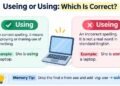
Using is the correct spelling. Useing is incorrect. The word using is the -ing form of the verb use, meaning to employ something for a particular purpose. In English, verbs ending in a silent e usually drop that letter before adding -ing. Therefore, use becomes using, not useing.
Useing or Using: Which Is Correct?
The correct spelling is using. It is used when someone is employing a tool, following a method, working with information, or making use of something.
Useing is a spelling mistake and has no separate meaning in standard English. It is not an alternative British or American spelling.
Here is a quick comparison:
| Feature | Using | Useing |
|---|---|---|
| Correct spelling | Yes | No |
| Meaning | Employing something | No independent meaning |
| Word form | Present participle or gerund | Misspelling |
| Example | She is using a computer. | She is useing a computer. |
For example:
- Correct: I am using a new notebook for my English lessons.
- Incorrect: I am useing a new notebook for my English lessons.
The meaning of the sentence is understandable in both cases, but only the first version follows standard spelling rules.
What Does Using Mean?
The word using comes from the verb use, which generally means to employ, apply, or make use of something for a particular purpose.
Its exact meaning depends on the context.
Consider these examples:
- Using a tool: The carpenter is using a hammer to repair the chair.
- Using a method: Our teacher is using a different approach to explain the lesson.
- Using a resource: The family is using less electricity this month.
- Using information: She is using the research findings to prepare her report.
In each sentence, using describes putting something to work or making use of it.
Is Using a Verb or a Noun?
Using can function as a present participle or a gerund.
As a present participle, it can appear in a continuous verb tense:
The students are using the library computers.
Here, are using is the present continuous form of the verb use.
As a gerund, it functions as a noun within the sentence:
Using a dictionary can improve your vocabulary.
The phrase using a dictionary acts as the subject of the sentence.
Although the grammatical functions differ, the spelling remains the same.
Why Is Useing Incorrect?
The mistake usually occurs because writers add -ing to the complete spelling of use without removing its final e.
However, the general spelling rule for verbs ending in a silent e is:
Remove the final e before adding -ing.
The formation is straightforward:
use
us + ing
using
Remove the final e, then add -ing.
This pattern applies to several everyday verbs.
| Base verb | Correct -ing form |
|---|---|
| Use | Using |
| Make | Making |
| Write | Writing |
| Take | Taking |
| Drive | Driving |
| Dance | Dancing |
| Hope | Hoping |
Notice that the final e disappears in each example.
However, this rule has exceptions. Words such as see and agree retain their final e when forming seeing and agreeing. The word dye becomes dyeing to distinguish it from dying, the -ing form of die.
The rule is therefore a useful general pattern rather than a rule without exceptions.
Examples of Using in a Sentence
Reading complete sentences is one of the easiest ways to understand how using works in everyday English.
Here are ten natural examples:
- She is using her phone to check the weather.
- I enjoy using colorful pens when taking notes.
- The chef is using fresh vegetables to prepare dinner.
- They are using public transportation to reach the office.
- He solved the problem by using a simple formula.
- We are using less water during the summer.
- Using clear language makes your writing easier to understand.
- The children are using their imagination to create a story.
- Are you using the correct instructions for this project?
- The researcher is using several sources to verify the information.
All these examples use the correct spelling.
Correct and Incorrect Sentence Comparisons
| Incorrect | Correct |
|---|---|
| I am useing my laptop. | I am using my laptop. |
| She is useing a calculator. | She is using a calculator. |
| We are useing the same book. | We are using the same book. |
| He enjoys useing new tools. | He enjoys using new tools. |
The extra e is the only spelling problem in these examples.
Synonyms for Using
Several words can replace using, but the best choice depends on what the sentence means.
| Synonym | Example |
|---|---|
| Employing | The company is employing a new strategy. |
| Utilizing | The team is utilizing available resources. |
| Applying | She is applying her knowledge to the problem. |
| Operating | He is operating the machine carefully. |
| Handling | The worker is handling the equipment safely. |
| Making use of | They are making use of the free materials. |
Using is usually the simplest and most natural option in everyday English.
For example, “She is using a new teaching method” is clear and direct. “She is employing a new teaching method” is also correct and may sound slightly more formal.
The two expressions communicate a similar idea, but they are not always interchangeable. Operating, for instance, works well with machinery but would sound unnatural in a sentence about using an opportunity.
How to Remember the Correct Spelling
A practical way to remember the spelling is to connect using with other familiar verbs.
Think of these three examples:
- Make becomes making.
- Take becomes taking.
- Use becomes using.
All three follow the same basic pattern: drop the silent e and add -ing.
Another simple trick is to remember that using contains only one e in its base form, and that e disappears when the suffix is added.
You can also check the structure of the word. If you write useing, you have kept a letter that the regular spelling pattern tells you to remove.
Using vs. Suing: What Is the Difference?
Using and suing are both correctly spelled English words, but they have different meanings.
Using means employing or making use of something.
Suing is the -ing form of sue, meaning to take legal action against a person, business, or organization.
Compare these sentences:
- Using: Maria is using her computer to complete a presentation.
- Suing: Maria is suing the company over a contract dispute.
The second word is spelled S-U-I-N-G, while using is spelled U-S-I-N-G.
Interestingly, both words follow the silent-e spelling rule:
Use → using
Sue → suing
The letters appear in a different order because the base verbs are different.
Common Mistakes to Avoid
Even after learning the correct spelling, a few related mistakes can occur.
1. Keeping the Silent E
Incorrect: She is useing her new camera.
Correct: She is using her new camera.
Remember to remove the final e before adding -ing.
2. Confusing Using With Used
Using and used are different forms of the verb use.
- Using: I am using the software right now.
- Used: I used the software yesterday.
Using can describe an ongoing action, while used is the simple past form and past participle.
3. Forgetting the Helping Verb
When using is part of a continuous verb tense, it normally needs a form of be.
Incorrect: She using the computer.
Correct: She is using the computer.
However, a helping verb is not always required. For example, Using the computer is easy is grammatically correct because using the computer is a gerund phrase functioning as the subject.
4. Adding Unnecessary Complexity
Writers sometimes replace using with utilizing because they believe the longer word is always more professional.
In most ordinary sentences, using is just as correct and often clearer.
Choose the word that best communicates your intended meaning.
Is Using Correct in American and British English?
Yes. Using is the standard spelling in both American and British English.
Unlike pairs such as color/colour or center/centre, there is no regional spelling difference between using and useing.
American, British, Australian, and Canadian English all use using as the standard form.
This means you do not need to change its spelling when writing for readers in different English-speaking countries.
Final Verdict: Useing or Using?
Using is the only correct standard spelling. It is formed by dropping the final e from use before adding -ing. The form useing is a misspelling and should be avoided in both casual and formal writing.
Remember the pattern use → using, just as make → making. Learning small spelling rules like this helps you write more confidently, which is exactly the kind of practical English guidance Grammarifyr aims to provide.
Frequently Asked Questions
Is useing a real English word?
Useing is not an accepted spelling of the verb form using in standard modern English. It is generally a spelling mistake caused by keeping the final e in use when adding -ing.
How do you spell using correctly?
The correct spelling is U-S-I-N-G. Start with the verb use, remove the final e, and add -ing. This produces using, which is appropriate in both American and British English.
What is the past tense of using?
The past tense of the base verb use is used. For example, I used my phone yesterday. The past continuous form is was using or were using, depending on the subject.
Can using be used at the beginning of a sentence?
Yes. A sentence can begin with using, especially when it introduces a gerund phrase or a participial phrase. For example, Using a planner helps me stay organized and Using a flashlight, she found her keys are both correct.
Is it correct to say “I am using”?
Yes. I am using is a grammatically correct present continuous construction. It usually describes an action happening now or around the present time. For example, I am using a different computer this week.
Is using acceptable in formal writing?
Yes. Using is completely acceptable in academic, professional, and formal writing. There is no requirement to replace it with longer alternatives such as utilizing. The simpler word is often preferable when it communicates the meaning clearly.