Gist or Jist: The Correct Spelling Explained
If you have heard someone say “the gist of it,” you may wonder whether the word should be spelled gist or jist. The confusion is understandable because the word begins with the same sound as the letter J. However, in standard English, there is only one spelling you should use for this meaning. Gist is the correct spelling, while jist is a common misspelling.
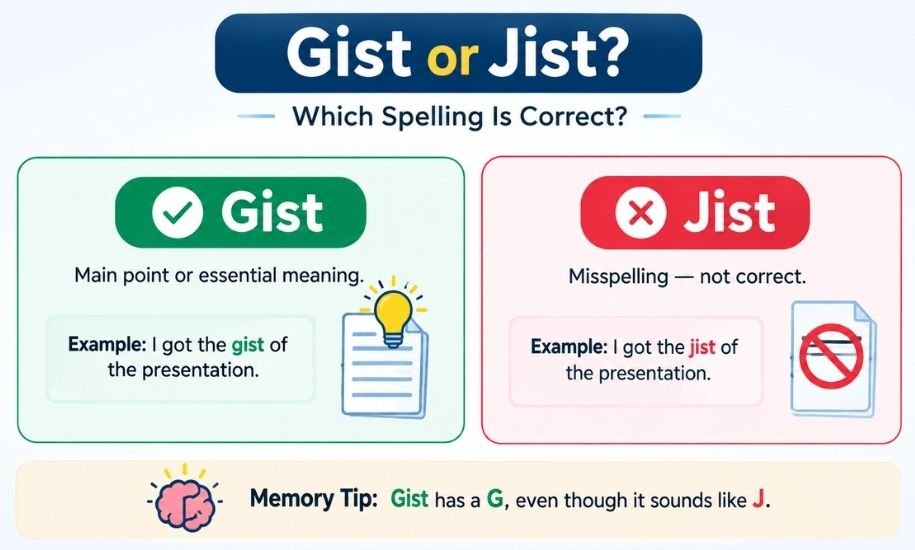
Gist is the correct spelling. It means the main point, central idea, or essential meaning of something. Jist is a misspelling, even though it sounds exactly like “gist” when pronounced.
Gist or Jist: Which Is Correct?
| Feature | Gist | Jist |
|---|---|---|
| Standard spelling? | Yes | No |
| Meaning | Main point or essence | — |
| Part of speech | Noun | — |
| Pronunciation | Sounds like “jist” | Same sound |
| Formal writing | Correct | Avoid |
| Example | I got the gist. | I got the jist. ❌ |
The key point is simple: write “gist,” not “jist.”
For example:
I didn’t understand every detail, but I got the gist of the presentation.
What Does “Gist” Mean?
Gist is a noun meaning the main point, essential meaning, or most important part of something.
When you understand the gist of a conversation, article, speech, or story, you understand what it is mainly about without necessarily knowing every detail.
For example:
- I didn’t read the whole report, but I understand the gist.
- Can you tell me the gist of the meeting?
- She explained the gist of the story in a few sentences.
- I didn’t catch every word, but I got the gist.
A useful way to think about the word is:
gist = the main idea or big picture
It does not usually mean a complete summary containing every detail.
Why Is “Jist” So Easy to Misspell?
The spelling mistake comes largely from pronunciation.
The g in gist is a soft g, producing the same initial sound heard in words such as giant and gym. As a result, gist sounds like “jist.”
Someone who has learned the word primarily by hearing it may naturally assume it begins with j.
This is why you may see or hear:
“I finally understood the jist.”
But the standard written form is:
“I finally understood the gist.”
The pronunciation does not change the spelling.
Is “Jist” a Real Word?
In standard modern English, jist is not the accepted spelling of the noun meaning “main point” or “essence.” It is generally treated as a misspelling of gist.
So if you are writing an essay, email, article, report, school assignment, or other formal text, use gist.
Correct:
What is the gist of the article?
Incorrect:
What is the jist of the article?
You should not create a different definition for jist simply because it appears in informal writing. For the meaning discussed here, gist is the standard form.
“Get the Gist” or “Get the Jist”?
The correct expression is “get the gist.”
To get the gist means to understand the general meaning or main point of something.
Examples:
I didn’t understand all the technical details, but I got the gist.
Did you get the gist of what the speaker was explaining?
Give me a quick summary so I can get the gist.
After reading the first few pages, I had the gist of the argument.
So if you are unsure whether to write “get the gist or jist,” choose get the gist.
How Do You Spell “Gist”?
The spelling is:
G-I-S-T
It is gist, not jist.
One reason this can be difficult is that English does not always allow pronunciation alone to predict spelling. The letter g can have a hard sound, as in go, or a soft sound, as in gist.
Compare:
- gift — hard g
- give — hard g
- giant — soft g
- gym — soft g
- gist — soft g
Knowing that gist uses a soft g can help you recognize the correct spelling.
Common Uses of “Gist”
The word most often appears in a few familiar patterns.
“The gist”
This refers to the main point or essential meaning.
I understand the gist, but I need more information about the details.
“The gist of”
This construction identifies what the main point concerns.
What’s the gist of the conversation?
She explained the gist of the proposal.
I understood the gist of what he was saying.
“Get the gist”
This means to understand the general meaning.
You don’t have to memorize everything to get the gist.
“Give someone the gist”
This means to tell someone the essential information without going through every detail.
I missed the meeting, so could you give me the gist?
These expressions are much more natural than trying to substitute jist for gist.
Gist in a Sentence: Correct Examples
Here are some natural examples showing how the word works:
- I read the report and got the gist of the recommendations.
- Can you give me the gist of the conversation?
- She didn’t remember the exact wording, but she remembered the gist.
- The gist of his argument was that the plan needed more time.
- I didn’t understand every technical term, but I got the gist.
- He gave me the gist of what happened while I was away.
Notice that gist refers to the central information rather than every individual detail.
Common Mistakes to Avoid
1. Writing “jist”
❌ The jist of the story was easy to understand.
✅ The gist of the story was easy to understand.
2. Writing “get the jist”
❌ I didn’t get the jist of the explanation.
✅ I didn’t get the gist of the explanation.
3. Assuming the spelling follows the sound
Because gist sounds like “jist,” spelling it with J may feel logical. But pronunciation is not always a reliable guide to English spelling.
4. Thinking “jist” is the British spelling
It isn’t a British-versus-American spelling difference. Gist is the standard spelling in both American and British English.
An Easy Way to Remember the Spelling
Remember this simple rule:
Gist has a G, even though it sounds like J.
You can also connect it with giant and gym. All three begin with a soft g sound:
gist → giant → gym
If you remember that gist starts with G-I, the spelling becomes easier to recall.
What Are Some Synonyms for “Gist”?
Depending on the context, you can replace gist with words such as:
- main point
- main idea
- essence
- core
- substance
- crux
- central idea
- basic meaning
For example:
I understood the gist of the proposal.
could become:
I understood the main point of the proposal.
The exact synonym depends on the sentence, but all convey the idea of focusing on what matters most rather than every detail.
Frequently Asked Questions
Is it gist or jist?
Gist is correct. It is the standard spelling for a noun meaning the main point, essence, or essential meaning of something. Jist is a common misspelling caused by the pronunciation of the word.
Is it “get the gist” or “get the jist”?
The correct phrase is “get the gist.” It means to understand the general meaning or main point of something. For example: “I didn’t read the entire report, but I got the gist.”
Why does “gist” sound like “jist”?
The g in gist is pronounced with a soft /dʒ/ sound, the same basic sound represented by j in words such as just. That makes the spelling less obvious when you have only heard the word spoken.
How do you spell gist or jist?
The correct spelling is gist: G-I-S-T. The form jist should not be used when you mean “the main point” or “essential meaning.”
Is “gist” a noun or a verb?
Gist is primarily a noun in standard modern usage. It refers to the central point, essence, or most important information of something. Common expressions include “the gist,” “the gist of,” and “get the gist.”
Can I use “jist” in formal writing?
No. When you mean the main point or essence, use gist in formal and standard English writing. Although jist may appear as an informal spelling or typographical error, it is not the standard form.
Final Verdict: Gist or Jist?
Gist is the correct spelling. Jist is a misspelling, even though the two forms sound alike when spoken. Use gist when referring to the main point, essence, or essential meaning of something, as in “I got the gist of the conversation.” For more straightforward explanations of confusing English words, Grammarify helps you know the difference and use the right words.
You may also Read : Axe or Ax: American and British English Explained
One Comment