Rhythm or Rythm: Meaning, Spelling and Examples
If you have ever hesitated over the spelling of this word, you are not alone. Rhythm has an unusual letter pattern, and its pronunciation does not make every letter obvious. That can make rythm look tempting, especially when writing quickly. But there is a simple answer: rhythm is the correct spelling in standard English, while rythm is a misspelling. The word refers to a repeated pattern of sounds, beats, movements, or changes and is commonly used in music, poetry, speech, dance, and everyday descriptions of routines.
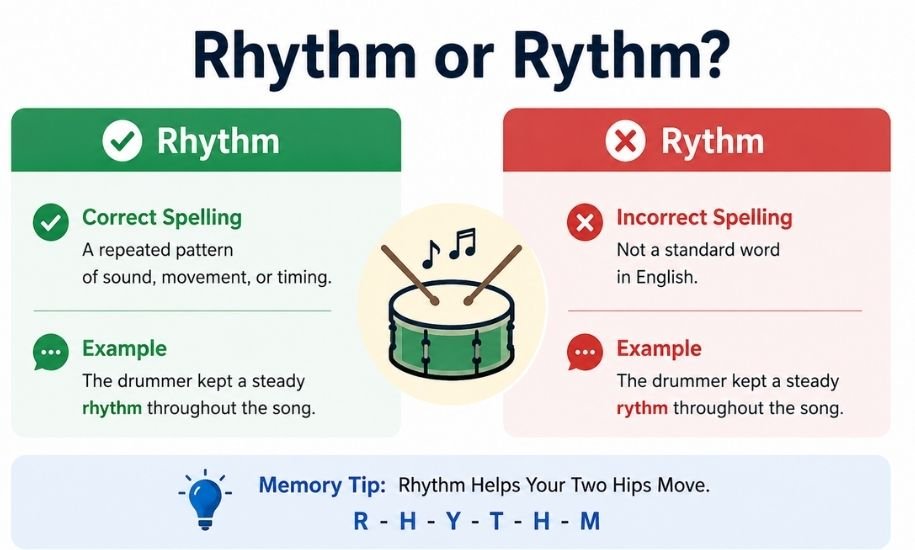
Rhythm is the correct spelling. Rythm is a common misspelling and should not be used in standard English. Rhythm means a repeated or regular pattern, especially one involving sound, movement, or timing.
Rhythm or Rythm: Which Is Correct?
The correct form is rhythm:
- ✅ rhythm
- ❌ rythm
There is no standard American-versus-British spelling difference here. Both American and British English use rhythm.
| Feature | Rhythm | Rythm |
|---|---|---|
| Correct spelling? | Yes | No |
| Standard English word? | Yes | No |
| Part of speech | Noun | — |
| Basic meaning | A repeated pattern or flow | — |
| US English | Rhythm | Not standard |
| UK English | Rhythm | Not standard |
So, if you are wondering “is it rhythm or rythm?”, use rhythm.
What Does “Rhythm” Mean?
Rhythm is a noun describing a regular or repeated pattern. It is especially common when talking about beats, sounds, movements, or timing.
In music, rhythm is the pattern created by beats and the timing of notes and rests.
The drummer kept a steady rhythm throughout the song.
The word can also describe movement:
The dancers moved in rhythm with the music.
In poetry and speech, rhythm refers to the pattern and flow produced by stressed and unstressed syllables or by the timing of words.
The poem has a gentle, flowing rhythm.
And rhythm does not have to involve music. We can talk about the rhythm of daily life, the rhythm of the seasons, or biological rhythms.
It took me several weeks to settle into the rhythm of my new routine.
Why Is “Rythm” So Easy to Misspell?
The spelling is difficult because rhythm contains an unusual sequence of consonants and only one conventional vowel letter: y.
The pronunciation also does not clearly reveal the spelling. In ordinary speech, the word sounds roughly like RITH-um, so it is easy to leave out one of the h letters.
That can produce the tempting spelling rythm.
The problem is that English spelling is not always a direct representation of pronunciation. In this case, you need to remember the complete form:
R-H-Y-T-H-M
The second h, immediately after the t, is easy to overlook.
How to Spell Rhythm Correctly
Break the word into its letters:
R + H + Y + T + H + M
A useful mnemonic is:
Rhythm Helps Your Two Hips Move
The first letters give you:
R H Y T H M
This is one of the easiest ways to remember the spelling because it preserves the two important H letters.
You can also remember that the word has “rh” at the beginning and “th” in the middle:
RH + Y + TH + M
Examples of “Rhythm” in a Sentence
Here are some natural examples showing how the word is used:
- The guitarist played a strong rhythm behind the singer.
- She has a natural sense of rhythm.
- The children clapped along to the rhythm of the song.
- The poem’s rhythm makes it pleasant to read aloud.
- After a few days, I settled into a comfortable work rhythm.
- The waves created a soothing rhythm as they reached the shore.
- The drummer changed the rhythm halfway through the performance.
Notice that rhythm can refer to sound, movement, writing, or a recurring pattern in ordinary life.
Correct vs. Incorrect Usage
Because rythm is a misspelling rather than a separate word, the distinction is straightforward.
Correct:
The band has a lively rhythm.
Incorrect:
The band has a lively rythm.
Correct:
I enjoy the rhythm of this song.
Incorrect:
I enjoy the rythm of this song.
The same rule applies whether you are writing casually, academically, professionally, or creatively.
Rhythm vs. Rhyme: Don’t Mix Them Up
Rhythm and rhyme are both associated with poetry and music, but they mean different things.
Rhythm concerns a pattern of beats, timing, or stressed and unstressed sounds.
Rhyme generally concerns words whose sounds correspond, particularly at the ends of lines.
For example:
The poem has a strong rhythm and an interesting rhyme scheme.
A poem can have rhythm without rhyming, and it can contain rhyming words without having the particular rhythm you expect.
Rhythm and Rhythmic: Related Forms
The adjective derived from rhythm is rhythmic.
- rhythm — noun
- rhythmic — adjective
- rhythmically — adverb
Examples:
The song has a powerful rhythm.
The music has a rhythmic quality.
The dancers moved rhythmically across the stage.
Learning these related forms can also help reinforce the spelling of the original noun.
Common Misspellings to Avoid
Rythm is not the only incorrect spelling you may encounter. Other attempts can include:
- rythem
- rhythem
- rhytm
- rhythym
- rythum
- rythym
These forms generally arise because writers try to spell the word according to how it sounds or because they forget the placement of the h.
The safest approach is to memorize the six-letter spelling:
RHYTHM
Is “Rythm” a Real Word?
In standard modern English, rythm is not the correct spelling of the noun. You should not treat it as an alternative form of rhythm.
If you see rythm in a sentence such as “The song has a great rythm,” it should be corrected to:
The song has a great rhythm.
This is particularly important in formal writing, where an unconventional spelling can distract the reader from your meaning.
Does British English Spell It Differently?
No. Unlike color/colour or center/centre, this is not a regional spelling difference.
Both varieties use:
- American English: rhythm
- British English: rhythm
So you do not need to choose between rhythm and rythm based on your audience. Rhythm is the standard form in both.
Frequently Asked Questions
Is it “rhythm or rythm”?
It is rhythm. The spelling rythm is incorrect in standard English. The correct word contains an h after the initial r and another h after the t: R-H-Y-T-H-M.
What is the meaning of rhythm?
Rhythm means a regular or repeated pattern, particularly one involving sound, movement, or timing. It can describe musical beats, poetic patterns, dance movements, speech, routines, or recurring natural and biological processes.
Is “rythm” an accepted spelling?
No. Rythm is a misspelling of rhythm, not a standard alternative spelling. It should be changed to rhythm in formal and standard English writing.
Why is rhythm spelled with two h’s?
The spelling comes from the word’s historical development rather than from a simple phonetic spelling system. Modern pronunciation does not make both h letters obvious, which is one reason the word is frequently misspelled.
How can I remember the spelling of rhythm?
Try the mnemonic “Rhythm Helps Your Two Hips Move.” Its initial letters spell R-H-Y-T-H-M, giving you the exact spelling of the word.
Is “rhythm” the same as “rhyme”?
No. Rhythm refers to a pattern of beats, timing, or sound, while rhyme refers to matching or corresponding sounds in words. They are related concepts but are not interchangeable.
Final Verdict: Rhythm or Rythm?
Rhythm is the only standard spelling. Rythm is a misspelling, not a British or American variant. When you need the word for a musical beat, poetic pattern, movement, or recurring flow, remember the six letters: R-H-Y-T-H-M. For more straightforward explanations of tricky English spellings and word choices, Grammarify helps you know the difference and use the right words.
You may also Read : Especially or Specially: Simple Grammar Guide