Especially or Specially: Simple Grammar Guide
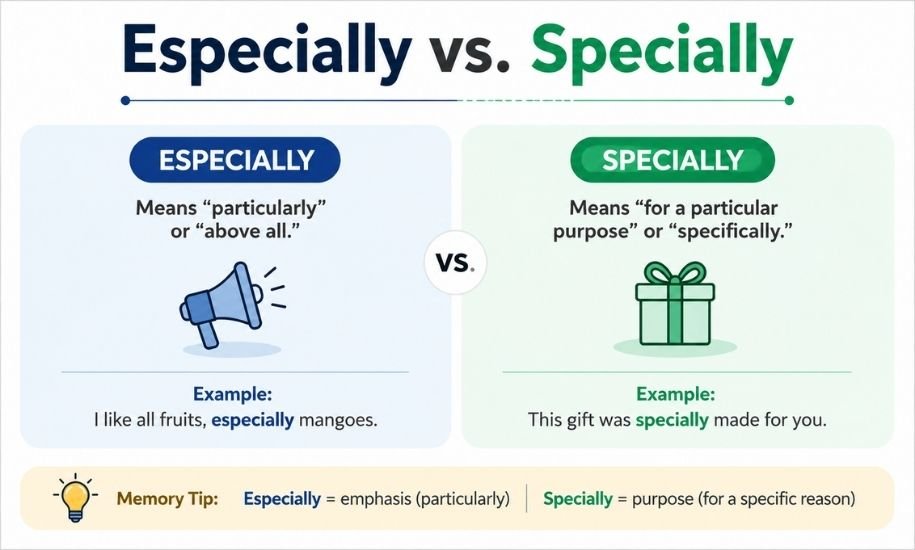
“Especially” and “specially” look and sound almost identical, so it is easy to mix them up. Both are correct English words, but they usually do different jobs in a sentence. The simplest distinction is that especially is generally used for emphasis, while specially usually refers to a particular purpose or specific intention. There is some overlap, however, particularly in phrases such as “especially for you,” so the difference is a little more nuanced than simply labeling one word correct and the other wrong.
Especially usually means “particularly,” “above all,” or “very.” Specially usually means “for a particular purpose” or “specifically.” For example, “I enjoy fruit, especially mangoes,” but “This equipment was specially designed for children.” Both words are correct; the intended meaning determines which one fits.
Especially or Specially: Which One Should You Use?
The easiest way to choose is to ask what you mean.
Use especially when you are emphasizing something:
I enjoy outdoor activities, especially hiking.
Here, hiking is being singled out from a larger group.
Use specially when you mean something was done, made, designed, or arranged for a particular purpose:
The shoes were specially designed for hiking.
Here, the important idea is the purpose for which the shoes were designed.
| Feature | Especially | Specially |
|---|---|---|
| Main meaning | Particularly; above all; very | For a particular purpose; specifically |
| Typical use | Emphasis or selection | Purpose or special preparation |
| Example | I especially like this song. | The song was specially recorded for the event. |
| Common pattern | especially important, especially useful | specially designed, specially made |
Cambridge, Oxford, and Merriam-Webster all recognize both words and document this general distinction, while also acknowledging areas where their meanings overlap.
What Does “Especially” Mean?
Especially is an adverb. It commonly means particularly, above all, or to a notably greater degree.
You use it when you want to emphasize one thing among several or strengthen the meaning of an adjective or adverb.
Examples
- I like all kinds of fruit, especially oranges.
- The final chapter was especially interesting.
- This rule is especially important for new drivers.
- She was especially pleased with the result.
In the first sentence, oranges are singled out from all kinds of fruit. In the other examples, especially adds emphasis: the chapter was particularly interesting, and the rule is particularly important.
A useful substitution test is to replace especially with particularly. If the sentence still makes sense naturally, especially is probably the right choice.
The weather is especially cold today.
The weather is particularly cold today.
Both work because the meaning is essentially the same.
What Does “Specially” Mean?
Specially is also an adverb. Its clearest and most useful meaning is for a particular purpose or specifically.
It frequently appears with words such as designed, made, built, prepared, developed, and trained.
Examples
- The software was specially designed for teachers.
- These gloves were specially made for cold-weather work.
- The employees were specially trained to operate the equipment.
- She prepared a meal specially for her guests.
In each example, something was done with a particular purpose, person, or situation in mind.
Oxford specifically highlights combinations such as “specially designed” and “specially made,” while Cambridge explains specially in terms of a particular purpose.
The Key Difference: Emphasis vs. Purpose
A simple rule can solve most cases:
Especially = emphasis
Specially = purpose
Compare these two sentences:
This jacket is especially warm.
The speaker is emphasizing how warm the jacket is.
This jacket was specially designed for winter hiking.
The sentence explains why or for whom the jacket was designed.
Another pair makes the difference even clearer:
I enjoy many sports, especially tennis.
Tennis is being highlighted.
The tennis shoes were specially designed for hard courts.
The shoes were created for a specific purpose.
This is a practical guideline rather than an absolute grammatical law because dictionaries recognize some overlap between the two adverbs.
When “Especially” Is the Better Choice
Choose especially when you mean:
- particularly
- above all
- very
- to a greater degree
- more than the others in a group
Examples
I love autumn, especially October.
The instructions are especially useful for beginners.
She was especially happy to see her old friend.
The road is especially busy in the morning.
Notice that none of these sentences describes something being created for a specific purpose. Instead, the speaker is emphasizing something.
Especially important
The phrase especially important is standard because especially means “particularly” here.
It is especially important to check the address.
Not usually:
It is specially important to check the address.
The second version can sound unnatural when the intended meaning is simply “particularly important.”
When “Specially” Is the Better Choice
Choose specially when something has been done for a particular person, purpose, situation, or occasion.
Examples
The room was specially prepared for the ceremony.
This device was specially developed for medical researchers.
They ordered a cake specially made for the celebration.
The guide was specially trained to work with children.
Here, replacing specially with specifically for this purpose preserves the intended meaning.
That is one of the most useful ways to distinguish the words in everyday writing.
“Especially for You” or “Specially for You”?
This is where the distinction becomes less absolute.
Both especially for you and specially for you can be found in standard English, depending on the intended nuance.
I bought this gift especially for you.
This can emphasize that you, rather than someone else, were the intended recipient.
I had this necklace specially made for you.
This strongly suggests that the necklace was made specifically for that person.
Cambridge notes that especially itself can sometimes have the meaning “for a particular purpose,” which is why phrases involving the two words cannot always be separated by a rigid rule.
When the sentence involves something being made, designed, prepared, or arranged for a particular purpose, however, specially often makes the intended meaning clearer.
Common Expressions to Remember
Certain combinations naturally favor one word.
Usually “especially”
- especially important
- especially useful
- especially difficult
- especially interesting
- especially good
- especially helpful
- especially when
- especially if
- especially for emphasis
Examples:
This advice is especially useful for beginners.
The route becomes difficult, especially when it rains.
Usually “specially”
- specially designed
- specially made
- specially prepared
- specially trained
- specially developed
- specially built
Examples:
The program was specially designed for young learners.
The equipment was specially built for the project.
These are not unbreakable rules, but they are reliable patterns for careful modern writing.
Is It Especially or Specially in a Sentence?
If you are unsure which form belongs in a sentence, try these two questions.
1. Could you say “particularly”?
If yes, use especially.
This book is especially helpful.
→ This book is particularly helpful.
I like the blue one, especially.
The exact construction may vary, but the underlying idea is emphasis.
2. Could you say “specifically for”?
If yes, specially is often the better choice.
The chair was specially designed for children.
→ The chair was specifically designed for children.
This quick test will handle most everyday cases.
Common Mistakes
Mistake 1: Using “specially” for ordinary emphasis
❌ This is specially important.
✅ This is especially important.
If you mean “particularly important,” especially is the natural choice.
Mistake 2: Using “especially” when purpose is the main idea
The equipment was specially designed for laboratory use.
Here, specially makes the specific purpose clear.
Mistake 3: Assuming specially is incorrect
Specially is not a misspelling of especially. It is a legitimate English word with its own meanings and uses.
Mistake 4: Treating the distinction as absolute
The words overlap in some contexts. In particular, expressions involving for you, for a particular occasion, or similar constructions may allow either word depending on the intended emphasis.
Special or Especial: Are Both Correct?
The related adjectives special and especial are also both real words, but they are not equally common.
Special is the normal choice in modern everyday English.
This is a special occasion.
She has special requirements.
We bought some special equipment.
Especial is a formal adjective that essentially means special, often with a sense of particular importance.
The issue is of especial importance.
Oxford and Cambridge both identify especial as a formal word. Oxford also indicates that it is used before a noun, which makes it less flexible than ordinary special.
So, if you are wondering is it special or especial, choose special in most ordinary writing. Use especial when a deliberately formal or literary tone is appropriate.
An Easy Way to Remember the Difference
Think of the extra -ly in specially as pointing toward a specific purpose.
- Especially → particularly
- Specially → specifically
Then remember a few common pairs:
especially important
specially designed
especially interesting
specially made
especially difficult
specially prepared
You do not need to memorize every possible phrase. If you remember emphasis = especially and purpose = specially, you can usually work out the correct choice.
Frequently Asked Questions
Is “especially” or “specially” correct?
Both are correct words. Especially normally means “particularly” or “very,” while specially generally means “for a particular purpose” or “specifically.” The correct choice depends on what you want the sentence to mean.
Is it “especially designed” or “specially designed”?
Specially designed is generally the clearer choice when you mean something was designed for a particular purpose or group.
The software was specially designed for children.
Is “especially important” correct?
Yes. Especially important is the standard expression when you mean “particularly important.”
It is especially important to read the instructions carefully.
Can “especially” and “specially” ever be interchangeable?
Yes. There are contexts where both can work, particularly when the meaning involves something being done for a particular person or occasion. Dictionaries recognize this overlap, so it is better to think of the usual distinction as a practical guideline rather than an absolute prohibition.
Is “especial” a real word?
Yes. Especial is a real English adjective meaning essentially “special,” but it is formal and much less common in everyday writing. In most situations, special is the natural choice.
Final Verdict: Especially or Specially?
Both especially and specially are correct, but they usually emphasize different ideas. Choose especially when you mean particularly, above all, or very. Choose specially when something is done for a particular purpose or specifically for someone or something. And when choosing between special and especial, special is the normal modern choice, while especial is more formal. For more clear explanations of confusing English words, Grammarify helps you know the difference and use the right words.
You may also Read : Combatting or Combating: Meaning and Usage Explained
One Comment