Flavorful or Palatable: What’s the Difference?
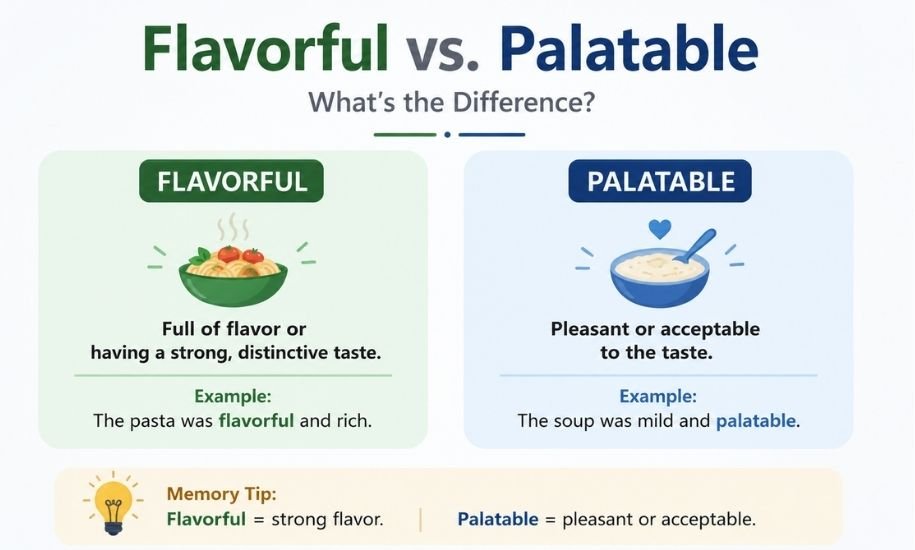
When describing food, flavorful and palatable can seem interchangeable because both can suggest that something tastes good. However, they emphasize different qualities. Flavorful focuses on the strength, richness, or distinctiveness of a food’s flavor, while palatable means pleasant or acceptable to the taste. Knowing the difference helps you choose the more precise word, especially when describing food in writing. There is also a separate spelling question worth clearing up: when talking about taste preferences, the correct word is palate, not pallet.
Both flavorful and palatable are correct words, but they are not exact synonyms. Flavorful describes food with a noticeable, rich, or distinctive taste, while palatable means agreeable or acceptable to the taste. When referring to someone’s sense or preference for taste, use palate, not “pallet.”
Flavorful vs. Palatable at a Glance
| Feature | Flavorful | Palatable |
|---|---|---|
| Part of speech | Adjective | Adjective |
| Basic meaning | Full of flavor or having a strong, distinctive taste | Pleasant or acceptable to the taste |
| Main emphasis | Quality or intensity of flavor | Acceptability or pleasantness |
| Can describe bland food? | Usually not | Yes, if it is still acceptable to eat |
| Example | “The stew was flavorful.” | “The stew was palatable.” |
The easiest distinction is this: flavorful tells you more about the food’s flavor, while palatable tells you whether the food is agreeable to the person eating it.
What Does “Flavorful” Mean?
Flavorful is an adjective meaning full of flavor or having a strong, distinctive, or appealing taste. It is commonly used for food and drinks.
For example:
- The roasted vegetables were surprisingly flavorful.
- Fresh herbs made the rice more flavorful.
- The sauce was rich and flavorful.
- This soup is simple but incredibly flavorful.
The word often carries a positive sense. If you describe a meal as flavorful, you generally mean that it has plenty of noticeable taste rather than being bland.
It can refer to many kinds of flavor, including savory, spicy, sweet, tangy, smoky, or aromatic combinations.
What Does “Palatable” Mean?
Palatable is also an adjective. It means pleasant, agreeable, or acceptable to the taste.
For example:
- The medicine was made more palatable with a sweet coating.
- The meal was basic but still palatable.
- Adding a little salt made the dish more palatable.
- The sauce was mild enough to be palatable to everyone at the table.
Notice that palatable does not necessarily suggest that something is delicious or strongly flavored. A food can be palatable simply because it is acceptable to eat.
The word can also be used figuratively to mean acceptable or easier to accept:
The company offered a more palatable explanation for the decision.
Here, palatable has nothing to do with literal food. It means that an idea or explanation is easier to accept.
The Key Difference
The difference becomes clearer when you consider two hypothetical dishes.
A heavily seasoned curry might be very flavorful because it has layers of spices and a strong taste. However, someone who dislikes spicy food might not find it palatable.
Conversely, a plain bowl of oatmeal might be palatable because it tastes pleasant enough, even though it is not particularly flavorful.
So:
Flavorful = characterized by noticeable or rich flavor.
Palatable = agreeable or acceptable to the person tasting it.
They can absolutely describe the same food:
The flavorful pasta was also highly palatable.
But they do not communicate precisely the same idea.
Can Something Be Flavorful but Not Palatable?
Yes.
Imagine a dish containing an unusually strong combination of bitter herbs. It may have a very distinctive and powerful flavor, making it flavorful in the descriptive sense, but that flavor may not be pleasant to everyone.
Likewise, a food can be:
- Flavorful and palatable: rich in taste and enjoyable.
- Flavorful but not palatable: strongly flavored but unpleasant to a particular eater.
- Palatable but not especially flavorful: acceptable and pleasant but mild.
- Neither: unpleasant and lacking appealing flavor.
This is why replacing one word with the other can sometimes change the meaning.
Flavorful or Palatable Crossword Clue: What Is the Answer?
If you encountered “flavorful or palatable” as a crossword clue, the answer may depend on the number of spaces and the crossing letters.
One particularly useful possibility is sapid.
Sapid means having flavor or taste and can also mean agreeable or pleasant to the taste. Because it connects both ideas, it can fit a clue such as “flavorful or palatable.”
Another common possibility is tasty, depending on the puzzle’s letter count and crossing answers.
For crossword solving, do not assume there is one universal answer. The grid determines which synonym fits.
Common possibilities
| Answer | Letters | Why it can fit |
|---|---|---|
| Sapid | 5 | Having flavor; agreeable to the taste |
| Tasty | 5 | Pleasant or flavorful to eat |
| Zesty | 5 | Full of lively, distinctive flavor |
If the clue specifically asks for a word that can mean both flavorful and palatable, sapid is especially relevant.
Flavor Pallet or Palate: Which Is Correct?
When discussing taste, the correct spelling is palate.
Correct: “The dish will appeal to a sophisticated palate.”
Incorrect: “The dish will appeal to a sophisticated pallet.”
A palate can mean the roof of the mouth. It can also refer to a person’s sense of taste or preference for particular foods and flavors.
A pallet, on the other hand, is a flat platform used to support and transport goods.
For example:
The warehouse worker loaded the boxes onto a pallet.
There is also a third word that often causes confusion: palette.
A palette is traditionally a board on which an artist mixes colors. It can also refer figuratively to a range or selection of colors, styles, or flavors.
So the three words are:
- Palate → taste or the roof of the mouth
- Pallet → platform for transporting or storing goods
- Palette → range of colors, or figuratively a range of flavors or choices
Easy way to remember “palate”
Think of palate and taste together:
Palate = taste
A pallet belongs in a warehouse, while a palette belongs in an artist’s studio—or can describe a range of flavors metaphorically.
Flavorful, Tasty, and Palatable
These three adjectives overlap, but their emphasis differs.
Flavorful suggests a noticeable, rich, or distinctive flavor.
The grilled vegetables were flavorful.
Tasty is a more general and informal way to say that food tastes good.
The grilled vegetables were tasty.
Palatable focuses on whether the food is agreeable or acceptable to the person eating it.
The grilled vegetables were palatable, even without much seasoning.
In everyday conversation, tasty is often the simplest choice when you merely want to say that something tastes good. Flavorful is more descriptive, while palatable is more concerned with acceptability.
Common Mistakes to Avoid
1. Treating “flavorful” and “palatable” as perfect synonyms
They overlap, but flavorful emphasizes flavor, whereas palatable emphasizes acceptability.
2. Writing “flavor pallet”
If you mean someone’s taste preferences, write flavor palate.
Correct: “The chef understands the customer’s palate.”
3. Confusing “pallet” with “palette”
A pallet is a platform for goods. A palette is associated with colors and can also be used figuratively for a range of flavors.
4. Assuming “palatable” always means delicious
It does not. Something described as palatable may simply be acceptable or pleasant enough to eat.
5. Assuming the crossword answer is always “sapid”
Sapid is a strong candidate for “flavorful or palatable,” but crossword answers depend on the puzzle’s required length and crossing letters. Tasty or another synonym may fit a particular grid better.
Examples in Sentences
Here are some examples that show the distinction naturally:
Flavorful:
The chef created a flavorful sauce using garlic, herbs, and roasted peppers.
Palatable:
The cook reduced the amount of salt to make the meal more palatable.
Both:
The flavorful and palatable dish quickly became the restaurant’s specialty.
Palate:
The spicy noodles may be too hot for a sensitive palate.
Pallet:
The supplier delivered the ingredients on a wooden pallet.
Palette:
The chef used a broad palette of citrus, herbs, and spices.
Frequently Asked Questions
Is flavorful or palatable the better word?
Neither is universally better. Choose flavorful when you want to emphasize the food’s noticeable or rich taste. Choose palatable when you want to say that something is pleasant or acceptable to the taste.
What is a five-letter synonym for flavorful or palatable?
Sapid and tasty are both five-letter possibilities. Sapid is particularly relevant because it can describe something having flavor as well as something agreeable to the taste. Crossword crossings should determine the final answer.
Is “flavor palate” correct?
Yes. Palate is the correct word when referring to a person’s sense or preference for taste. “Flavor pallet” is incorrect when pallet is being used to mean taste preference.
What is the difference between palate, pallet, and palette?
Palate relates to taste or the roof of the mouth. Pallet is a platform for transporting goods. Palette refers to an artist’s color board or, figuratively, a range of colors, flavors, or choices.
Does palatable mean tasty?
It can, but the meanings are not identical. Palatable means pleasant or acceptable to the taste, whereas tasty more directly means that something tastes good.
Can food be flavorful without being palatable?
Yes. Food may have a strong, complex, or distinctive flavor while still being unpleasant to a particular person. Flavorful describes the nature of the flavor; palatable describes how acceptable that flavor is to the eater.
Final Verdict: Flavorful or Palatable?
Both words are correct, but they serve slightly different purposes. Flavorful describes food with noticeable, rich, or distinctive flavor, while palatable means pleasant or acceptable to the taste. If you’re solving a crossword clue, sapid and tasty are useful possibilities, depending on the grid. And when you’re talking about taste preferences, remember: palate, not pallet. For more clear explanations of confusing English words, Grammarify helps you know the difference and use the right words.
You may also Read : Learnt or Learned: British vs American English