Combatting or Combating: Meaning and Usage Explained
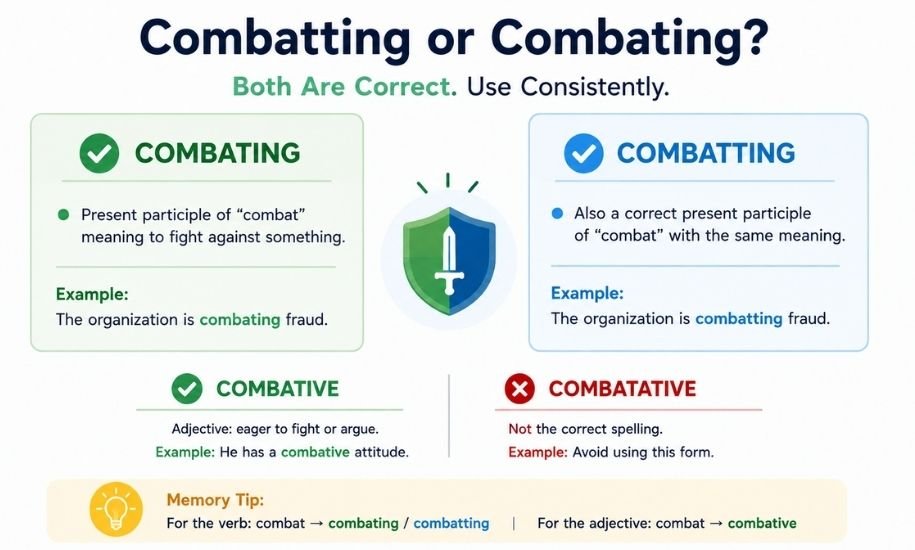
If you have ever hesitated over whether to write combatting or combating, you are not alone. The two forms look almost identical, and the extra t can make the spelling feel uncertain. The good news is that this is not a simple case of one being right and the other being wrong. Both “combating” and “combatting” are accepted forms of the verb “combat.” The same is true of “combated” and “combatted.” However, there is a separate spelling issue to watch for: the correct adjective is “combative,” not “combatative.”
Combating and combatting are both correct forms of “combat.” Combating is a good default choice, especially for general American English, but combatting is also an established form. For the adjective, use combative; “combatative” is not the standard spelling.
Combating or Combatting: What’s the Difference?
The main difference is simply spelling. Both forms are the present participle, or -ing form, of the verb combat.
| Form | Correct? | Grammatical role | Example |
|---|---|---|---|
| combating | Yes | Present participle/gerund | They are combating fraud. |
| combatting | Yes | Present participle/gerund | They are combatting fraud. |
| combated | Yes | Past tense/past participle | They combated the problem. |
| combatted | Yes | Past tense/past participle | They combatted the problem. |
| combative | Yes | Adjective | He has a combative attitude. |
| combatative | No in standard English | — | Avoid this spelling. |
Major dictionaries recognize the alternative forms. Merriam-Webster lists “combated or combatted” and “combating or combatting,” while Oxford also lists both sets of verb forms.
So, if you write “The organization is combating crime,” your spelling is correct. If you write “The organization is combatting crime,” that is also correct.
What Does “Combat” Mean?
Combat can be a noun or a verb.
As a verb, it means to fight against something, oppose it, or work to reduce or eliminate something harmful. Cambridge gives examples involving crime, terrorism, inflation, and disease.
For example:
- The government is combating corruption.
- Scientists are combating antibiotic resistance.
- New measures aim to combat inflation.
- The organization is combating online fraud.
As a noun, combat means fighting or a fight, especially in a military context.
The soldiers had extensive experience in combat.
The verb is also commonly used in a figurative sense. You do not have to be physically fighting someone to combat something. A government can combat poverty, a doctor can combat disease, and a company can combat fraud.
Why Do Both “Combating” and “Combatting” Exist?
The spelling becomes confusing because English has several patterns for forming words with -ing.
Some verbs double their final consonant:
- run → running
- sit → sitting
- stop → stopping
That can make combatting look especially natural. At the same time, combating is an established spelling and is extremely common in standard English.
The important point is that you do not need to invent a rule that declares one form universally correct and the other incorrect. Authoritative dictionaries recognize both. Merriam-Webster explicitly gives combating or combatting, and Oxford lists both forms in its verb-form table.
If you want a simple default for general writing, choose combating.
When Should You Use “Combating”?
Combating is an excellent choice when you want the most straightforward form for general-purpose writing.
Examples include:
The charity is combating homelessness through local programs.
Researchers are combating the spread of misinformation.
New regulations are aimed at combating financial fraud.
The campaign focuses on combating discrimination.
It works naturally in academic, professional, journalistic, and everyday writing.
Merriam-Webster’s current entry uses combating in examples such as “combating poverty” and “combating the rebels,” while its thesaurus identifies combatting as a variant.
When Is “Combatting” Correct?
Combatting is also a legitimate form. You may encounter it in formal writing, published material, and British or international English.
For example:
The agency is combatting illegal trade.
The organization has developed new methods for combatting fraud.
Researchers are working on ways of combatting the disease.
There is no difference in meaning between these sentences and their versions using combating.
Cambridge has a dedicated entry for combatting and identifies it as the present participle of combat.
Therefore, it is inaccurate to say that combatting is simply a misspelling.
A practical rule
If you are unsure which one to choose, use:
combat → combating
This is a simple, consistent choice for general writing. If you are following a particular publication’s style guide and it prefers combatting, use that spelling consistently instead.
Combated or Combatted?
The same variation occurs in the past tense and past participle.
Both are correct:
- combated
- combatted
For example:
The organization combated the spread of false information.
The organization combatted the spread of false information.
Both sentences are grammatical and have the same meaning.
Oxford lists both combated and combatted as past-tense and past-participle forms of combat. Merriam-Webster does the same.
If you prefer the simpler spelling for general use, combated is a sensible default.
Verb-form reference
| Verb form | Standard forms |
|---|---|
| Base form | combat |
| Third-person singular | combats |
| Past tense | combated / combatted |
| Past participle | combated / combatted |
| -ing form | combating / combatting |
This is one reason the spelling can feel inconsistent: English permits two established forms for both the past and -ing forms.
Combative or Combatative: Which Is Correct?
This question has a much simpler answer:
Combative is correct.
Combatative is not the standard spelling and should be avoided in formal or edited English.
Combative is an adjective meaning eager or ready to fight or argue. Cambridge defines it as “eager to fight or argue,” while Oxford describes someone who is ready and willing to fight or argue.
Examples:
- The lawyer took a combative approach.
- His tone became increasingly combative.
- She was in a combative mood during the debate.
- The candidate gave a combative response to the criticism.
So the correct forms are:
combative attitude ✅
combative personality ✅
combative response ✅
Not:
combatative attitude ❌
combatative personality ❌
combatative response ❌
Why Is “Combatative” a Mistake?
The incorrect form is easy to create because the word combat is visible inside combative.
A writer may mentally build the adjective as:
combat + ative = combatative
But the established adjective is simply:
combative
The spelling does not require the extra at.
A useful way to remember it is to connect the adjective directly to combat:
combat → combative
not:
combat → combatative
Merriam-Webster and Oxford both list combative as the adjective; neither treats combatative as the standard form.
Combating vs. Combative
These words are related, but they do different grammatical jobs.
Combating is a verb form:
The researchers are combating the problem.
Combative is an adjective:
The researchers became combative during the dispute.
The first describes an action. The second describes a quality, attitude, or behavior.
Compare:
- combating crime = fighting against crime
- a combative person = someone inclined to fight or argue
- combating misinformation = working against misinformation
- a combative debate = a debate characterized by confrontation
This distinction is especially useful when deciding whether an -ing form or an -ive adjective belongs in a sentence.
Common Mistakes to Avoid
1. Treating “combatting” as always wrong
Combatting is an accepted form. It is not simply a spelling error. Major dictionaries list it as a variant of combating.
2. Assuming “combated” is the only past-tense form
Both combated and combatted are recognized.
3. Writing “combatative”
Use combative instead.
4. Confusing the verb and adjective
The group is combating corruption. ✅
The group is combative corruption. ❌
But:
The group’s response was combative. ✅
5. Switching spellings without a reason
Although both forms are accepted, consistency is useful. If you choose combating, continue using that form throughout a document unless you are quoting or following a source’s spelling.
Examples in Sentences
Here are some natural examples showing the forms in context:
Combating
The new program is aimed at combating cybercrime.
Combatting
The agency introduced new procedures for combatting financial fraud.
Combated
The community has combated flooding by improving its drainage system.
Combatted
The organization combatted discrimination through education and advocacy.
Combative
His combative tone made the negotiations more difficult.
Notice that the first four forms are verb forms, while combative is an adjective.
Easy Way to Remember the Difference
For the verb forms, remember:
combat → combating / combatting
combat → combated / combatted
Both versions are acceptable.
For the adjective, remember:
combat → combative
There is no extra “at” in combative.
If you want the simplest everyday choice, use combating and combated. If you encounter combatting or combatted, you do not need to assume they are errors.
Frequently Asked Questions
Is “combatting” a correct word?
Yes. Combatting is a correct form of combat. Cambridge identifies it as the present participle, and Merriam-Webster lists it as a variant of combating.
Is “combating” or “combatting” preferred?
Combating is a straightforward default, particularly for general American English. However, combatting is also accepted, so it is not grammatically wrong. The best choice is often the form that matches your preferred variety or style guide.
Are “combated” and “combatted” both correct?
Yes. Both combated and combatted are established past-tense and past-participle forms of combat.
Is it “combative” or “combatative”?
The correct spelling is combative. Combatative is not the standard spelling. Use combative to describe someone or something that is eager or ready to fight or argue.
What is the past tense of “combat”?
You can use combated or combatted. Both forms are recognized by major dictionaries.
Can I use “combatting” in formal writing?
Yes. Combatting is an accepted English form and can appear in formal writing. If you want a simple default, especially for American English, combating is a good choice.
Final Verdict: Combatting or Combating?
Both “combating” and “combatting” are correct. If you need one default spelling, combating is a clear choice for general and American English writing. Likewise, both combated and combatted are accepted past forms.
The spelling that needs correction is combatative. When you mean “ready or willing to fight or argue,” use combative. For more straightforward answers to confusing-word questions like this, Grammarify helps you know the difference and use the right words.
You may also Read : Flavorful or Palatable: What’s the Difference?