Smoky or Smokey: Correct Spelling Explained
If you have ever written about a smoky room, smoky food, or a smoky color, you may have wondered whether the word should end in -y or -ey. The confusion is understandable because both smoky and smokey appear in English dictionaries. However, they are not equally common in every context. Smoky is the standard spelling to use when describing something filled with smoke, resembling smoke, or having a smoke-like flavor or appearance. Smokey is also an accepted variant of the adjective, and it has some additional uses as a proper name or noun in American English.
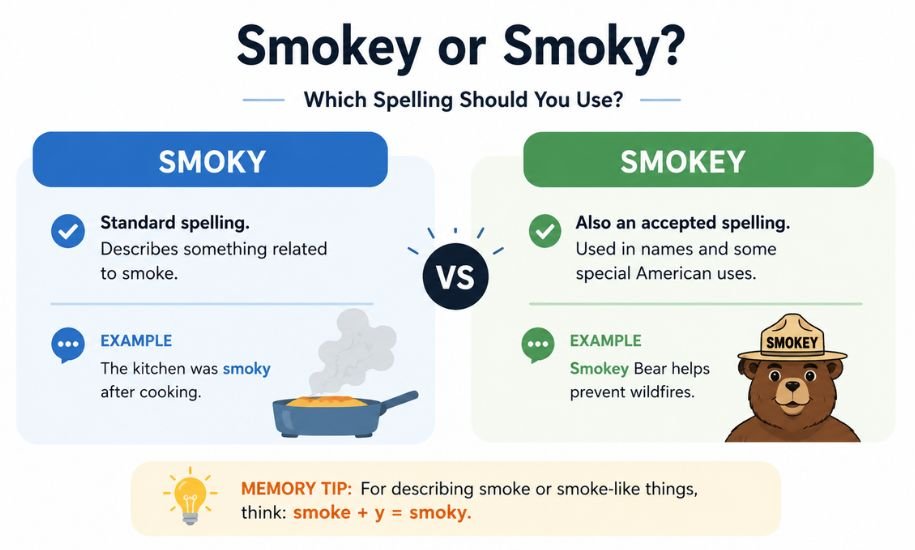
Smoky is the preferred standard spelling when the adjective describes something related to smoke. Smokey is also a recognized variant, so it is not simply a misspelling. In most ordinary writing, however, choose smoky; reserve “Smokey” for established names and contexts where that spelling is specifically intended.
Smokey or Smoky: Which One Should You Use?
For normal English writing, smoky is the best choice.
The word is an adjective formed from smoke and describes something that contains, produces, resembles, or tastes like smoke. For example, you can have a smoky room, a smoky fire, a smoky flavor, or a smoky gray color.
Major dictionaries recognize smokey as an alternative spelling of the adjective. Cambridge lists “also smokey,” while Collins similarly identifies smokey as another spelling of smoky.
So the distinction is not simply correct vs. incorrect. It is better understood as standard/preferred spelling vs. an accepted variant, with some separate uses of Smokey that have nothing to do with the ordinary adjective.
Quick comparison
| Feature | Smoky | Smokey |
|---|---|---|
| Standard adjective | Yes | Yes, as a variant |
| Meaning related to smoke | Yes | Yes |
| Describes a smoke-filled place | Yes | Yes |
| Describes smoke-like appearance | Yes | Yes |
| Describes smoky food flavor | Yes | Yes |
| Best default choice | Yes | Usually no |
| Can be part of a proper name | Sometimes | Yes |
| Special American noun use | No | Yes |
What Does “Smoky” Mean?
Smoky is an adjective with several closely related meanings.
First, it can describe a place or environment containing a lot of smoke:
- The kitchen became smoky after the pan overheated.
- We had to leave the smoky room.
- A smoky fire filled the cabin with haze.
Second, it can describe something that resembles smoke in appearance or color:
- She chose a smoky gray paint for the bedroom.
- The mountain disappeared into a smoky haze.
- The glass had a smoky tint.
Third, it can describe food or drink with a flavor associated with smoke or smoked ingredients:
- The grilled vegetables had a delicious smoky flavor.
- This cheese has a pleasantly smoky taste.
- The sauce adds a smoky note to the dish.
Cambridge gives smoky meanings connected with being filled with smoke and with having smoke-like flavor or appearance. Collins likewise includes meanings involving smoke, smoke-like color, and smoked-food flavor.
What Does “Smokey” Mean?
When smokey is used as an adjective, it generally has the same meaning as smoky.
For example:
- a smokey room
- a smokey flavor
- a smokey blue color
This means that calling smokey a simple spelling error would be misleading. Collins explicitly describes the adjective as an alternative spelling of smoky.
Nevertheless, smoky is the safer choice when you are writing standard English and have no particular reason to use the alternative form.
This is especially useful in formal writing, educational material, professional content, and general-purpose articles. Using the standard form keeps your spelling consistent with the main dictionary form.
Why Are the Two Spellings Confused?
The confusion comes from the fact that both forms exist and have essentially the same adjective meaning.
The base word is smoke, and adding -y naturally produces smoky. English also contains many words where an extra letter appears in a related spelling, so it is easy to assume that smokey must be a separate standard form.
In reality, dictionaries recognize both spellings for the adjective. Cambridge lists smokey as another form of smoky, and Collins does the same.
There is another source of confusion: Smokey can appear as a name or as a distinct noun in American English. That capitalized form should not be treated as merely an alternative way to spell the adjective.
When Should You Use “Smoky”?
Use smoky whenever you are describing something as being filled with smoke, resembling smoke, or having a smoky taste or appearance.
Here are some natural examples:
- The fireplace made the living room smoky.
- We noticed a smoky smell coming from the kitchen.
- The restaurant is famous for its smoky barbecue.
- She wore smoky gray eyeshadow.
- The whisky had a rich, smoky character.
- A smoky haze covered the valley.
Notice that the word works naturally before nouns such as room, fire, flavor, haze, and color.
The standard comparative and superlative forms are smokier and smokiest.
For example:
- Today’s air is smokier than yesterday’s.
- That was the smokiest room in the building.
Related forms include smokily and smokiness.
When Is “Smokey” Appropriate?
There are two main situations in which smokey deserves attention.
1. As an adjective variant
You may encounter smokey where the writer uses it as an alternative spelling of smoky. The meaning is normally unchanged.
For instance:
The dish has a smokey flavor.
This is understandable and dictionary-recognized, but smoky flavor is the better default for standard writing.
2. In names and special American usage
Smokey is also associated with proper names, most famously Smokey Bear, the American wildfire-prevention mascot.
Collins also records smokey as an American slang noun referring to a state highway patrol officer or a state police car. This is a completely different use from the ordinary adjective.
Therefore, capitalization and context matter. If you are talking about the appearance, smell, or flavor of smoke, you almost certainly want the adjective smoky.
If you are referring to a specific name such as Smokey Bear, keep the established spelling Smokey.
Smoky vs. Smoked: Don’t Mix Them Up
Another useful distinction is between smoky and smoked.
Smoky describes something that has the qualities or characteristics of smoke. Smoked often describes food that has actually been preserved or flavored using smoke.
Compare:
- The restaurant has a smoky atmosphere.
- We ordered smoked salmon.
- The sauce has a smoky flavor.
- They served smoked cheese.
The distinction can be subtle with food because something that is smoked may naturally have a smoky flavor. However, the two adjectives are not interchangeable in every sentence.
Cambridge defines smoked in food contexts as food preserved using smoke from burning wood, while smoky can describe a flavor that resembles smoke.
Correct and Incorrect Usage Examples
Because smokey is an accepted variant, it is more accurate to describe these examples as preferred versus less-preferred rather than universally correct versus incorrect.
Preferred
The room was smoky after the fire.
Variant
The room was smokey after the fire.
The first version is the standard choice.
Preferred
The chicken has a delicious smoky flavor.
Variant
The chicken has a delicious smokey flavor.
Again, smoky is the better default.
Proper name
Smokey Bear is associated with wildfire prevention.
Here, changing Smokey to Smoky would be incorrect because the established name uses Smokey.
Common Mistakes to Avoid
Mistake 1: Assuming “smokey” is always wrong
It is not. Dictionaries recognize smokey as an alternative adjective spelling.
Mistake 2: Using “Smokey” for every meaning
Capitalization and context matter. Smokey can be part of a proper name or have a special American noun meaning, while smoky is normally the adjective you need.
Mistake 3: Confusing “smoky” with “smoked”
A smoky flavor describes a flavor resembling smoke, while smoked food has been treated or preserved with smoke.
Mistake 4: Changing the comparative incorrectly
The normal forms are:
- smoky
- smokier
- smokiest
For example:
This sauce is smokier than the one we tried yesterday.
An Easy Way to Remember the Preferred Spelling
If you are using the word as an ordinary adjective, think:
smoke + y = smoky
That gives you the standard form immediately.
You can remember Smokey separately as the spelling used in established names and certain special contexts.
So if you are writing “___ flavor,” “___ room,” “___ haze,” or “___ gray,” choose smoky unless there is a specific reason to use the variant.
Frequently Asked Questions
Is “smoky” the correct spelling?
Yes. Smoky is the standard spelling and the best choice for most ordinary writing. It describes something filled with smoke, resembling smoke, or having a flavor associated with smoke.
Is “smokey” a misspelling?
Not necessarily. Smokey is recognized by major dictionaries as an alternative spelling of the adjective smoky. However, smoky is the preferred default form in general writing.
Are smoky and smokey pronounced differently?
Normally, no. The adjective forms are pronounced essentially the same. The difference is primarily in spelling rather than meaning or pronunciation.
Should I write “smoky flavor” or “smokey flavor”?
Smoky flavor is the recommended choice. Smokey flavor can be understood and is dictionary-recognized as a variant, but the standard spelling is more suitable for most formal and general writing.
What are the comparative and superlative forms of smoky?
The standard forms are smokier and smokiest. For example: “This sauce is smokier than the original” and “That was the smokiest room in the house.”
Is “Smokey” different from “smoky”?
As an adjective, the two spellings can have the same meaning. However, Smokey is also used in established names and has a separate slang noun use in American English, so context can make the distinction important.
Final Verdict: Smokey or Smoky?
For ordinary English writing, smoky is the spelling to choose. It is the standard form for describing smoke-filled surroundings, smoke-like colors or appearances, and smoke-related flavors. Smokey is not simply wrong—it is a recognized variant and also appears in specific names and special American usage. When you need the ordinary adjective and want the safest standard form, remember smoky. For more clear, practical explanations of confusing English words, Grammarifyr helps you know the difference and use the right words.
You may also Read : Auntie or Aunty: Meaning and Correct Usage