Memento or Momento: The Correct Spelling Explained
Choosing between momento or memento can be surprisingly confusing. The two forms look and sound similar, and the word is often associated with a memorable moment, which makes the spelling “momento” seem perfectly logical. However, standard English has a preferred form that you should use in most writing.
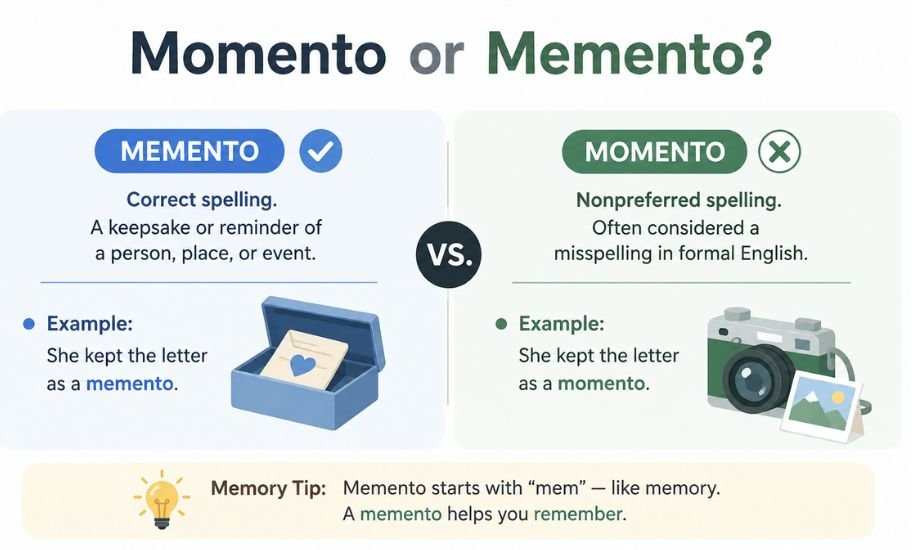
The correct and safest choice is memento when you mean a keepsake, souvenir, or object that reminds you of a person, place, event, or experience. Although momento is recorded as a variant spelling in some dictionaries, it is commonly regarded as a nonpreferred form and may be marked as a misspelling in edited English.
Memento is the preferred spelling in standard English. It means something kept as a reminder of a person, place, event, or experience. Momento is found as a variant spelling, but it is often treated as a misspelling, so memento is the better choice for formal and professional writing.
Memento or Momento: What’s the Difference?
The main distinction is one of standard usage and spelling preference, rather than a major difference in meaning.
| Feature | Memento | Momento |
|---|---|---|
| Standard spelling | Yes | No, generally nonpreferred |
| Meaning | A keepsake or reminder | Usually intended to mean the same thing |
| Part of speech | Noun | Variant noun form |
| Formal writing | Recommended | Best avoided |
| Example | “She kept the letter as a memento.” | “She kept the letter as a momento.” |
If you are writing an essay, article, business document, academic paper, or other carefully edited text, memento is the form to choose.
Importantly, it would be too absolute to say that momento does not exist at all. Some dictionaries record it as a variant. The practical point is that memento is the established and preferred spelling.
What Does “Memento” Mean?
A memento is something that helps you remember a person, place, event, or experience. It is usually a physical object, although the word can be used broadly for something that serves as a reminder.
A memento can be a photograph, souvenir, piece of jewelry, handwritten note, medal, ticket, gift, or another meaningful object.
For example:
- She kept the old photograph as a memento of her childhood.
- He bought a small wooden carving as a memento of his trip.
- The medal became a treasured memento of her achievement.
- They gave their teacher a book as a memento of their final year together.
The word generally carries the idea of remembering something meaningful.
Memento as a Noun
Memento is a countable noun.
You can have:
- a memento
- several mementos
- a treasured memento
- a personal memento
- a special memento
For instance:
The concert ticket became a special memento of that evening.
Here, the ticket is an object preserved because it reminds the person of a particular experience.
Is “Momento” a Real Word?
This is where the comparison becomes slightly more complicated.
Momento is recorded in some dictionaries as a variant of memento, so it is not accurate to claim that the form has never existed in English. However, many English usage resources regard it as a spelling error or nonstandard variant when the intended meaning is a keepsake or reminder.
That means there is an important difference between “found in a dictionary” and “the spelling you should normally use.”
Consider these two sentences:
Preferred:
She saved the postcard as a memento of her vacation.
Nonpreferred:
She saved the postcard as a momento of her vacation.
The second sentence can be understood, but memento is the much safer choice in standard edited English.
So if you are unsure, remember this simple rule:
Use memento.
Why Do People Confuse These Spellings?
The confusion is understandable because memento closely resembles the word moment.
A memento is often associated with a memorable moment. For example, someone might keep a concert ticket because it reminds them of a special moment in their life. That connection can make “momento” look like a logical spelling.
The problem is that the word does not come from moment. Its spelling has a different origin.
Memento comes from Latin and is connected with the idea of remembering. This helps explain why the word begins with mem- rather than mom-.
There is also another source of potential confusion: momento exists in other languages with meanings related to “moment.” English speakers may therefore encounter the spelling outside English and assume it is an equally standard English form.
For English writing, however, memento remains the preferred choice.
How to Use “Memento” Correctly
The word works naturally when talking about an object that has sentimental or commemorative value.
Example 1: A souvenir
I bought a small painting as a memento of my visit to the city.
The painting is being kept to remember the trip.
Example 2: A personal keepsake
The watch was a memento from her grandfather.
The watch has emotional significance because it reminds her of her grandfather.
Example 3: An important event
The photograph became a memento of their wedding day.
The photograph preserves the memory of the event.
Example 4: An achievement
The trophy served as a memento of his first championship.
The trophy reminds him of a significant achievement.
Example 5: A farewell gift
Her colleagues gave her a framed picture as a memento of her time at the company.
The picture represents the period she spent with her colleagues.
Mementos or Mementoes: What Is the Plural?
The standard plural of memento can be written in two ways:
- mementos
- mementoes
Both forms are accepted.
Mementos is the shorter and increasingly convenient plural form, while mementoes is also an established spelling.
Examples:
The travelers brought home several mementos from their journey.
The museum contains many personal mementoes from the artist’s life.
You do not need to change the spelling of the singular word to momento when forming the plural.
If you are using the preferred form, simply use mementos or mementoes according to your preferred style.
Memento Mori: Why the Spelling Matters
You may have encountered the expression memento mori.
This is a Latin phrase traditionally understood as a reminder of human mortality. In this expression, memento carries the sense of “remember.”
The spelling is therefore:
memento mori
Not:
momento mori
This phrase is another useful reminder that the word is connected with the idea of remembering, rather than the English word moment.
Common Mistakes With This Word
1. Writing “momento” in formal English
The most common mistake is replacing the first e with o.
Incorrect or nonpreferred:
She kept the necklace as a momento.
Preferred:
She kept the necklace as a memento.
2. Assuming it comes from “moment”
The meaning can make this assumption tempting, but memento is not simply a modified spelling of moment.
A memento can remind you of a moment, but that does not determine its spelling.
3. Using “mementoes” incorrectly
Some writers assume that the plural must always be mementoes. In fact, mementos is also correct.
We collected several mementos during the trip.
4. Treating “momento” as universally incorrect
This is the opposite mistake. Because memento is preferred, it can be tempting to say that momento is not a word under any circumstances.
A more accurate explanation is that momento is recorded as a variant spelling, but it is generally not the preferred form for standard formal English.
That distinction is useful because dictionary entries do not always divide words into simply “correct” and “incorrect.”
An Easy Way to Remember the Spelling
Here is a simple memory trick:
Memento = Memory
Both memento and memory begin with mem-.
Think:
MEMory → MEMento
A memento is something that helps you remember, so connecting the word with “memory” can make the spelling easier to recall.
You can also remember:
A memento helps you remember a moment, but it is not spelled like moment.
That small distinction can prevent the most common spelling error.
Memento vs. Momento in Formal Writing
When the quality of your writing matters, consistency and standard usage are important.
For school assignments, professional documents, websites, reports, applications, and published articles, choose memento.
For example:
The photograph is a meaningful memento of our journey.
This is clear, conventional, and appropriate in formal English.
Although readers will generally understand momento, using the preferred spelling avoids unnecessary correction and makes the writing look more polished.
Frequently Asked Questions
Is “memento” the correct spelling?
Yes. Memento is the preferred standard English spelling when referring to a keepsake, souvenir, or reminder of a person, place, event, or experience.
Is “momento” a misspelling?
It is commonly treated as a misspelling or nonpreferred variant of memento. Some dictionaries record momento as a variant, so calling it universally invalid would be too strong. In formal English, memento is the safer choice.
What is the plural of memento?
The two accepted plural forms are mementos and mementoes. For example: “She collected several mementos from her travels.”
What does memento mean?
A memento is something kept as a reminder of a person, place, event, or experience. A photograph, souvenir, medal, letter, or gift can all serve as mementos.
Is “memento” a noun or a verb?
Memento is a noun in modern English. It refers to an object or thing that serves as a reminder or keepsake.
How can I remember how to spell memento?
Connect memento with memory. Both begin with mem-, and a memento is something that helps you remember. This makes “memento” easier to distinguish from the nonpreferred “momento.”
Final Verdict: Momento or Memento?
If you are choosing between momento or memento, use memento. It is the preferred spelling in standard English and clearly refers to a keepsake, souvenir, or reminder of something meaningful. Although momento appears as a variant in some dictionaries, it is often treated as nonstandard or a spelling error in formal writing. For more clear and practical explanations of confusing English words, Grammarifyr helps you know the difference and use the right words.
You may also Read : Smoky or Smokey: Correct Spelling Explained
One Comment