Imbedded or Embedded: Meaning and Correct Usage
It is easy to hesitate over imbedded or embedded, especially because both forms appear in dictionaries and published writing. The confusion comes from the fact that imbed exists as a variant of embed, so imbedded is not simply a made-up spelling. However, the two forms are not equally common or equally useful in modern English. If you are writing an article, email, report, academic paper, or webpage and want the safest standard form, there is a clear choice.
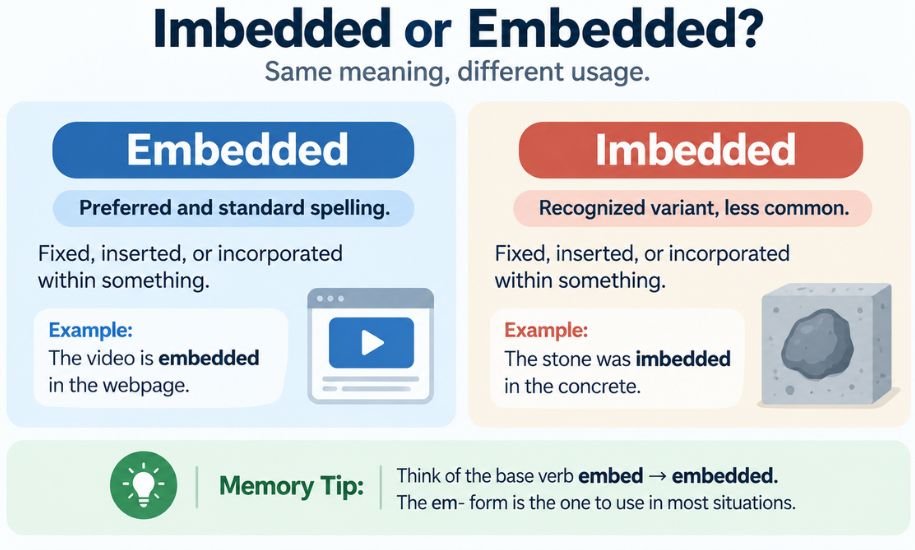
Embedded is the standard and preferred spelling in modern English. Imbedded is a recognized variant, particularly noted in US English, but it is much less common. For most formal, professional, academic, and everyday writing, choose embedded.
Imbedded or Embedded: Which Is Correct?
Embedded is the form you should normally use.
The word is the past tense and past participle of the verb embed, and it can also function as an adjective. It means something has been firmly fixed, inserted, enclosed, or incorporated into something else.
Imbedded is also a legitimate dictionary-recognized form because imbed exists as a variant of embed. It is not accurate to say that imbedded is always an outright spelling error. The practical distinction is that embedded is overwhelmingly the better default for contemporary standard writing.
Quick comparison
| Feature | Embedded | Imbedded |
|---|---|---|
| Is it recognized? | Yes | Yes, as a variant |
| Base verb | embed | imbed |
| Meaning | Fixed, inserted, or incorporated | Essentially the same |
| Modern preference | Preferred | Less common |
| Formal writing | Recommended | Usually avoid |
| US English | Standard | Recognized variant |
| UK English | Standard | Rare/less usual |
What Does “Embedded” Mean?
Embedded means firmly fixed, placed, or incorporated within something.
It can describe something physical:
The small metal piece was embedded in the wooden frame.
It can also describe something abstract that has become firmly established:
The tradition is deeply embedded in the community.
The word is especially common in technology, where content can be placed inside another digital environment.
For example:
The video is embedded in the article.
Here, the video is displayed within the webpage rather than requiring the reader to leave the page to view it.
Common uses of “embedded”
You may encounter phrases such as:
- embedded image
- embedded video
- embedded link
- embedded content
- embedded software
- embedded system
- embedded device
- embedded code
- embedded file
The meaning changes slightly depending on context, but the central idea remains something being placed firmly within another thing.
What Does “Imbedded” Mean?
Imbedded has essentially the same meaning as embedded.
It comes from the less common verb imbed, which dictionaries recognize as a variant of embed. Thus, a sentence such as:
The stone was imbedded in the concrete.
has essentially the same meaning as:
The stone was embedded in the concrete.
The issue is not a major difference in definition. Instead, it is usage and preference.
Modern readers are far more accustomed to seeing embedded. As a result, imbedded can look unusual even though it has dictionary support.
Imbedded or Embedded Meaning and Definition
If you are looking specifically for the meaning or definition, both forms refer to the same basic concept.
Embedded definition: firmly fixed, inserted, enclosed, or incorporated within something else.
Depending on the sentence, embedded can describe:
- A physical object placed inside another material The jewel was embedded in the ring.
- An idea, belief, or characteristic that is deeply established The principle is embedded in the organization’s culture.
- Digital material incorporated into another document or webpage The presentation contains an embedded video.
- A person working closely within a particular group or environment The reporter was embedded with the military unit.
In each case, the word suggests that something has been placed within or as part of something else.
Why Are “Imbedded” and “Embedded” Confused?
The confusion has a genuine linguistic basis: imbed is an established variant of embed.
English contains many words in which prefixes and spelling patterns can make the initial letters seem interchangeable. Because imbed exists, a writer who produces imbedded is not necessarily making a random spelling mistake.
There is also a straightforward visual reason for the uncertainty. The words differ by only one letter:
- embedded
- imbedded
Both forms look plausible, and both have appeared in dictionaries and published material.
Nevertheless, modern standard usage strongly favors embed → embedded.
That makes the decision easy when you are unsure: use embedded.
Is “Imbedded” Correct in US English?
Yes, imbedded is recognized in US English, but that does not make it the preferred spelling.
American dictionaries recognize imbed as a variant of embed. The corresponding past form, imbedded, can therefore be found in American writing.
However, embedded remains the safer and more conventional choice.
For example, in American English, write:
The photograph is embedded in the document.
rather than choosing imbedded simply because you believe it is more American.
There is no need to switch to imbedded when writing for a US audience.
Imbedded or Embedded in UK English
For British English, embedded is the natural modern choice.
British writers may encounter imbedded in older or less common sources, but it is not the spelling you would normally select for contemporary formal writing.
For example:
The sensor is embedded in the device.
This spelling is appropriate for British English as well as American English.
The useful rule is therefore simple: embedded works across both major varieties of English.
Examples of Embedded in Sentences
Here are several natural examples:
- The roots were embedded deep in the soil.
- A tiny microphone is embedded inside the device.
- The photograph is embedded in the report.
- The belief is deeply embedded in the culture.
- The journalist was embedded with the troops.
- An embedded video appears below the introduction.
- The manufacturer embedded the sensor into the dashboard.
Notice that the same spelling works naturally in physical, abstract, technological, and journalistic contexts.
Correct and Incorrect Usage
Because imbedded is a recognized variant, it is better to describe it as less preferred rather than universally incorrect.
Preferred
The image is embedded in the webpage.
The chip is embedded inside the device.
These values are deeply embedded in the organization’s culture.
Less common variant
The image is imbedded in the webpage.
The chip is imbedded inside the device.
These sentences are understandable, and the second spelling has dictionary recognition, but embedded is the better choice for modern general writing.
A common mistake
Some writers assume that imbedded must be the correct form because the word begins with a sound similar to the prefix im-. There is no need to make that adjustment. The standard verb is embed, so its normal past and participle form is embedded.
Embed, Embedded, and Embedding
Understanding the related forms makes the spelling easier to remember.
| Form | Example |
|---|---|
| embed | Please embed the video. |
| embeds | The website embeds the video automatically. |
| embedded | The video is embedded on the page. |
| embedding | Embedding the image is simple. |
The same pattern applies to many contexts.
For example:
We embed the chart in the report.
The chart is embedded in the report.
Embedding the chart makes the report easier to read.
The less common variant follows the same grammatical pattern:
- imbed
- imbeds
- imbedded
- imbedding
But unless you have a particular reason to use the variant, the em- forms are preferable.
Easy Way to Remember the Correct Spelling
A simple memory trick is:
Embed → embedded
Think of the standard verb first. If the base word is embed, the familiar form is embedded.
You can also remember the common technology phrase “embedded video.” This is one of the most frequent modern uses of the word, and seeing it repeatedly reinforces the preferred spelling.
If you are writing and hesitate between the two forms, choose:
embedded
That choice will be understood and accepted in both American and British English.
Common Mistakes to Avoid
1. Treating “imbedded” as completely nonexistent
Although embedded is preferred, imbedded is a recognized variant. Calling it an invented word is unnecessarily absolute.
2. Assuming the two forms have different meanings
They generally do not. The difference is primarily frequency and standard preference, not meaning.
3. Using “imbedded” because you are writing for Americans
US English recognizes the variant, but American readers commonly encounter embedded. There is no reason to replace the standard spelling with imbedded.
4. Switching spellings within the same document
If a source, publication, or style guide requires a particular form, follow it. Otherwise, consistently use embedded.
5. Confusing “embedded” with “embarrassed” or other double-letter patterns
The spelling contains embedded with the sequence -bed- followed by -ded:
embed → embedded
Writing the word carefully rather than relying on how it sounds can prevent unnecessary spelling errors.
Which Form Should You Use?
In almost every ordinary writing situation, use embedded.
Choose it for:
- websites and blogs
- academic writing
- business documents
- emails
- journalism
- technical documentation
- general communication
- American English
- British English
You might encounter imbedded in dictionaries, older publications, or writing that follows a particular house style. Its existence is legitimate, but its relative rarity means that it is usually not the best choice when you simply want the standard modern spelling.
Frequently Asked Questions
Is “imbedded” a real word?
Yes. Imbedded is a recognized variant of embedded, derived from the verb imbed. However, it is much less common than embedded, so the latter is normally recommended in contemporary writing.
Is it imbedded or embedded?
Embedded is the preferred spelling. Imbedded is an accepted variant, but if you are unsure which form to use, choose embedded.
Do “imbedded” and “embedded” mean the same thing?
Yes, essentially. Both describe something that is fixed, inserted, enclosed, or incorporated within something else. The main distinction is that embedded is much more common in modern English.
Is “imbedded” American or British?
Imbedded is recognized particularly as a US variant, while embedded is the standard form used in both American and British English. For either audience, embedded is the safest choice.
Is “embedded” acceptable in American English?
Absolutely. Embedded is standard in American English and is also the form most appropriate for general professional and formal writing.
How can I remember the spelling?
Remember the base verb embed. Its standard past tense and past participle is embedded. The phrase “embedded video” is also a useful everyday reminder of the preferred spelling.
Final Verdict: Imbedded or Embedded?
Embedded is the spelling to use in most situations. Imbedded is a legitimate but less common variant, so it should not automatically be labeled a spelling error. If you want the clearest, most widely accepted choice for modern American or British English, stick with embedded. Grammarifyr helps make these small word choices easier by focusing on the forms that are most useful in real-world English writing.
You may also Read : Hunny or Honey: Meaning, Nickname and Usage
One Comment