Preventive or Preventative Care and Maintenance
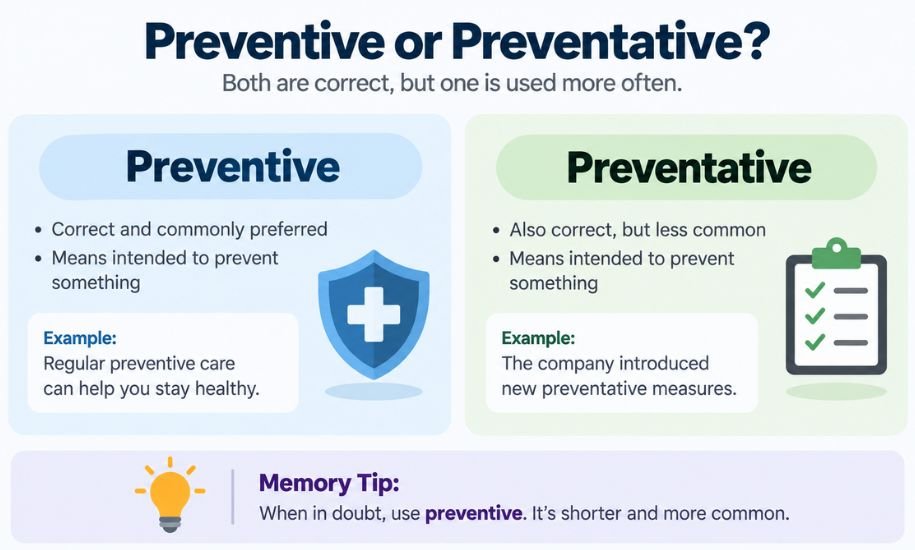
If you have ever hesitated between preventive and preventative, you are not alone. Both forms appear in dictionaries and are used in standard English, and both describe something intended to stop a problem before it happens. The difference is mainly one of preference and usage rather than meaning. In most modern professional and formal writing, preventive is the shorter and more commonly preferred form. Preventative is also correct, but it is generally less common. The same principle applies to phrases such as preventive care and preventive maintenance.
Preventive and preventative are both correct English words with essentially the same meaning. However, preventive is shorter and generally preferred, especially in medical, technical, and professional writing. For example, preventive care and preventive maintenance are the usual choices.
Preventive or Preventative: What’s the Difference?
The two adjectives mean essentially the same thing: intended to prevent something from happening.
The main distinction is usage:
| Feature | Preventive | Preventative |
|---|---|---|
| Correct word? | Yes | Yes |
| Basic meaning | Intended to prevent | Intended to prevent |
| Word type | Adjective | Adjective |
| Length | Shorter | Longer |
| General preference | More common | Less common |
| Formal/professional writing | Usually preferred | Acceptable |
| Example | preventive care | preventative care |
So, if you are wondering “is it preventive or preventative?”, you can use either. But if you want the more concise and conventional choice, preventive is usually the better option.
What Does “Preventive” Mean?
Preventive is an adjective meaning designed or intended to prevent a problem, disease, accident, failure, or other unwanted event.
It comes from the verb prevent and is widely used in healthcare, maintenance, safety, education, and everyday English.
Examples
- Regular exercise can be part of a preventive health plan.
- The mechanic recommended preventive maintenance.
- Wearing protective equipment is an important preventive measure.
- Doctors may recommend preventive screenings based on a patient’s risk factors.
The word can describe almost any action taken before a problem occurs.
What Does “Preventative” Mean?
Preventative is also an adjective. It has essentially the same meaning as preventive: intended to prevent something.
For example:
- The company introduced new preventative safety measures.
- Regular inspections are a preventative strategy.
- The doctor discussed several preventative options.
There is no major difference in meaning between preventive and preventative in these sentences.
The reason many editors prefer preventive is largely practical: it is shorter and more established in many formal expressions.
Why Is “Preventive” Usually Preferred?
If both words are correct, why choose one over the other?
The simplest answer is convention and frequency of use. Preventive has become the standard form in many established expressions, particularly in medicine and technical fields.
For example, you will commonly see:
- preventive care
- preventive medicine
- preventive treatment
- preventive measures
- preventive screening
- preventive maintenance
- preventive action
That does not make preventative grammatically wrong. It simply means that preventive is usually the safer choice when you want concise, conventional professional wording.
For an English-language website, this is especially useful: if you are unsure which form to use, choose preventive.
Preventive or Preventative Care: Which Is Better?
Preventive care is the preferred expression in healthcare writing.
Preventive care refers to healthcare intended to help prevent illness, identify health problems early, or reduce health risks. Depending on the context, it can include routine checkups, vaccinations, screenings, and other health measures.
You may also encounter preventative care, and the phrase is understandable and grammatically acceptable. However, preventive care is the more conventional form.
Examples
Preferred:
Regular preventive care can help identify certain health concerns early.
Also acceptable:
Regular preventative care can help identify certain health concerns early.
The meaning does not change when preventative replaces preventive.
A useful rule
When writing about healthcare, preventive care is the best default choice.
Preventive or Preventative Maintenance?
The same distinction appears in maintenance terminology.
Preventive maintenance is the conventional technical phrase for planned maintenance performed to reduce the likelihood of equipment failure or other problems.
It can apply to:
- vehicles
- machinery
- buildings
- HVAC systems
- industrial equipment
- computers and infrastructure
- electrical systems
The goal is to address potential problems before they result in a breakdown or costly repair.
Examples
The company follows a regular preventive maintenance schedule.
Changing the oil at recommended intervals is a basic form of preventive maintenance.
The technician performed several preventive maintenance tasks before the equipment was returned to service.
You can also see preventative maintenance, and it is not inherently incorrect. However, preventive maintenance is the more established technical expression.
Is It Preventive or Preventative Maintenance?
If you are specifically asking “is it preventive or preventative maintenance?”, the recommended answer is:
Use “preventive maintenance” as your first choice.
“Preventative maintenance” is also a valid expression, but preventive maintenance is more concise and is the standard terminology used in many technical and engineering contexts.
For example:
- Preferred: The machine requires preventive maintenance every six months.
- Acceptable: The machine requires preventative maintenance every six months.
Both sentences communicate the same idea.
Preventive vs. Prevention
Another source of confusion is the difference between preventive and prevention. They belong to different grammatical categories.
Prevent is a verb:
Regular maintenance can prevent equipment failure.
Prevention is a noun:
Regular maintenance is important for prevention of unexpected failures.
Preventive is an adjective:
The company has a preventive maintenance program.
Preventative is also an adjective:
The company has a preventative maintenance program.
This distinction matters because you cannot simply substitute one form for another in every sentence.
For instance, preventive cannot replace prevention in:
Prevention is better than cure.
You would need an adjective instead if you were describing a noun:
Preventive measures are better than waiting for a problem.
What About “Pura D’Or Hair Loss Prevention”?
The phrase “Pura D’or hair loss prevention” is somewhat different from the main grammar question because prevention is a noun rather than an adjective.
The grammatical relationship is:
- prevent — verb
- prevention — noun
- preventive — adjective
- preventative — adjective
For example:
The product is marketed for hair loss prevention.
You could also use an adjective:
The company promotes preventive hair-care practices.
In a product-related context, it is important not to assume that the words preventive or prevention establish that a particular product is medically effective. The grammatical meaning of prevention simply refers to an attempt or purpose of preventing something.
Examples: Preventive and Preventative in Sentences
Here are some natural examples showing that either form can work.
Preventive
- The doctor recommended preventive measures to reduce the patient’s risk.
- Regular inspections are part of the company’s preventive maintenance program.
- Preventive care can include routine screenings and vaccinations.
- The school introduced preventive measures to improve student safety.
Preventative
- The doctor recommended preventative measures to reduce the patient’s risk.
- Regular inspections are part of the company’s preventative maintenance program.
- The organization developed a preventative safety policy.
- The treatment was described as a preventative measure.
In each pair, the basic meaning remains unchanged.
Common Mistakes to Avoid
1. Calling “preventative” a spelling error
This is the biggest mistake.
Preventative is a real English word. It should not automatically be marked as incorrect.
2. Assuming the two words have different meanings
In ordinary usage, they have essentially the same meaning. The important distinction is generally preference, not definition.
3. Using “prevention” where an adjective is needed
Incorrect:
The company introduced prevention maintenance.
Better:
The company introduced preventive maintenance.
4. Switching between forms unnecessarily
If you choose preventive in a formal article, it is usually better to use that form consistently rather than alternating between preventive and preventative without a reason.
5. Treating “preventative” as exclusively informal
Although preventive is often preferred in professional writing, preventative is not simply an informal or incorrect spelling. It is an established English adjective.
An Easy Way to Remember Which One to Use
When you are unsure, remember:
Prevent → preventive
The shorter adjective is an easy default.
Think of common professional expressions such as:
- preventive care
- preventive medicine
- preventive action
- preventive maintenance
- preventive measures
If you encounter preventative, don’t assume it is wrong. Simply recognize it as the longer alternative.
Which Form Should You Use in Formal Writing?
For most formal, academic, medical, business, and technical writing, preventive is the strongest default.
Choose preventive when:
- you want concise wording;
- you are writing technical documentation;
- you are writing about healthcare;
- you are discussing maintenance;
- you want to follow established professional terminology;
- you want consistent, straightforward English.
Use preventative if it fits your organization’s established style or if you naturally prefer that form. There is no need to “correct” another writer solely because they used preventative.
The key is consistency.
Frequently Asked Questions
Is “preventative” a correct word?
Yes. Preventative is a legitimate English word and functions as an adjective meaning intended to prevent something. It is not simply a misspelling of preventive.
Is preventive or preventative more common?
Preventive is generally more common and is the preferred form in many professional contexts. This is particularly noticeable in established phrases such as preventive care and preventive maintenance.
Should I write “preventive care” or “preventative care”?
Preventive care is the preferred choice in most formal healthcare writing. Preventative care is also understandable and grammatically acceptable, but it is less conventional.
Is it preventive or preventative maintenance?
Preventive maintenance is the preferred form. Preventative maintenance is also valid and has the same basic meaning.
Do preventive and preventative have different meanings?
No significant difference exists in their ordinary meaning. Both describe something intended to stop an undesirable event, condition, or problem from occurring.
Is “preventative” wrong in formal writing?
No. It is not inherently wrong. However, preventive is generally the more concise and conventional choice for formal and professional writing.
Final Verdict: Preventive or Preventative?
Both “preventive” and “preventative” are correct. They function as adjectives and have essentially the same meaning. The practical difference is that preventive is shorter, more common, and usually preferred, particularly in established phrases such as preventive care and preventive maintenance. If you want a simple default, choose preventive.
For more clear explanations of confusing English words and usage choices, Grammarifyr follows a simple principle: know the difference and use the right words.
You may also Read : Trick or Trade: Pokémon Cards, 2025 Details and Value
One Comment