Sergeant or Sargent: Correct Spelling Explained
If you have ever heard the word sergeant pronounced aloud, its spelling can seem surprisingly difficult to remember. The pronunciation sounds roughly like “SAR-jent,” which makes sargent feel like a logical spelling. However, when you mean the military or police rank, there is only one standard spelling in modern English: sergeant. The form Sargent does exist, but it is most commonly a surname rather than another spelling of the rank.
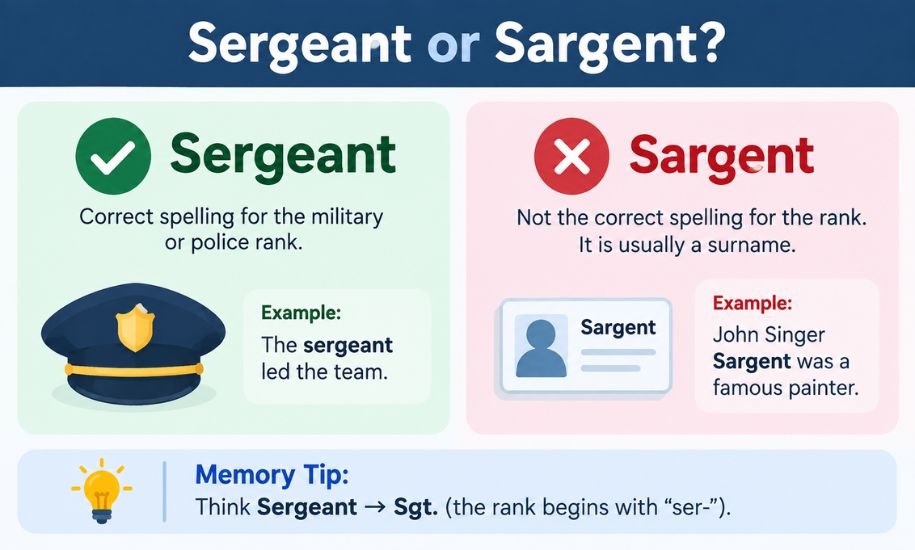
Sergeant is the correct spelling for the military or police rank. Sargent is generally a misspelling when it is intended to mean that rank, although Sargent is a legitimate surname. If you are writing about a police or military officer, use sergeant.
Sergeant vs. Sargent: A Quick Comparison
| Feature | Sergeant | Sargent |
|---|---|---|
| Standard spelling of the rank? | Yes | No |
| Military rank | Yes | No |
| Police rank | Yes | No |
| Can be a surname? | Occasionally | Yes |
| Example | Army sergeant | John Singer Sargent |
| Abbreviation | Sgt. | Not an abbreviation for the rank |
The key point is simple: sergeant is the spelling to use when referring to a rank.
What Does “Sergeant” Mean?
Sergeant is a noun used for a rank in military and police organizations. The exact responsibilities and position of a sergeant depend on the organization, but the word generally refers to a noncommissioned military officer or a police officer holding that rank.
For example:
- The sergeant instructed the recruits.
- She was promoted to sergeant last year.
- The police sergeant interviewed the witnesses.
- The army sergeant inspected the equipment.
The word can also appear as part of a longer rank title, such as staff sergeant, master sergeant, or sergeant major.
When the title comes before a person’s name, it is normally capitalized:
Sergeant Davis led the team.
When it is used as a general noun, lowercase is usually appropriate:
Davis was promoted to sergeant.
Is “Sargent” a Real Word?
Sargent is a real word when it is used as a surname, but it is not the standard spelling of the military or police rank.
One well-known example is the American painter John Singer Sargent. In his name, Sargent is a family name and should not be changed to Sergeant.
This distinction is important because saying that Sargent is “never a word” would be inaccurate.
Compare these examples:
Correct rank:
The sergeant addressed the soldiers.
Correct surname:
John Singer Sargent was a prominent portrait painter.
Incorrect rank spelling:
The sargent addressed the soldiers.
So, if the context involves an officer’s rank, choose sergeant. If Sargent is someone’s actual surname, keep the spelling exactly as it is.
Why Is the Spelling So Confusing?
The biggest reason is pronunciation.
In common American pronunciation, sergeant sounds approximately like “SAR-jent.” The spoken form does not clearly reveal the letters e-r-g-e-a in the written word.
Someone encountering the word primarily through speech might therefore reasonably guess:
sargent
rather than:
sergeant
This is a spelling error caused by writing the word according to how it sounds. English has many words whose pronunciation does not provide an obvious guide to their spelling, and sergeant is a particularly noticeable example.
The historical development of the word also helps explain its unusual spelling. Modern sergeant comes through older French and Middle English forms, while its pronunciation has changed over time. The established spelling remained even though the modern pronunciation no longer closely matches the written form.
Police Sergeant or Sargent?
When referring to a law-enforcement rank, the correct expression is police sergeant.
For example:
The police sergeant arrived at the station early.
She hopes to become a police sergeant.
The sergeant supervised several officers.
Writing police sargent is incorrect when sargent is intended as the rank.
The same rule applies regardless of whether you are discussing a particular police department or police work generally. Sergeant is the standard spelling.
Correct and incorrect examples
Correct:
The police sergeant reviewed the report.
Incorrect:
The police sargent reviewed the report.
Correct:
Maria was promoted to sergeant.
Incorrect:
Maria was promoted to sargent.
If you are writing a formal report, news article, résumé, academic paper, or other professional document, use sergeant.
Sergeant or Sargent in the Military
The same spelling rule applies in military contexts. If you mean the rank, use sergeant.
Examples include:
- army sergeant
- military sergeant
- staff sergeant
- master sergeant
- sergeant major
For example:
The sergeant gave the unit its instructions.
He served as a military sergeant before retiring.
The staff sergeant organized the training exercise.
The spelling sargent should not be substituted for sergeant in these expressions.
It is also useful to remember that Sgt. is a common abbreviation for sergeant:
Sgt. Brown reported for duty.
The abbreviation does not make sargent an acceptable spelling of the full word.
Is It “Sargent” or “Sergeant”?
If you are asking “is it sargent or sergeant?” because you need to write the name of the rank, the answer is sergeant.
A quick way to decide is to ask what you are referring to:
- A military or police rank? → sergeant
- A person’s surname? → Possibly Sargent
- An abbreviation for the rank? → Sgt.
This three-part distinction prevents most mistakes.
Examples of “Sergeant” in Sentences
Here are several natural examples showing how the word works in everyday writing:
- The sergeant checked the soldiers’ equipment.
- The police sergeant spoke with the witnesses.
- He was promoted to sergeant after several years of service.
- Sergeant Lee gave the team its instructions.
- The staff sergeant supervised the training session.
- Her goal was to become a sergeant in the police department.
Notice that the word remains sergeant whether it refers to the military, law enforcement, or a specific rank title.
Common Mistakes to Avoid
1. Writing “sargent” for the rank
This is the most common mistake.
Incorrect:
The sargent ordered the group to move.
Correct:
The sergeant ordered the group to move.
2. Assuming pronunciation determines spelling
Because sergeant sounds roughly like “sar-jent,” spelling it sargent may seem logical. However, English spelling cannot always be predicted directly from pronunciation.
3. Changing the surname “Sargent”
If Sargent is someone’s surname, it should remain Sargent.
For example:
John Singer Sargent was an American artist.
Changing his surname to Sergeant would create a different word and an incorrect name.
4. Using the wrong abbreviation
The standard abbreviation for sergeant is Sgt., not Sarg. or Sgtnt.
An Easy Way to Remember the Correct Spelling
A useful memory trick is to connect sergeant with Sgt.
Think:
Sergeant → Sgt.
The abbreviation reminds you that the word begins with ser-, not sar-.
You can also remember the basic rule:
Rank = sergeant
Surname = Sargent may be correct
If you are describing someone who holds a military or police rank, choose sergeant every time.
Frequently Asked Questions
Is “sargent” an acceptable spelling of the military rank?
No. Sergeant is the standard modern spelling of the military rank. Sargent may be a legitimate surname, but it should not normally be used as an alternative spelling for the rank.
Is “police sergeant” or “police sargent” correct?
Police sergeant is correct. The word sergeant is used for the relevant police rank. Therefore, write “the police sergeant,” not “the police sargent.”
Why do people spell sergeant as sargent?
The pronunciation is the main source of confusion. Sergeant sounds roughly like “SAR-jent,” so someone who learns the word by hearing it may naturally try to spell it sargent.
Is Sargent ever spelled correctly?
Yes. Sargent is a legitimate surname. For example, John Singer Sargent has this spelling as part of his name. It is not, however, the standard spelling of the military or police rank.
What is the abbreviation for sergeant?
The common abbreviation is Sgt. For example: Sgt. Miller. The abbreviation is useful in military, police, and other contexts where rank titles are commonly shortened.
Is “serjeant” the same as “sergeant”?
Serjeant is a historical or specialized British variant that can occur in certain contexts. It should not be confused with sargent, which is generally a misspelling when intended to refer to the modern rank.
The Bottom Line
When you mean the military or police rank, the correct spelling is sergeant. Although Sargent is a genuine surname, it should not replace sergeant in expressions such as “army sergeant,” “military sergeant,” or “police sergeant.” Remembering sergeant → Sgt. is a simple way to keep the spelling straight. For more clear explanations of confusing English words and spellings, Grammarifyr helps you Know the Difference. Use the Right Words.
You may also Read : CC'd or CC'ed: Meaning and Correct Usage
One Comment