Inattentive or Unattentive: Correct Word Explained
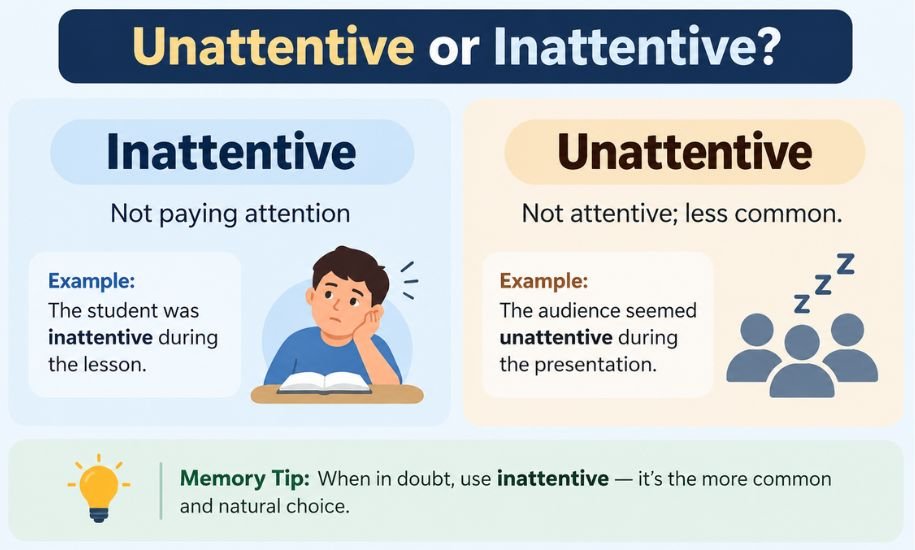
If you are unsure whether to write “unattentive” or “inattentive,” you are not alone. The two words look almost identical and both relate to a lack of attention. The important point is that both are real English words, so this is not simply a case of one being a spelling mistake. However, they are not equally common in everyday writing. Inattentive is the established and generally preferred choice when you mean “not paying attention,” while unattentive is a valid but less common alternative.
Inattentive is the preferred word in most modern English. Unattentive is also a legitimate adjective meaning “not attentive,” but it is much less common. If you want the safest and most natural choice for general, academic, or professional writing, use inattentive.
Inattentive or Unattentive: What’s the Difference?
The basic meanings of the two words overlap almost completely.
| Feature | Inattentive | Unattentive |
|---|---|---|
| Is it a real word? | Yes | Yes |
| Part of speech | Adjective | Adjective |
| Basic meaning | Not paying attention | Not attentive |
| Standard use | Common and established | Less common |
| Best general choice | Yes | Usually not necessary |
| Example | She was inattentive during class. | She was unattentive during class. |
Merriam-Webster defines inattentive as “not attentive” or “not paying attention.” It separately recognizes unattentive as an adjective meaning “not attentive.”
So, saying that “unattentive” is always wrong would be inaccurate. The more useful distinction is that inattentive is the normal choice, whereas unattentive is relatively uncommon.
What Does “Inattentive” Mean?
Inattentive is an adjective used for someone or something that does not receive enough attention.
It can describe a person who is distracted, careless, not listening, or failing to notice something important. Cambridge defines it as “not giving attention to someone or something.”
For example:
- The student was inattentive during the lesson.
- The driver was inattentive and failed to notice the warning sign.
- He became inattentive to the needs of his family.
- The employee was inattentive to several important details.
The word can describe a temporary state or a person’s general behavior.
“Inattentive to” as a Common Construction
One particularly useful pattern is:
inattentive to + person/thing
For example:
The manager was inattentive to the concerns of the staff.
She was inattentive to the details of the agreement.
He became inattentive to his responsibilities.
Cambridge specifically records “inattentive to someone/something” as a common grammatical construction.
What Does “Unattentive” Mean?
Unattentive is also an adjective. It means essentially not attentive, not focused, or careless. Collins gives the meaning “not attentive or focused; careless,” while Merriam-Webster defines it simply as “not attentive.”
For example:
The audience was unattentive during the presentation.
The child became unattentive during the long lecture.
These sentences are understandable and grammatically possible. The issue is not that unattentive has an incorrect meaning. Instead, inattentive is the more familiar and conventional choice for most readers.
That distinction matters when deciding what to use in polished writing.
Why Are the Two Words Confused?
The confusion is easy to understand because both words are formed from attentive and express a negative idea.
The base word is:
attentive → paying attention
The two alternatives are:
inattentive → not attentive
unattentive → not attentive
English has several words in which different negative prefixes produce forms with similar meanings. As a result, both forms can seem equally natural even though one has become much more established in ordinary usage.
There is also a practical reason for the confusion: unattentive looks perfectly logical. If attentive means paying attention, adding un- appears to create the opposite. And in this case, dictionaries do recognize the resulting word.
Is “Unattentive” a Real Word?
Yes. Unattentive is a real English word.
This is an important point because some spelling guides may incorrectly lead readers to assume that unattentive is simply a misspelling of inattentive. It is not. Major dictionaries, including Merriam-Webster and Collins, list it as an adjective.
However, being a legitimate dictionary word does not automatically make it the best choice in every context.
Consider these two sentences:
The student was inattentive during the lecture.
The student was unattentive during the lecture.
Both can be understood, but the first is the more conventional choice for modern general English.
Therefore, if your question is “Is it unattentive or inattentive?”, the practical answer is:
Choose “inattentive” unless you have a specific reason to use “unattentive.”
Inattentive vs. Unattentive in Sentences
Seeing the words in context makes the distinction easier.
Inattentive
The teacher noticed that Mark was inattentive during the lesson.
The inattentive driver missed the road sign.
She was inattentive to the customer’s concerns.
I was tired and became inattentive during the meeting.
These are natural examples of the standard word.
Unattentive
The audience seemed unattentive during the speech.
The child became unattentive after several hours of study.
The sentences are grammatically understandable because unattentive is a recognized adjective. However, many writers would naturally choose inattentive instead.
Correct and Less-Preferred Examples
Here is a simple way to apply the distinction:
Preferred:
The student was inattentive in class.
Possible but less common:
The student was unattentive in class.
Preferred:
The manager was inattentive to the team’s concerns.
Possible but less common:
The manager was unattentive to the team’s concerns.
In each pair, the meaning is essentially the same. The difference is mainly about conventional usage and naturalness, not grammar.
Which Word Should You Use in Formal Writing?
For formal writing, inattentive is the better default.
Use it in:
- academic essays
- reports
- professional writing
- educational material
- news writing
- formal emails
- general website content
For example:
The study examined the effects of inattentive behavior in the classroom.
This sounds natural and clear.
You could technically write:
The study examined the effects of unattentive behavior in the classroom.
But the first version is more conventional and is therefore preferable.
When a word has a less common alternative that means essentially the same thing, choosing the familiar form usually makes your writing clearer.
A Useful Way to Remember It
You do not need a complicated mnemonic.
Simply remember:
Attentive = paying attention
Inattentive = not paying attention
The pair attentive → inattentive is the combination you are most likely to need.
If you are writing a sentence and hesitate between the two negative forms, inattentive is the safer choice.
Common Mistakes to Avoid
1. Calling “unattentive” a spelling error
It is not simply a misspelling. Major dictionaries recognize the word.
2. Assuming both forms are equally common
They are not necessarily equally natural in contemporary general writing. Inattentive is the more established choice.
3. Using “inattentive” when you mean “unattended”
These words are different.
Inattentive describes a lack of attention:
The driver was inattentive.
Unattended means not watched or looked after:
The luggage was left unattended.
Merriam-Webster defines unattended in terms of something not being watched, guarded, or looked after.
4. Confusing “inattentive” with “inadvertent”
These words can sometimes appear in similar contexts, but they are not identical.
Inattentive means not paying attention.
Inadvertent can mean unintentional or accidental, and it can also have a sense related to failing to pay attention.
For example:
His inattentive behavior caused the mistake.
The error was inadvertent.
The first focuses on a lack of attention; the second emphasizes that something was accidental or unintended.
What Is the Best Choice?
If you simply want the most natural word, use inattentive.
It works comfortably in sentences about:
- people
- students
- employees
- drivers
- audiences
- customers
- responsibilities
- details
- behavior
For example:
The employee was inattentive to the details of the report.
The children became inattentive near the end of the lesson.
An inattentive driver can fail to notice important road signs.
The word is also supported by major dictionaries and is widely established in standard English.
Frequently Asked Questions
Is it “unattentive” or “inattentive”?
Inattentive is the preferred choice for most modern English writing. Unattentive is also a legitimate word meaning “not attentive,” but it is less common. When you want the safest, most familiar option, choose inattentive.
Is “unattentive” a correct word?
Yes. Unattentive is recognized by major dictionaries and means not attentive, focused, or careful. It should not be described simply as a misspelling. However, inattentive is generally the better choice for ordinary formal and general-purpose writing.
What is the meaning of inattentive?
Inattentive means not giving sufficient attention to someone or something. It can describe a person who is distracted, careless, or failing to notice what is happening. For example: “The student was inattentive during the lecture.”
Can I use “unattentive” in a sentence?
Yes. For example: “The audience appeared unattentive during the long presentation.” The sentence is grammatically possible, but inattentive would usually be the more conventional wording: “The audience appeared inattentive during the long presentation.”
Is “inattentive” an adjective?
Yes. Inattentive is an adjective. It describes someone or something that is not giving attention. Related forms include inattentively and inattentiveness.
Is “inattentive to” correct?
Yes. Inattentive to is a standard construction. For example: “The manager was inattentive to the employees’ concerns.” It means that the manager failed to give adequate attention to those concerns.
Final Verdict: Unattentive or Inattentive?
Inattentive is the best choice for most situations. It means “not paying attention” and is the established form you should normally use in formal, academic, professional, and everyday writing. Unattentive is not wrong—it is a legitimate adjective with essentially the same meaning—but it is less common and usually unnecessary. When in doubt, choose inattentive. For more clear explanations of easily confused English words, Grammarifyr follows the same principle: Know the Difference. Use the Right Words.
You may also Read : Maxxed or Maxed: Meaning and Correct Usage
One Comment