Handle vs Handel: Meaning, Usage and Examples
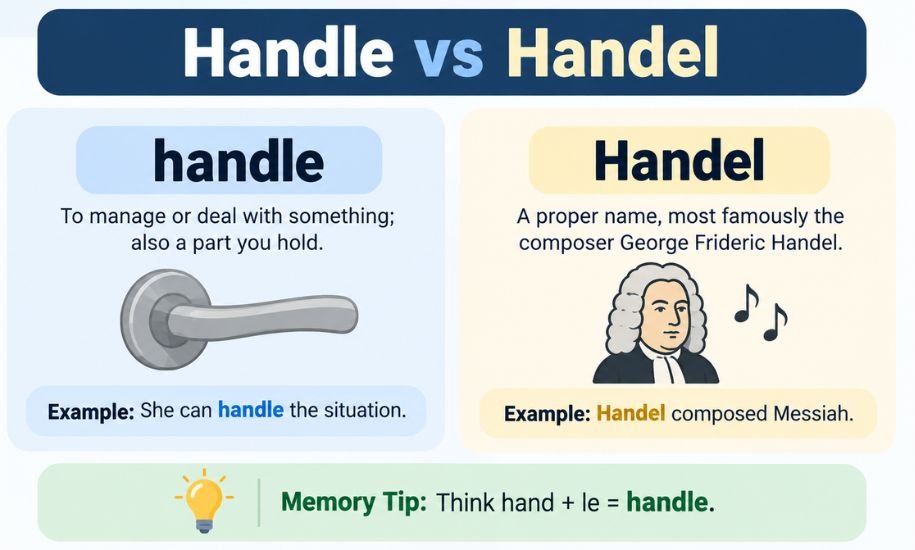
If you are unsure whether to write handle or handel, you are not alone. The two spellings look almost identical, but they do not normally serve the same purpose in modern English. Handle is the standard English word used for something you hold or for the verb meaning to manage or deal with something. Handel, on the other hand, is most familiar in English as a proper name, especially the surname of composer George Frideric Handel. There is also a separate spelling issue with handling and handeling: only handling is correct when forming the -ing form of handle.
Handle is the correct standard English spelling when you mean “to manage,” “to deal with,” or the part of an object that you hold. Handel is generally a proper name in English, most notably the surname of composer George Frideric Handel. The correct -ing form is handling, not “handeling.”
Handle vs Handel: What’s the Difference?
The main distinction is simple:
| Word | Standard everyday English use | Meaning |
|---|---|---|
| handle | Yes | To manage or deal with something; also a part designed to be held |
| Handel | Usually a proper name | Most commonly the surname of composer George Frideric Handel |
| handling | Yes | The -ing form of handle |
| handeling | No | Incorrect spelling of handling |
So, if you want to say that someone can manage a difficult situation, write:
She can handle the situation.
Not:
She can handel the situation.
If you are referring to the famous composer, however, Handel is the correct spelling:
Handel composed the oratorio Messiah.
What Does “Handle” Mean?
Handle is a standard English word that can function as both a noun and a verb.
Handle as a noun
As a noun, a handle is a part of an object that is designed to be held, pulled, lifted, or operated.
Examples include:
- a door handle
- a suitcase handle
- a cup handle
- a drawer handle
- a hammer handle
For example:
The suitcase has a broken handle.
Here, handle refers to the physical part you use to carry the suitcase.
The word can also have figurative meanings. For example, someone may have a “handle” on a problem, meaning they have a good understanding or degree of control over it.
Handle as a verb
As a verb, handle commonly means to manage, deal with, control, or take responsibility for something.
Examples:
I can handle this assignment.
She handled the complaint professionally.
He knows how to handle difficult customers.
Can you handle the pressure?
In each case, handle refers to dealing with or managing something rather than physically holding an object.
What Does “Handel” Mean?
In ordinary English writing, Handel is not the spelling you should use for the everyday word handle.
The best-known English use of Handel is as the surname of George Frideric Handel, the celebrated composer associated with works including Messiah, Water Music, and Music for the Royal Fireworks.
For example:
We listened to Handel’s Messiah during the concert.
Here, Handel is a proper name and therefore begins with a capital letter.
It is important not to say that handel can never exist as a word. The spelling appears in some other languages with meanings unrelated to the ordinary English word handle. It can also appear in historical or linguistic contexts. But if you are writing a normal English sentence and mean “manage,” “deal with,” or “the part you hold,” handle is the form you need.
Handel vs Handle Meaning: Which One Should You Use?
The question “handel vs handle meaning” is essentially about whether the two spellings represent the same English word. They do not.
Handle means:
- to manage something
- to deal with something
- to control or take responsibility for something
- to touch or use something
- a part of an object designed to be held
Example:
Maria knows how to handle difficult situations.
Handel usually refers to:
- the surname Handel, especially George Frideric Handel
- a word in certain non-English languages
Example:
Handel’s music remains widely performed.
The capitalization is useful here. Handle is normally a common noun or verb, while Handel as the composer’s surname is a proper noun.
Why Are Handle and Handel Confused?
The confusion is easy to understand because the two spellings differ by only one letter position:
handle
handel
The letters are almost identical, and the difference can be easy to miss when typing quickly.
There is another reason the confusion may feel natural: handle is historically connected with hand, so its spelling has a logical relationship to the word hand. Modern English nevertheless uses handle, not handel, for the everyday noun and verb.
People may also encounter Handel as a surname and then accidentally use that spelling when they mean the ordinary English word.
Handling vs Handeling: Which Is Correct?
The correct form is handling.
Handling is the present participle and gerund form of handle.
Correct:
She is handling the customer complaint.
Incorrect:
She is handeling the customer complaint.
The spelling changes from:
handle → handling
The final e is dropped before -ing is added.
You can see the same general pattern in words such as:
- make → making
- take → taking
- use → using
- write → writing
- handle → handling
Therefore, handeling is not the standard spelling of the -ing form.
Correct Examples in Sentences
Seeing the words in context makes the distinction easier.
Examples with “handle”
Please handle the glass carefully.
I don’t think he can handle the responsibility.
She handled the situation calmly.
The door handle needs to be replaced.
Our team will handle the request tomorrow.
Examples with “Handel”
Handel was a highly influential composer.
We studied Handel’s Messiah in music class.
The orchestra performed a piece by Handel.
Examples with “handling”
Proper handling of the equipment is essential.
She is handling the project while her manager is away.
The company has experience handling complex cases.
These examples show why substituting handel for handle changes the intended word.
Correct vs Incorrect Spelling
Here are some common examples at a glance:
| Incorrect | Correct |
|---|---|
| I can handel the problem. | I can handle the problem. |
| Please handel this carefully. | Please handle this carefully. |
| The door handel is loose. | The door handle is loose. |
| She is handeling the case. | She is handling the case. |
| He knows how to handel pressure. | He knows how to handle pressure. |
One important exception is when Handel is a name:
Handel wrote Messiah.
That spelling is correct because it refers to the composer, not the verb handle.
An Easy Way to Remember the Correct Spelling
A simple memory trick is to connect handle with hand.
Think:
HAND → HANDLE
A handle is something your hand can grasp, and to handle something can mean to take it in hand, manage it, or deal with it.
So when you mean the everyday English word, remember:
hand + le = handle
For the -ing form, remember that the final e disappears:
handle → handling
That gives you two useful forms to keep straight:
handle → handling
Not:
handel → handeling
Common Mistakes to Avoid
1. Using “handel” as the verb
Incorrect:
I will handel the situation.
Correct:
I will handle the situation.
The verb is always handle in standard English.
2. Writing “handeling”
Incorrect:
He is handeling the project.
Correct:
He is handling the project.
The correct -ing form is handling.
3. Confusing the composer’s name with the verb
Correct:
Handel composed Messiah.
Correct:
She can handle the assignment.
The capitalization and context make the distinction clear.
4. Assuming “handel” is simply an alternative spelling
It is not a standard American or British alternative spelling of handle. If you are writing standard English, don’t treat handle and handel as interchangeable.
Is “Handel” Ever a Real Word?
Yes, but context matters.
Handel is certainly a real proper name in English, most famously associated with George Frideric Handel. The spelling can also occur as a word in other languages, where it may have a completely different meaning.
That does not make handel an acceptable replacement for handle in an ordinary English sentence.
For example:
❌ I can handel the workload.
The correct English sentence is:
✅ I can handle the workload.
So it is more accurate to call handel incorrect in this particular English usage rather than claiming that the letter sequence can never occur anywhere.
Is This a British or American Spelling Difference?
No. Handle is the standard spelling in both American and British English.
There is no standard regional distinction such as:
- American: handel
- British: handle
That would be incorrect.
Both varieties use handle and handling in ordinary English.
For example:
American English:
She can handle the situation.
British English:
She can handle the situation.
The spelling remains the same.
How to Choose the Right Form
Use handle when you mean to:
- manage something
- deal with something
- control something
- touch or use something
- refer to a part that you hold
Use handling when you need the -ing form.
Use Handel when the context refers to the proper name, particularly the composer.
A quick test is to ask yourself what you mean:
Managing something? → handle
The part you hold? → handle
Doing the action? → handling
The composer? → Handel
That simple distinction covers most situations.
Frequently Asked Questions
Is “handel” correct in English?
Not when you mean the ordinary English word handle. The standard spelling is handle. Handel is most commonly encountered in English as a proper name, especially the surname of composer George Frideric Handel, although the spelling also exists in some other languages.
Is it “handling” or “handeling”?
Handling is correct. The word handle loses its final e before the -ing ending is added: handle → handling. Handeling is an incorrect spelling when you intend the present participle or gerund of handle.
What is the difference between handle and Handel?
Handle is an everyday English noun and verb. It can refer to a part you hold or to managing or dealing with something. Handel is generally a proper name in English, most famously the surname of composer George Frideric Handel.
Is “handel” a British spelling of “handle”?
No. Handle is the standard spelling in both British and American English. Handel is not a British alternative to handle.
How do you remember the spelling of “handle”?
Connect it with hand. A handle is something your hand can hold, and the verb handle originally relates naturally to using or taking something in hand. For the -ing form, remember: handle → handling.
Final Verdict: Handle or Handel?
For normal English writing, choose handle when you mean “manage,” “deal with,” or the part of an object that you hold. Choose handling for the -ing form. Handel has a different role, most notably as the name of the famous composer, so the two spellings should not be treated as interchangeable.
When you want a quick, reliable guide to confusing spellings and word choices, Grammarifyr helps you know the difference and use the right words.
You may also Read : Inattentive or Unattentive: Correct Word Explained



One Comment