Naive or Nieve: Meaning, Spelling and Examples
If you are unsure whether to write naive or nieve, the correct English spelling depends on the meaning you intend. When you want to describe someone as inexperienced, overly trusting, innocent, or lacking worldly knowledge, the correct spelling is naive. You may also see naïve, which is an accepted spelling of the same word. Nieve is not the standard English spelling of this adjective, although it is a real word in Spanish with a different meaning.
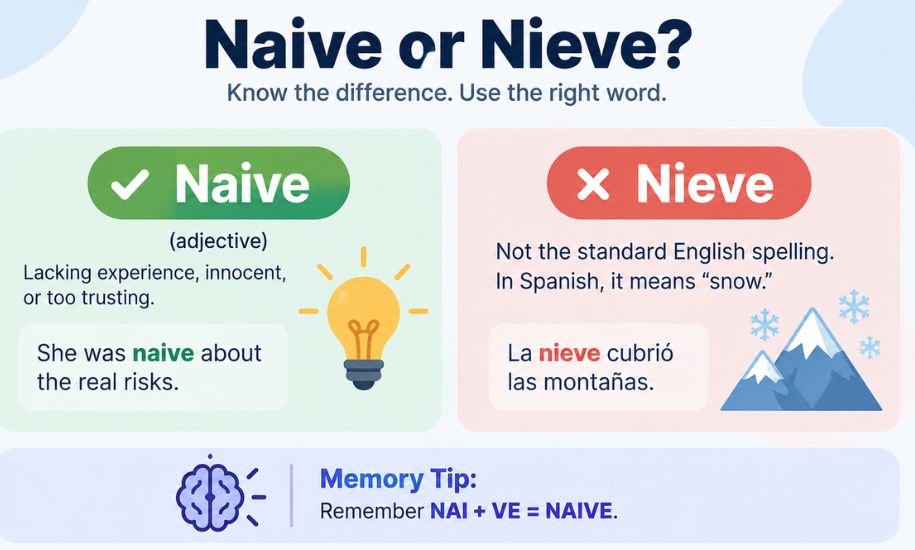
Naive is the correct English spelling when you mean inexperienced, innocent, or too trusting. Naïve is also correct, with the diaeresis over the “i.” Nieve is not the standard English spelling of this adjective.
Naive or Nieve: Which Is Correct?
Naive is the word you should use in standard English.
The word is an adjective used to describe someone who lacks experience or knowledge and may therefore trust people too easily or have an overly simple view of a situation.
For example:
- Correct: It was naive to believe that the offer had no hidden conditions.
- Incorrect: It was nieve to believe that the offer had no hidden conditions.
There is also a second accepted spelling, naïve. The two forms have the same meaning and pronunciation. The version with the diaeresis is closer to the original French spelling, while naive is very common in modern English.
Quick comparison
| Form | Standard English? | Meaning |
|---|---|---|
| naive | Yes | Inexperienced, innocent, or overly trusting |
| naïve | Yes | Same meaning as naive |
| nieve | No, for this meaning | Not the standard English spelling of naive |
So, if you are deciding between nieve or naive, choose naive.
What Does “Naive” Mean?
Naive is an adjective. It usually describes someone who does not have enough experience or knowledge to understand how complicated a situation may be.
A naive person may believe something too readily because they assume that other people are honest or that circumstances are simpler than they really are.
For example:
- He was naive about the difficulties of running a business.
- She was too naive to recognize the warning signs.
- It would be naive to assume that every agreement is risk-free.
- His naive optimism made him believe everything would work out immediately.
The word does not necessarily mean stupid. A person can be intelligent but still naive about a particular subject because they lack experience in that area.
For instance, someone who is an excellent engineer might be naive about investing because they have little financial experience.
Is “Nieve” a Real Word?
This is where the spelling question gets slightly more interesting.
Nieve is not the standard English spelling for the adjective meaning inexperienced or overly trusting. However, it should not necessarily be described as a completely meaningless word.
In Spanish, nieve means “snow.” Therefore, you may encounter nieve in Spanish-language writing.
But when writing an English sentence such as:
She was naive about the situation.
you should not replace naive with nieve.
The two forms are not alternative English spellings of the same adjective.
Why Do People Confuse the Two Spellings?
The spelling naive can be confusing because its pronunciation does not make the letter order immediately obvious.
In English, it is commonly pronounced approximately “nye-EVE.” This can make it tempting to spell the word phonetically as nieve, especially when writing quickly.
The unusual vowel sequence in naive is another reason the incorrect version can look plausible.
Compare the spellings:
N-A-I-V-E → naive
N-I-E-V-E → nieve
Only the order of the a and i changes, but that small difference determines whether you have the standard English spelling.
Naive vs. Naïve: Are Both Correct?
Yes. Naive and naïve are both accepted English spellings.
The dots over the i are called a diaeresis. In naïve, they indicate that the vowels are pronounced separately rather than being treated as a single vowel sound.
You may therefore write:
- She was naive about the risks.
- She was naïve about the risks.
Both sentences are correct.
The plain spelling naive is especially convenient in ordinary English writing and digital communication. The spelling naïve is also perfectly acceptable, particularly when a writer wants to preserve the traditional form.
The important point is that neither should be changed to nieve.
How to Use “Naive” in a Sentence
Here are several examples showing natural usage:
- It was naive of me to think the project would be finished in one day.
- The young traveler was naive about the risks of accepting help from strangers.
- She had a naive belief that everyone would always tell the truth.
- His proposal was based on a naive assumption about the cost of materials.
- You would have to be quite naive to ignore those obvious warning signs.
Notice that naive often appears with about, assumption, belief, or to think.
For example:
- naive about politics
- a naive assumption
- a naive belief
- naive to think that…
The exact construction depends on the sentence, but the adjective itself remains naive.
What Is the Difference Between Naive and Gullible?
Although naive and gullible can overlap, they are not exact synonyms.
Naive generally suggests a lack of experience, knowledge, or sophistication.
Gullible more specifically describes someone who is easily persuaded or deceived.
Consider these examples:
- He was naive about the real estate market.
This means he lacked experience or understanding. - He was gullible and believed the scammer immediately.
This emphasizes that he was easily deceived.
Someone may be naive without being particularly gullible. Likewise, a knowledgeable person can sometimes be gullible in a particular situation.
Common Mistakes With This Word
1. Writing “nieve” in English
Incorrect: She was nieve about the dangers.
Correct: She was naive about the dangers.
The letters a and i appear in the opposite order in the incorrect version.
2. Thinking “naïve” is a different word
It is not. Naive and naïve are spelling variants of the same English adjective.
3. Assuming naive means unintelligent
Calling someone naive usually refers to their lack of experience or worldly knowledge, not their overall intelligence.
4. Using “nieve” because it sounds right
English spelling often does not follow pronunciation perfectly. In this case, remembering the written form naive is more reliable than trying to spell it from sound.
An Easy Way to Remember the Spelling
A simple way to remember naive is to focus on the middle:
NAI + VE = NAIVE
The first three letters are NAI, not NIE.
You can also connect the spelling with its variant:
naive = naïve
Both forms contain NAI at the beginning.
So when you are deciding between naive and nieve, remember:
NAI comes before VE.
That small spelling pattern can help prevent the most common mistake.
Naive or Nieve Meaning in Different Contexts
The meaning of naive can change slightly depending on the context, but the basic idea remains a lack of experience or sophistication.
In everyday conversation, it can describe someone who is too trusting:
He was naive enough to believe the stranger’s story.
In business, it can describe an unrealistic assumption:
The plan makes a naive assumption about how quickly customers will adopt the product.
In politics, politically naive can describe someone who lacks political knowledge or experience.
The word can also have a relatively positive meaning when describing something simple, innocent, or unaffected. In art, for example, naive art can refer to a style characterized by a simple or unsophisticated visual approach.
Frequently Asked Questions
Is “naive” or “nieve” correct?
Naive is the correct standard English spelling for the adjective meaning inexperienced, innocent, or overly trusting. Naïve is also correct. Nieve should not be used as the English spelling of this word.
Is “naïve” better than “naive”?
Neither is inherently better. Both are accepted. Naïve retains the traditional diaeresis, while naive is a standard modern English spelling. Choose either form and use it consistently.
Is “nieve” an English word?
Not as the standard spelling of the adjective naive. However, nieve is a Spanish word meaning “snow.” Therefore, it can legitimately appear in Spanish-language contexts, but it should not replace naive in an English sentence.
What part of speech is “naive”?
Naive is an adjective. It describes a person, idea, assumption, attitude, or approach as inexperienced, unsophisticated, innocent, or overly trusting.
Does naive mean gullible?
Not exactly. Naive usually emphasizes a lack of experience or knowledge, while gullible emphasizes being easily deceived. The meanings can overlap, but they are not interchangeable in every sentence.
How can I remember the spelling?
Remember the opening letters NAI: NAI + VE = NAIVE. If you write NIE, you have reversed the vowel order and created the incorrect spelling for this English meaning.
Final Verdict: Naive or Nieve?
When writing in English, use naive for someone who is inexperienced, innocent, or too trusting. Naïve is an equally valid spelling, while nieve is not the standard English form of the adjective. Keeping the NAI spelling in mind will help you avoid this easy-to-make error. For more straightforward explanations of confusing spellings and word choices, Grammarifyr helps you know the difference and use the right words.
You may also Read : Check or Cheque: US, UK, and Canadian English


One Comment