Transferred or Transfered: Correct Spelling Explained
It is easy to hesitate over transferred and transfered, especially because adding -ed to a verb often seems straightforward. However, this verb follows a spelling pattern that requires a doubled final consonant. The correct form is transferred, with two r’s. The same pattern appears in transferring, while the related adjective is usually spelled transferable. Understanding these forms makes the spelling much easier to remember and helps you avoid a common error in formal writing.
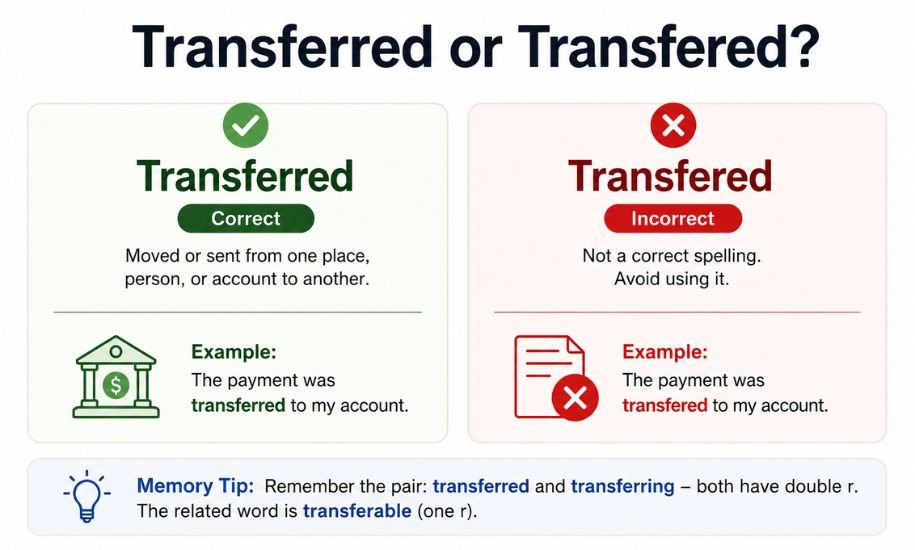
Transferred is the correct spelling. Transfered is a misspelling and should not be used in standard English. The verb transfer becomes transferred in the past tense and past participle, with the final r doubled.
Transferred vs. Transfered: The Quick Difference
| Feature | Transferred | Transfered |
|---|---|---|
| Correct spelling? | Yes | No |
| Part of speech | Verb form | — |
| Base verb | transfer | transfer |
| Meaning | Moved, passed, or shifted | No standard meaning |
| Example | The funds were transferred. | The funds were transfered. ❌ |
If you are writing a sentence in standard English, choose transferred.
What Does “Transferred” Mean?
Transferred is the past tense and past participle of transfer. The verb transfer means to move something or someone from one place, person, account, organization, or situation to another.
For example:
- The bank transferred the payment to the correct account.
- Maya was transferred to another department.
- The student transferred to a different university.
- We transferred the files to a new computer.
The word is common in many contexts, including education, banking, employment, healthcare, technology, and everyday communication.
Transferred as a Past Tense Verb
Use transferred when describing an action that happened in the past:
The manager transferred the employee to the London office.
Transferred as a Past Participle
It can also follow helping verbs such as has, have, had, or was:
The money has been transferred.
The patient was transferred to another hospital.
In both cases, the spelling remains transferred.
Is “Transfered” a Real Word?
No. Transfered with only one r is not the standard spelling of the past tense or past participle of transfer.
The error usually happens because writers apply a simple pattern:
transfer + ed = transfered
But English spelling requires the final consonant to be doubled in this form:
transfer + ed = transferred
So:
Correct: The documents were transferred yesterday.
Incorrect: The documents were transfered yesterday.
The incorrect version should be avoided in formal, academic, professional, and edited writing.
Why Does “Transferred” Have Two Rs?
The spelling follows the consonant-doubling pattern used with certain verbs ending in a stressed consonant-vowel-consonant pattern.
Compare:
- refer → referred
- prefer → preferred
- defer → deferred
- occur → occurred
- transfer → transferred
The important part of transfer is the ending -fer. When -ed is added, the final r is doubled.
That gives us:
transfer → transferred
The same spelling principle also explains the related form:
transfer → transferring
This is why both transferred and transferring contain two r’s.
Transferring or Transfering?
The correct form is transferring, not transfering.
| Form | Correct? |
| transferring | ✅ |
| transfering | ❌ |
| transferred | ✅ |
| transfered | ❌ |
Examples:
We are transferring the data to the new server.
She is transferring to another school next semester.
The company is transferring ownership of the property.
A useful way to remember the pattern is that the r stays doubled when transfer takes either -ed or -ing:
transfer → transferred → transferring
What About “Transferable” or “Transferrable”?
This form is slightly different and deserves some care.
Transferable is the usual preferred spelling:
The course provides transferable skills.
These credits are transferable to another institution.
Transferrable is also recognized as a variant, although transferable is generally the safer choice for standard professional and academic writing.
This can seem inconsistent at first:
- transfer → transferred
- transfer → transferring
- transfer → transferable
The different suffixes do not all follow exactly the same spelling pattern. Therefore, do not assume that every word derived from transfer must contain two r’s.
For most everyday writing, remember:
transferred and transferring, but usually transferable.
Why Do People Write “Transfered”?
The most likely reason is straightforward: the spelling looks as though it should be formed by simply adding -ed to the base verb.
Writers may know that:
work → worked
help → helped
open → opened
and therefore instinctively write:
transfer → transfered
However, transfer belongs to a group of verbs where the final consonant is doubled when the appropriate suffix is added.
The same issue occurs with words such as referred, preferred, and deferred. Recognizing the pattern is more useful than memorizing transferred as an isolated spelling.
Correct Usage in Sentences
Here are several natural examples:
Correct: The payment was transferred to my account.
Incorrect: The payment was transfered to my account.
Correct: He was transferred to a different branch.
Incorrect: He was transfered to a different branch.
Correct: The files have been transferred successfully.
Incorrect: The files have been transfered successfully.
Correct: She is transferring to another university.
Incorrect: She is transfering to another university.
Notice that the same double-r pattern appears in both the past-tense and -ing forms.
Is the Spelling Different in American and British English?
No. Transferred is the standard spelling in both American and British English.
There is no American-versus-British distinction in which transfered is correct in one variety and transferred is correct in the other. If you are writing for a U.S., U.K., Canadian, Australian, or international audience, transferred is the appropriate standard form.
The related word transferable is also widely used, although transferrable can be encountered as a variant.
A Simple Way to Remember the Spelling
Think of the word as a small family:
TRANSFER
→ TRANSFERRED
→ TRANSFERRING
→ TRANSFERABLE
For the two forms that add -ed and -ing, keep the double r:
transfer + red = transferred
transfer + ring = transferring
You do not need to memorize a complicated rule every time. If you remember that the final r doubles before -ed and -ing, the correct forms become much easier to recognize.
Related Uses of “Transferring”
The word transferring also appears in scientific and educational language, which can explain some of the related phrases people encounter.
For example, a wave can be described as a repeating disturbance that transfers energy through matter or space. In physics, the important idea is that a wave transports energy, while the material through which a mechanical wave travels does not simply move along with the wave as a whole.
Likewise, in chemistry, the distinction between sharing and transferring electrons is important:
- Covalent bonding involves sharing electrons.
- Ionic bonding involves electron transfer.
These meanings are unrelated to the spelling question itself, but they use the correctly spelled form transferring.
Common Mistakes to Avoid
1. Writing “transfered”
Use transferred instead.
❌ The money was transfered.
✅ The money was transferred.
2. Writing “transfering”
Use transferring.
❌ They are transfering the files.
✅ They are transferring the files.
3. Assuming every related form has two Rs
Do not automatically write transferrable simply because transferred and transferring have two r’s. Transferable is the preferred spelling in most contexts.
4. Treating the spelling as a U.S./U.K. difference
Transferred is standard in both varieties. Transfered is not an alternative British spelling.
Frequently Asked Questions
Is “transfered” ever correct?
No. In standard English, transfered is a misspelling. The correct past tense and past participle of transfer are transferred, with two r’s.
What is the past tense of “transfer”?
The past tense is transferred.
She transferred the money yesterday.
The same form also functions as the past participle:
The money has been transferred.
Is it “transfering” or “transferring”?
Transferring is correct. The final r is doubled before -ing, just as it is before -ed in transferred.
Is “transferrable” spelled correctly?
Transferrable is a recognized variant, but transferable is the more usual preferred spelling. For most formal writing, transferable is a good choice.
Is “transferred” an American or British spelling?
It is standard in both American and British English. There is no regional spelling distinction between transferred and transfered.
How can I remember “transferred”?
Remember the related pair transferred / transferring. Both double the final r. Then treat transferable separately, since that adjective is normally written with one r after transfe.
The Bottom Line
The correct spelling is transferred, not transfered. The same double-r pattern appears in transferring, while transferable is the preferred spelling of the related adjective. Once you recognize these forms as part of the same word family, the spelling becomes much easier to remember. That practical approach fits the purpose of Grammarifyr: know the difference, use the right words.
You may also Read : Shiny or Shiney: Correct Spelling Explained



One Comment