Principal or Principle? Easy Ways to Tell Them Apart
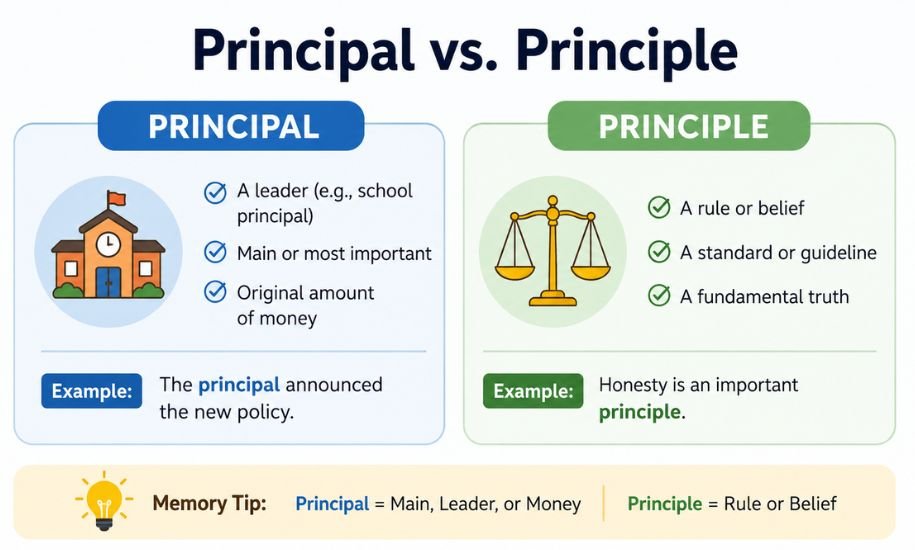
If you have ever hesitated over principal or principle, you are dealing with two genuine English words that look and sound remarkably similar but have different meanings. The good news is that the distinction becomes straightforward once you connect each word with its most common uses. Principal can refer to a leader, something most important, or the original amount of money borrowed. Principle refers to a rule, belief, standard, or fundamental truth.
Both principal and principle are correct words. Use principal for a school leader, something most important, or the original amount of a loan. Use principle for a rule, belief, standard, or fundamental truth.
Principal vs. Principle: The Quick Difference
| Word | Meaning | Example |
|---|---|---|
| Principal | A leader, something main or most important, or the original amount of money | The principal spoke to the students. |
| Principle | A rule, belief, standard, or fundamental truth | Honesty is an important principle. |
A simple way to think about the distinction is:
Principal = person, main thing, or money
Principle = rule, belief, or standard
That rule covers most everyday situations.
What Does “Principal” Mean?
Principal can be a noun or an adjective.
As a noun, it can refer to a person in charge, particularly the head of a school:
- The principal announced the new school policy.
- The students thanked their principal.
It can also refer to the original amount of money borrowed or invested:
- She made an extra payment toward the loan principal.
- The bank calculated interest on the remaining principal.
As an adjective, principal means main, chief, or most important:
- The principal reason for the change was cost.
- Safety was the principal concern during the project.
- The principal objective is to improve reliability.
So if you can replace the word with main, chief, or original amount borrowed, principal is probably the right choice.
What Does “Principle” Mean?
Principle is a noun. It describes a rule, belief, standard, or fundamental idea that guides behavior or explains how something works.
For example:
- She refused to compromise her principles.
- Fairness is an important principle of the organization.
- The machine operates according to a simple scientific principle.
- He agreed with the proposal in principle.
A principle can be moral, such as honesty or fairness, or fundamental, such as a principle of physics.
If you mean a rule, belief, standard, or fundamental truth, choose principle.
Which Is Correct on a Loan: Principal or Principle?
When talking about borrowed money, the correct term is loan principal.
The principal is the original amount borrowed, excluding interest. As you make payments, part of each payment may go toward reducing the principal, while another part covers interest and potentially other charges.
For example:
I borrowed $15,000, and the remaining loan principal is now $9,000.
So:
- loan principal ✓
- loan principle ✗ when referring to the amount borrowed
- principal balance ✓
- principal payment ✓
- principal and interest ✓
This is why the correct phrase is principle or principal on a loan? → principal.
Principal vs. Interest
These terms are often used together:
Principal = the amount borrowed
Interest = the cost charged for borrowing that money
For example:
Making an extra payment toward the principal can reduce the balance on the loan.
Do not write loan principle when you mean the amount of money still owed.
Principal Engineer or Principle Engineer?
The standard job title is principal engineer.
Here, principal is an adjective meaning leading, senior, or most important. A principal engineer is generally a highly experienced engineer with significant technical responsibility.
Correct: She was promoted to principal engineer.
Incorrect: She was promoted to principle engineer.
The same distinction applies to other professional titles:
- principal investigator
- principal architect
- principal analyst
- principal consultant
- principal designer
In each case, principal describes someone or something in a leading or senior position.
Principles or Principals?
The plural forms create another common source of confusion.
Principles is the plural of principle:
The organization operates according to several important principles.
Principals is the plural of principal:
The principals of five schools attended the meeting.
Compare these:
- principles = rules, beliefs, standards, or fundamental truths
- principals = leaders, people in charge, or other meanings of the noun principal
So if you are asking, “Is it principles or principals?”, the answer depends on what you mean.
Examples
Correct: The judge explained the principles behind the decision.
Correct: The school principals met to discuss the new policy.
Correct: She has strong principles.
Correct: Several principals attended the conference.
Common Expressions With Each Word
Certain phrases make the choice easier.
Expressions with “principal”
- school principal
- principal amount
- loan principal
- principal balance
- principal reason
- principal concern
- principal objective
- principal engineer
Examples:
The principal reason for the delay was bad weather.
He paid down the principal on his mortgage.
Expressions with “principle”
- moral principle
- guiding principle
- scientific principle
- basic principle
- in principle
- on principle
- a matter of principle
Examples:
She would not accept the offer on principle.
The two sides agreed in principle.
Notice that the expression is in principle, not in principal.
Why Are These Words So Easy to Confuse?
The confusion is largely caused by their nearly identical spelling and pronunciation. Both begin with princip-, and their final letters differ by only one vowel.
There is also some overlap in their historical development, which helps explain why the words look related. But their modern meanings are distinct.
The safest approach is not to rely entirely on pronunciation. Instead, identify the meaning you need.
Ask yourself:
- Am I talking about a leader? → principal
- Do I mean main or most important? → principal
- Am I talking about money borrowed? → principal
- Do I mean a rule or belief? → principle
- Do I mean a standard or fundamental truth? → principle
Principal or Principle: Examples in Sentences
Here are some side-by-side examples:
Principal: The principal welcomed the new students.
Principle: Respect is one of the school’s guiding principles.
Principal: The principal cause of the problem was a software failure.
Principle: The design is based on a well-established engineering principle.
Principal: They made an additional payment toward the loan principal.
Principle: She would not abandon her principles to gain an advantage.
Principal: The principal engineer reviewed the design.
Principle: The engineer explained the scientific principle behind the design.
The context determines which word belongs in each sentence.
An Easy Way to Remember the Difference
One traditional mnemonic is:
“The principal is your pal.”
It can help you remember the school-related meaning because a school principal is a person.
But it does not cover every use of principal. A more complete memory rule is:
Principal = Main, Leader, or Money
Think:
- principal = main
- principal = leader
- principal = loan amount
Principle = Rule or Belief
Think:
- principle = rule
- principle = belief
- principle = standard
A quick substitution test can also help. If main fits, use principal. If rule, belief, or standard fits, use principle.
Common Mistakes to Avoid
1. “Loan principle”
Incorrect: I paid $500 toward the loan principle.
Correct: I paid $500 toward the loan principal.
Money borrowed is principal.
2. “Principle engineer”
Incorrect: He is a principle engineer.
Correct: He is a principal engineer.
The job title uses principal because it describes a leading or senior position.
3. “In principal”
Incorrect: We agreed in principal.
Correct: We agreed in principle.
The expression in principle means in theory or at the level of a general agreement.
4. “School principle”
Incorrect: The school principle addressed the students.
Correct: The school principal addressed the students.
The head of a school is the principal.
5. “My principals”
Incorrect: I would never compromise my principals.
Correct: I would never compromise my principles.
Rules or moral beliefs are principles.
Frequently Asked Questions
Is it “principal or principle”?
Both are correct words, but they are used differently. Principal means a leader, something main or most important, or the original amount of money borrowed. Principle means a rule, belief, standard, or fundamental truth.
Is it “principle or principal” on a loan?
It is principal. The principal is the original amount borrowed or the amount of that debt still outstanding. For example, “I made an extra payment toward the loan principal.”
Is it “principal or principle engineer”?
The correct phrase is principal engineer. Here, principal is an adjective describing a leading or senior engineering position. Principle engineer is not the standard spelling for this job title.
Is “principals” a real word?
Yes. Principals is the plural of principal. For example, “The principals of several schools attended the meeting.” Principles, meanwhile, is the plural of principle and refers to rules, beliefs, or standards.
Is “in principal” ever correct?
When you mean “in theory” or “generally,” the expression is in principle. For example: “The committee agreed in principle.” The phrase in principal would only make sense in an unusual context where principal functions as a noun or adjective, not as the standard expression.
How can I remember principal vs. principle?
Remember principal = main, leader, or money, while principle = rule or belief. The familiar phrase “the principal is your pal” is also useful for remembering the school leader meaning.
Final Verdict: Principal or Principle?
Choose principal when you mean a leader, something main or most important, or money borrowed. Choose principle when you mean a rule, belief, standard, or fundamental truth. When in doubt, ask whether the sentence is about a person/main thing/money or a rule/belief. That simple distinction will get you right in most cases—and it is exactly the kind of practical word guidance Grammarify is designed to make easier.
You may also Read : Capitol or Capital? Learn the Difference Easily