Colour or Color: US and UK Spelling Explained
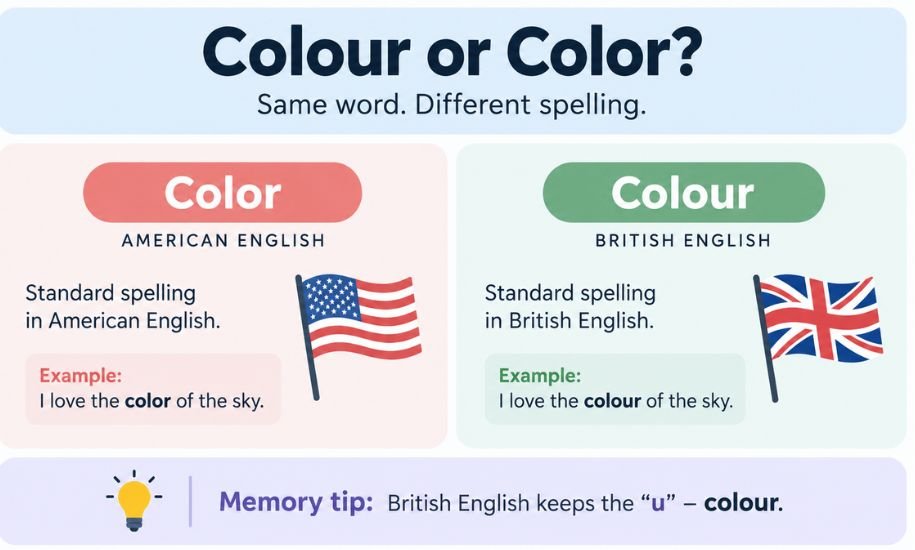
If you have ever wondered whether to write colour or color, you are dealing with a difference between two standard varieties of English rather than a simple right-versus-wrong spelling. Both forms refer to the visual quality produced when light interacts with an object, and both are fully correct in the appropriate variety of English. The main distinction is geographical: color is the standard spelling in American English, while colour is standard in British English. Knowing which form to choose is mainly a matter of identifying your audience and remaining consistent.
Both color and colour are correct. Color is the standard American English spelling, while colour is preferred in British English and several other varieties. They have the same meaning, so choose the form that matches your intended variety of English.
Color vs Colour: What’s the Difference?
The difference is spelling, not meaning.
Color is used in American English:
- The color of the sky was beautiful.
- Blue is my favorite color.
- What color would you like for the walls?
Colour is used in British English:
- The colour of the sky was beautiful.
- Blue is my favourite colour.
- What colour would you like for the walls?
Notice that the difference can affect other words in the sentence too. American English normally uses favorite, while British English uses favourite. The spelling of the noun itself follows the same regional pattern: color in American English and colour in British English.
| Feature | American English | British English |
|---|---|---|
| Singular | color | colour |
| Plural | colors | colours |
| Past form | colored | coloured |
| -ing form | coloring | colouring |
| Related adjective | colorful | colourful |
| Example | favorite color | favourite colour |
Neither spelling is inherently more correct than the other. The important thing is to use the appropriate convention consistently.
What Does “Color” Mean?
Color is a noun that describes the visual characteristic of an object or substance based on how it reflects or emits light. It can refer to basic shades such as red, blue, and green, as well as more specific descriptions such as turquoise, crimson, or lavender.
It can also be used as a verb. In American English, color can mean to add color to something or to change its appearance by using a particular color.
Examples:
- Her favorite color is green.
- The artist used several bright colors in the painting.
- Please color the flowers yellow.
- The sunset added color to the evening sky.
The word can also have figurative meanings. For example, something may “color” a person’s perception of an event, meaning it influences the way that person understands or views it.
What Does “Colour” Mean?
Colour has the same meaning and grammatical functions as color. It is simply the spelling normally used in British English.
Examples:
- Her favourite colour is green.
- The artist used several bright colours in the painting.
- Please colour the flowers yellow.
- The sunset added colour to the evening sky.
The spelling with -our is also found in related British English words such as coloured, colouring, and colourful.
So, if you are writing according to British conventions, these forms belong together:
colour → colours → coloured → colouring → colourful
In American English, the corresponding forms are:
color → colors → colored → coloring → colorful
Is It Color or Colour in American English?
In standard American English, color is the normal spelling.
For example:
The company changed the color of its logo.
Which color do you prefer?
The children enjoyed coloring their pictures.
Using colour in an American English document is generally understood, but it does not follow the usual American spelling convention. If your article, assignment, website, or business communication is intended for an American audience, color is the safer choice.
The same principle applies to compounds and related words. American English generally writes colorful, colored, and coloring without the u.
Is It Colour or Color in British English?
In British English, colour is the conventional spelling.
For example:
The colour of the house has faded.
She chose three different colours for the design.
The children spent the afternoon colouring pictures.
British English also retains the u in related forms such as colourful and coloured.
Therefore, if you are following British English spelling throughout a piece of writing, use colour rather than switching between the two forms.
Colours or Colors: Which Plural Is Right?
Both colours and colors are correct plural forms. The choice depends on the English variety.
Use colors in American English:
- The flag has three colors.
- She likes warm colors.
- The painting contains many different colors.
Use colours in British English:
- The flag has three colours.
- She likes warm colours.
- The painting contains many different colours.
The difference is exactly the same as the singular distinction. If your singular form is color, the plural is normally colors. If your singular form is colour, the plural is normally colours.
Why Do People Write It Differently?
The two spellings developed as part of broader differences between American and British spelling conventions. A number of words that traditionally contain -our in British English are commonly written with -or in American English.
You can see the same pattern in words such as:
- colour / color
- honour / honor
- labour / labor
- favour / favor
- neighbour / neighbor
This is why the spelling difference is not unique to this particular word.
For practical writing, however, you do not need to memorize the historical development behind every spelling. The useful rule is simple: American English generally drops the “u” in this group, while British English retains it.
Which Is Correct: Color or Colour?
If you are asking which spelling is universally correct, the answer is that both are correct.
The better question is: Which English variety am I using?
Choose color when writing in American English.
Choose colour when writing in British English.
For example:
American English:
“I love the color of your new car.”
British English:
“I love the colour of your new car.”
Both sentences are grammatically correct. The spelling simply reflects the regional convention.
How to Choose the Right Spelling
The easiest approach is to consider your intended readers.
If your writing is specifically for readers in the United States, use color. If you are writing for a British audience, use colour.
Consistency matters most. Avoid writing one paragraph with color and another with colour unless you are deliberately discussing the difference between the two varieties.
This applies especially to longer pieces of writing. Once you select an English style, keep related spellings consistent throughout the document.
For example, American English commonly uses:
- color
- favorite
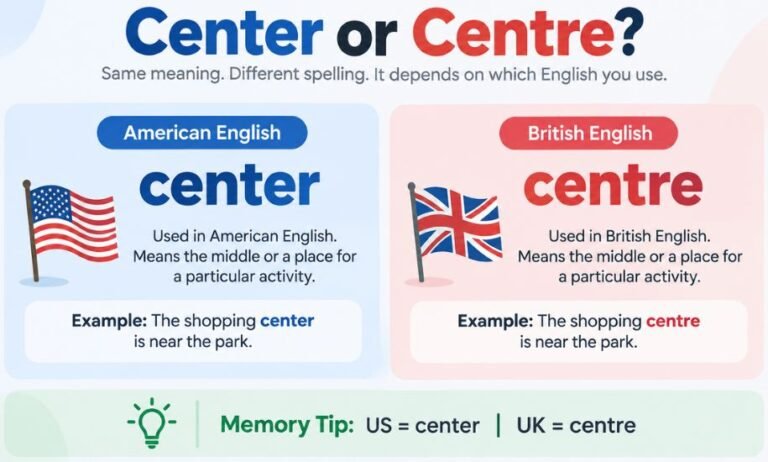
- center
- organization
British English commonly uses:
- colour
- favourite
- centre
- organisation
There are additional differences between the two varieties, but the important point is to follow one spelling system rather than mixing conventions unnecessarily.
Common Mistakes to Avoid
Treating “colour” as incorrect
Colour is not a misspelling. It is the standard British English form.
Treating “color” as incorrect
Likewise, color is not an incorrect version of colour. It is the standard American spelling.
Mixing the two forms
Switching between color and colour in the same document can make your writing look inconsistent.
Forgetting related forms
The regional distinction also applies to related words:
- American: colored, coloring, colorful
- British: coloured, colouring, colourful
Assuming one form works everywhere
Neither spelling is universally preferred in every English-speaking context. Your audience and chosen style guide should determine which form you use.
An Easy Way to Remember the Difference
A simple memory trick is to associate the u in colour with British spelling.
Think:
British → colour
American → color
You can extend the pattern to related words:
colour → coloured → colouring → colourful
and
color → colored → coloring → colorful
Once you remember that British English keeps the u, the related forms become much easier to recognize.
Examples Side by Side
Seeing the forms in context makes the distinction especially clear:
| American English | British English |
|---|---|
| What is your favorite color? | What is your favourite colour? |
| The walls are a bright color. | The walls are a bright colour. |
| I like these colors. | I like these colours. |
| She colored the drawing. | She coloured the drawing. |
| He enjoys coloring books. | He enjoys colouring books. |
| It is a very colorful design. | It is a very colourful design. |
The meaning remains the same. Only the spelling conventions change.
Frequently Asked Questions
Is color spelled color or colour?
Both spellings are accepted. Color is the standard American English spelling, while colour is the standard British English spelling. The correct choice depends on the variety of English you are following.
Is it colour or color in formal writing?
Either can be appropriate in formal writing. Use color when following American English conventions and colour when following British English conventions. Formal writing does not make one of these regional spellings incorrect.
Are colours and colors both correct?
Yes. Colours is the British English plural, while colors is the American English plural. They mean exactly the same thing.
Which is right: color or colour?
Both are right. The choice depends on regional English. American English normally uses color, whereas British English normally uses colour.
Can I use color and colour in the same article?
You can, but it is generally better to choose one spelling system and use it consistently. Mixing American and British spelling without a reason can make an article appear inconsistent.
Final Verdict: Colour or Color?
Color and colour are both correct spellings of the same word. Use color for American English and colour for British English. The plural forms follow the same pattern: colors in American English and colours in British English. When choosing between them, focus on your audience and maintain consistency throughout your writing. For more straightforward explanations of confusing English choices, Grammarifyr follows its goal of helping readers know the difference and use the right words.
You may also Read : VTI or VOO: Key Differences Explained

One Comment