Pass or Past: Easy Grammar Guide
“Pass” and “past” sound alike, which makes them easy to confuse in writing. However, they do different jobs in a sentence. Pass is mainly a verb that describes an action, while past usually refers to an earlier time or something beyond a particular point. The confusion becomes even greater when passed, the past tense of pass, enters the picture. Knowing how these three forms work will help you choose the right word in sentences such as “walked past,” “passed the test,” “passed away,” and “past due.”
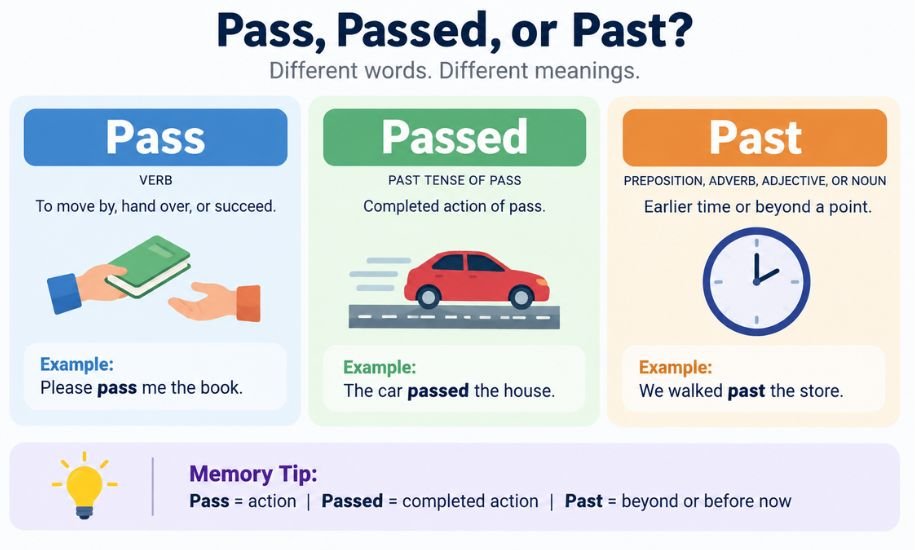
Both pass and past are correct words, but they have different meanings and grammatical functions. Pass is a verb meaning to move by, hand over, succeed, or go beyond, while past commonly means earlier than now or beyond a particular point. Passed is the past tense of pass, so phrases such as “passed away” and “passed the exam” are correct, while “past away” and “past the exam” are not.
Pass, Past, and Passed at a Glance
The easiest way to understand these words is to compare their basic roles:
| Word | Main role | Basic meaning | Example |
|---|---|---|---|
| pass | Verb | To move by, succeed, hand over, or go beyond | I hope I pass the test. |
| past | Preposition, adverb, adjective, noun | Earlier time or beyond a point | We walked past the library. |
| passed | Past tense/past participle of pass | Completed action involving passing | She passed the library. |
The important point is that passed and past are not simply two spellings of the same word. Passed is a grammatical form of the verb pass. Past is a separate word with its own meanings.
What Does “Pass” Mean?
Pass is primarily a verb. It can describe movement, transferring something, succeeding in a test, spending time, or moving beyond a particular point.
For example:
- Please pass me the book.
- I need to pass my driving test.
- The runners pass the stadium every morning.
- Time seems to pass quickly during holidays.
- Can you pass the message to Sarah?
The word can appear in several grammatical forms:
- pass — present/base form
- passes — third-person singular present
- passed — past tense and past participle
- passing — present participle/gerund
This is why “passed” is closely connected to “pass,” while “past” is not simply another form of the verb.
What Does “Past” Mean?
Past commonly relates to time or position. It can mean something that happened before the present or something located beyond a particular point.
Examples involving time include:
- We should learn from the past.
- The past few months have been busy.
- It is half past six.
- She has moved past that difficult period.
Examples involving movement or position include:
- We walked past the museum.
- The bus went past our house.
- He looked past me toward the door.
- The temperature has gone past 40 degrees.
Unlike pass, past is not the verb form of pass. It can function as a preposition, adverb, adjective, or noun depending on the sentence.
Passed or Past: How Do You Choose?
The distinction between passed or past becomes much easier when you identify the verb.
Use passed when you need the past-tense form of pass:
The car passed our house.
Here, passed is the action performed by the car.
Use past when it means “by,” “beyond,” or relates to an earlier time:
The car drove past our house.
Here, drove is the verb. Past tells us where the car went.
Compare these sentences:
- She passed the building.
- She walked past the building.
Both can describe movement, but the grammar is different.
Another useful pair is:
- The deadline passed yesterday.
- The deadline is past.
In the first sentence, passed is a verb. In the second, past indicates that the deadline is already beyond the relevant point.
Past or Passed? A Simple Test
If you are unsure whether to use past or passed, ask yourself whether the word is performing the action of the verb pass.
If it is, use passed for a completed action:
The train passed the station.
If the word means “beyond” or “by,” use past:
The train went past the station.
You can also try replacing past with by. If the sentence still makes sense, past may be the correct choice.
We walked past the restaurant.
We walked by the restaurant.
Both work.
But:
We passed the restaurant.
Here, passed is the main verb, so replacing it with by does not work in the same grammatical way.
Walked Passed or Past?
The correct expression is “walked past.”
We walked past the old theater.
The expression “walked passed” is incorrect when passed is intended to describe the location or direction.
Why? Because walked is already the verb. Past acts as a preposition or adverb indicating movement beyond something.
Correct:
I walked past the bakery.
Incorrect:
I walked passed the bakery.
However, passed can be correct when it functions as the main verb:
I passed the bakery on my way home.
So remember:
walked past something = moved by or beyond it
passed something = moved beyond it, with passed functioning as the verb
Passed Away or Past Away?
The correct expression is “passed away.”
Her grandfather passed away peacefully.
Passed away is a conventional, polite expression meaning “died.” The word passed comes from the verb pass.
“Past away” is not the standard expression in English.
Therefore:
- passed away ✅
- past away ❌
Examples:
- We were saddened to hear that she passed away.
- His uncle passed away several years ago.
- The actor passed away at an advanced age.
This is a particularly common spelling confusion because passed and past have the same pronunciation in standard English.
Past Due or Passed Due?
The correct expression is “past due.”
Your payment is past due.
Past due means that something has gone beyond its required or expected deadline. It is similar in meaning to overdue.
Examples:
- The electricity bill is past due.
- My payment became past due yesterday.
- The invoice is now past due.
- The account has several past-due payments.
The phrase “passed due” is not the standard form when you mean overdue.
There is an important difference between these two sentences:
The due date has passed.
and:
The payment is past due.
In the first sentence, has passed is a verb phrase. In the second, past due describes the status of the payment.
Therefore:
- past due ✅
- passed due ❌
Is It Passed or Past?
The correct choice depends entirely on the sentence.
Use passed when it is the completed form of the verb pass:
The ball passed over the goalkeeper.
She passed her final exam.
The bus passed us without stopping.
Use past when you mean beyond a point or earlier than the present:
We drove past the school.
The worst part is in the past.
It is past midnight.
A useful comparison is:
The time passed quickly.
Here, passed means “went by.”
It is past midnight.
Here, past means “beyond.”
These sentences look similar but use completely different grammar.
Common Mistakes With These Words
1. “I walked passed the store.”
Incorrect:
I walked passed the store.
Correct:
I walked past the store.
Because walked is the verb and past indicates movement beyond the store.
2. “He past the exam.”
Incorrect:
He past the exam.
Correct:
He passed the exam.
Here, passed is the past tense of the verb pass.
3. “She past away last year.”
Incorrect:
She past away last year.
Correct:
She passed away last year.
The established expression is passed away.
4. “The invoice is passed due.”
Incorrect:
The invoice is passed due.
Correct:
The invoice is past due.
Here, past means that the due date has been exceeded.
5. “We drove passed the house.”
Incorrect:
We drove passed the house.
Correct:
We drove past the house.
The verb is drove, so past describes the movement relative to the house.
An Easy Way to Remember Pass, Past, and Passed
Try remembering this three-part rule:
Pass = action
Passed = completed action
Past = beyond or before now
For example:
- I pass the store every day.
- I passed the store yesterday.
- I walked past the store yesterday.
Another useful pattern is to look for the main verb:
The car passed me.
Passed = verb.
The car drove past me.
Past = position/direction.
You can also remember that passed contains -ed, which is a useful clue that it is a completed form of the verb pass.
More Examples in Context
Seeing the words in different situations makes the distinction easier.
Movement
The cyclist passed the truck.
The cyclist rode past the truck.
Tests and exams
I hope I pass the exam.
I passed my English exam last week.
You would not normally use past as the verb in these sentences.
Time
Several hours passed before they arrived.
The meeting lasted past noon.
In the first example, passed means “went by.” In the second, past means “beyond.”
Location
The bus passed our stop.
The bus drove past our stop.
Again, both forms can describe movement, but their grammatical roles differ.
Deadlines
The deadline passed yesterday.
The application is past due.
These are both correct, but the first uses passed as a verb and the second uses past to describe a status.
How to Decide Which Word to Use
When writing, use these questions as a quick checklist:
1. Is it an action performed by someone or something?
Use pass or passed, depending on the tense.
She passed the ball.
2. Does it mean “by” or “beyond”?
Use past.
She walked past the ball.
3. Does it refer to an earlier time?
Use past.
That happened in the past.
4. Does it mean that something has gone by?
Use passed.
The opportunity passed.
5. Is the phrase about death?
Use passed away.
6. Is something overdue?
Use past due.
This approach handles most everyday cases without needing to memorize complicated grammar terminology.
Frequently Asked Questions
Is “pass” or “past” correct?
Both are correct words, but they are used differently. Pass is primarily a verb, while past commonly refers to an earlier time or something beyond a particular point. The correct choice depends on the sentence.
Is it “passed or past” the house?
Both can be correct depending on the construction. You can say, “The car passed the house,” or “The car drove past the house.” In the first sentence, passed is the verb; in the second, past indicates movement beyond the house.
Is “walked passed” or “walked past” correct?
Walked past is correct when you mean that someone walked by or beyond something. For example, “I walked past the library.” Passed would be incorrect in that particular construction because walked is already the main verb.
Is it “past away” or “passed away”?
The standard expression is passed away. It is a polite way of saying that someone died. “Past away” is not the standard spelling of this expression.
Is it “passed due” or “past due”?
The standard expression is past due, meaning overdue or beyond the required deadline. For example, “The payment is past due.” However, you can correctly say, “The due date has passed,” because passed is the verb in that sentence.
What is the easiest way to remember the difference?
Remember: pass/passed = the action; past = beyond or before now. “I passed the shop” uses passed as a verb, while “I walked past the shop” uses past to describe where I walked.
Final Verdict: Pass or Past?
Pass, passed, and past are all legitimate English words, but they cannot be used interchangeably. Use pass for the base verb and passed for its past-tense or past-participle form. Use past when referring to an earlier time or something beyond a particular point. That gives you the correct forms walked past, passed away, and past due. For more straightforward explanations of confusing English words and grammar choices, Grammarifyr helps you Know the Difference. Use the Right Words.
You may also Read : Cringy or Cringey: Meaning, Spelling and Usage
One Comment