Cringy or Cringey: Meaning, Spelling and Usage
If you have ever written about an awkward video, embarrassing conversation, or painfully uncomfortable moment, you may have paused over cringy or cringey. Which spelling should you use? The good news is that this is not a case where one spelling is simply a mistake. Both “cringy” and “cringey” are accepted English forms, and they have essentially the same meaning. However, “cringey” is often the safer choice when you want the spelling that is most clearly connected to the verb cringe and commonly recognized in edited writing.
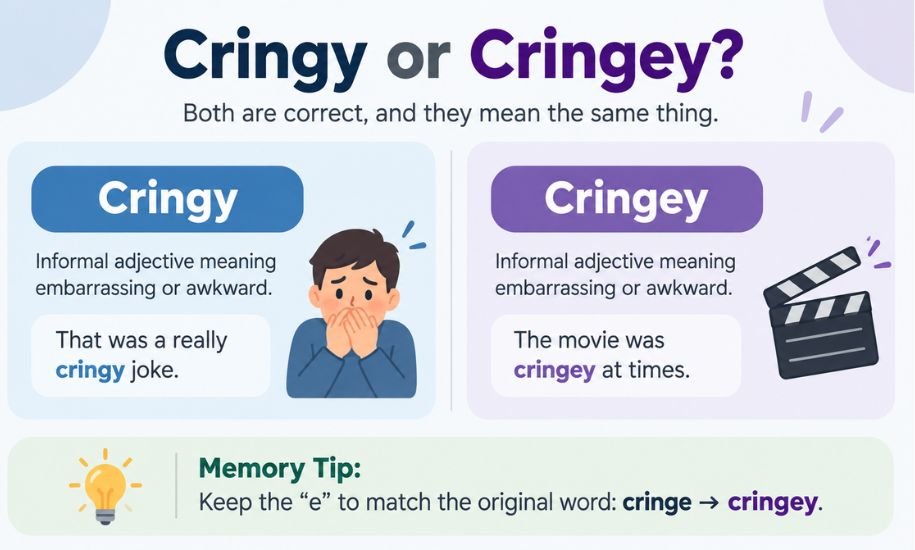
Both cringy and cringey are correct spellings of the informal adjective meaning embarrassing, awkward, or uncomfortable. Cringey is generally the safer default spelling, while cringy is an accepted variant. They are normally pronounced the same and can be used interchangeably in casual English.
Cringy or Cringey: What’s the Difference?
There is very little difference between the two forms. Both are adjectives derived from cringe, and both describe something that makes a person feel embarrassed, uncomfortable, awkward, or secondhand embarrassment.
| Feature | Cringey | Cringy |
|---|---|---|
| Correct spelling? | Yes | Yes |
| Part of speech | Adjective | Adjective |
| Basic meaning | Embarrassing or awkward | Embarrassing or awkward |
| Pronunciation | Usually the same | Usually the same |
| Formality | Informal | Informal |
| Usage | Commonly preferred default | Accepted alternative |
The important point is that cringy is not simply a misspelling of cringey. Major English dictionaries recognize both forms.
If you are writing an article, school assignment, or other edited content and want one form to use consistently, cringey is a sensible choice.
What Does “Cringey” Mean?
Cringey is an informal adjective used for something that causes embarrassment, awkwardness, discomfort, or a feeling of wanting to recoil.
For example:
- That speech was incredibly cringey.
- I found the forced dialogue in the movie cringey.
- His attempt at telling a joke became cringey very quickly.
- Watching my old videos is sometimes painfully cringey.
The word can describe a person’s behavior, a conversation, a performance, a social situation, a piece of media, or almost anything else that produces an uncomfortable reaction.
It is especially useful when you mean “embarrassing to watch or experience.”
Cringey vs. cringe
It is also useful to distinguish the adjective from the related word cringe.
Cringe can function as a verb or noun:
I had to cringe when I heard the recording.
That moment gave me serious cringe.
Cringey is an adjective:
That was a cringey moment.
So you would not normally use cringe and cringey in exactly the same grammatical position.
What Does “Cringy” Mean?
Cringy has essentially the same meaning as cringey. It describes something that produces embarrassment, awkwardness, discomfort, or a cringe reaction.
For example:
- That was a really cringy joke.
- The commercial felt cringy rather than funny.
- Some of his old posts are surprisingly cringy.
- The scene was intentionally cringy.
There is no important difference in meaning between:
That was cringey.
and
That was cringy.
Both tell the reader that the situation was embarrassing or uncomfortable.
The difference is primarily spelling preference, not meaning.
Is It Cringy or Cringey in a Sentence?
If you are wondering is it cringy or cringey, either form can work.
Consider these examples:
Cringey:
Her attempt to imitate the singer was extremely cringey.
Cringy:
Her attempt to imitate the singer was extremely cringy.
Both sentences are grammatically acceptable.
Another example:
That pickup line was so cringey that everyone went silent.
You could replace cringey with cringy without changing the meaning:
That pickup line was so cringy that everyone went silent.
When choosing between them, consistency matters more than trying to create a difference that does not exist.
Why Are There Two Spellings?
The two forms arise from adding the adjective-forming ending -y to cringe.
English sometimes handles a final silent e differently when forming adjectives. This can result in competing spellings.
That gives us:
cringe → cringey
and
cringe → cringy
Both forms have established usage, which is why dictionaries recognize them rather than treating one as an ordinary spelling error.
The spelling cringey has the advantage of making the connection to cringe visually obvious. That may be one reason it is a particularly useful default when writing for a broad audience.
Which Spelling Should You Use?
If you simply need to choose one, use cringey.
That does not mean cringy is wrong. Rather, cringey is a straightforward choice when you want to avoid readers wondering whether you made a spelling mistake.
Use “cringey” when:
- You are writing an edited article.
- You want to make the connection with cringe obvious.
- You are choosing one consistent spelling for a publication.
- You prefer the dictionary form commonly presented as cringey.
Use “cringy” when:
- You are writing casually.
- You are quoting someone’s wording.
- You naturally prefer the shorter spelling.
- The surrounding text already uses that spelling consistently.
The most important rule is do not switch randomly between the two forms in the same piece of writing.
Examples: Cringey and Cringy in Context
Here are some natural examples showing that either spelling can describe the same kind of situation.
Social situations
His attempt to impress everyone at dinner was cringey.
His attempt to impress everyone at dinner was cringy.
Entertainment
The movie deliberately includes several cringey scenes.
The movie deliberately includes several cringy scenes.
Old memories
Looking back at my teenage messages is incredibly cringey.
Looking back at my teenage messages is incredibly cringy.
Behavior
Her exaggerated reaction seemed cringey.
Her exaggerated reaction seemed cringy.
These examples demonstrate why it is misleading to describe one spelling as having a completely different definition.
Is “Cringey” a Real Word?
Yes. Cringey is a real English word, and it is recognized by major dictionaries.
It is generally classified as an informal adjective. The word has been established in English usage for decades rather than being merely a recent internet invention.
Similarly, cringy is recognized as a variant spelling.
Therefore, if you write:
“That was cringey.”
you are not making a spelling mistake.
And if you write:
“That was cringy.”
you are not necessarily making one either.
The choice depends largely on spelling preference and context.
Cringy or Cringey in Tagalog
The question of cringey or cringy in Tagalog is slightly different because there is no single perfect translation for every situation.
Depending on context, possible Tagalog expressions include:
- nakakahiya — embarrassing or shame-inducing
- nakaka-ilang — making someone feel awkward or uncomfortable
- korni — corny, lame, or uncool in an informal context
For example:
That video is so cringey.
could be expressed naturally in Tagalog as:
Nakakahiya talaga ang video na iyon.
In another context, especially when cringey means “lame” or “uncool,” korni might communicate the intended idea better.
This is why a direct word-for-word translation is not always ideal. The best Tagalog equivalent depends on whether the English speaker means embarrassing, awkward, uncomfortable, corny, or painfully awkward.
Common Mistakes to Avoid
1. Assuming “cringy” is always wrong
This is the biggest misconception.
Cringy is an accepted variant, so it should not automatically be corrected to cringey.
2. Assuming the two words have different meanings
They generally do not. Both describe something that causes a cringe reaction or feelings of embarrassment and discomfort.
3. Treating “cringey” as formal vocabulary
Although it is a recognized word, it is still informal. In formal writing, alternatives such as embarrassing, awkward, or uncomfortable may be more appropriate.
For example:
Informal:
His presentation was painfully cringey.
More formal:
His presentation was extremely awkward.
4. Mixing spellings without reason
If you choose cringey in an article, stick with it unless there is a specific reason to reproduce cringy.
Consistency makes writing look more polished.
5. Confusing “cringe” with “cringey”
Remember the grammatical roles:
I cringe whenever I hear that song.
That song is cringey.
The first uses cringe as a verb; the second uses cringey as an adjective.
An Easy Way to Remember the Preferred Spelling
If you want a simple practical rule, remember:
CRINGE → CRINGEY
Keeping the e makes the relationship between the adjective and the original word immediately visible.
You can still use cringy, because it is an accepted variant. But when you are unsure which form to choose, cringey is the easy default.
Is One Form Better for Formal Writing?
Neither form is particularly formal.
Even though dictionaries recognize both, cringey and cringy are associated with informal conversation and contemporary casual English.
If you are writing something formal, consider what you actually mean and choose a more precise adjective:
- embarrassing
- awkward
- uncomfortable
- painful to watch
- humiliating, when the context warrants it
- embarrassing to observe, in more formal prose
For example:
Casual:
The interview was really cringey.
More formal:
The interview contained several awkward moments.
The better choice depends on the tone of your writing.
Frequently Asked Questions
Is “cringy” or “cringey” correct?
Both are correct. Cringey is generally the safer default spelling, while cringy is an accepted variant. Both are informal adjectives describing something embarrassing, awkward, or uncomfortable.
Is it cringy or cringey in American English?
Both forms can be used in American English. There is no American-versus-British distinction that makes one universally correct and the other incorrect. Choose one spelling and use it consistently.
Is “cringey” a real word?
Yes. Cringey is a recognized informal English adjective. Dictionaries define it in terms of causing embarrassment, discomfort, or a cringe reaction.
Is “cringy” a misspelling?
No. Cringy is an accepted spelling variant of cringey. Although some writers prefer cringey, it is inaccurate to say that cringy is always a spelling error.
What does cringey mean in Tagalog?
There is no single translation that works in every context. Depending on the situation, cringey can correspond to nakakahiya, nakaka-ilang, or korni. The intended meaning determines the most natural translation.
Which spelling should I use in an article?
Cringey is a good default choice for an edited article because it is clearly recognizable and closely reflects the base word cringe. However, cringy is also acceptable.
Final Verdict: Cringy or Cringey?
When choosing between cringy or cringey, you do not need to worry about one being an outright spelling error. Both are valid forms with essentially the same meaning, but cringey is the better default if you want one spelling for polished general writing. For more formal contexts, consider replacing either word with a precise alternative such as awkward or embarrassing. For more useful word comparisons and practical grammar guidance, Grammarifyr follows the simple principle: know the difference and use the right words.
You may also Read : Naive or Nieve: Meaning, Spelling and Examples


One Comment