Lite or Light: The Simple English Usage Guide
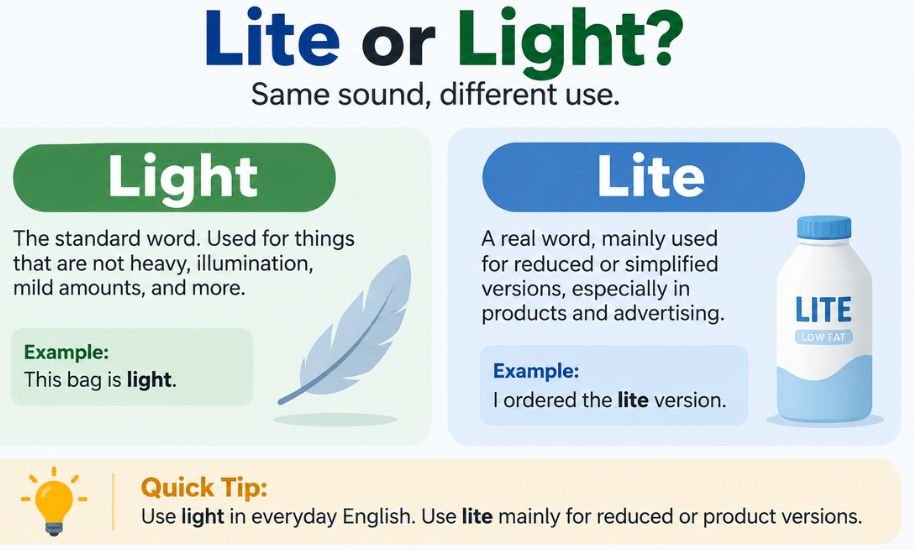
If you are unsure whether to write lite or light, the correct choice depends on what you mean. Light is the standard English word and is used for things that are not heavy, illumination, mild amounts, and many other meanings. Lite is also a real word, but it is mainly used informally, especially in advertising, product names, food labels, and expressions describing a reduced or simplified version of something. Knowing the context makes the choice much easier.
Light is the standard spelling in ordinary English. Lite is a recognized but more limited form, commonly used for reduced-calorie products, simplified versions, advertising, and brand names. If you mean “not heavy,” always use light.
Lite or Light: What’s the Difference?
The two words sound exactly alike, but their standard uses are different.
| Word | Standard use | Example |
|---|---|---|
| light | General English word with many meanings | This box is light. |
| lite | Informal, commercial, or product-related spelling | I ordered a lite version. |
| light | Something with little weight | The jacket is light. |
| lite | Reduced or simplified product/version | Try the lite plan. |
The safest general rule is simple: choose “light” unless “lite” is deliberately being used as a commercial, informal, or established product form.
What Does “Light” Mean?
Light is a versatile English word that can function as a noun, adjective, verb, or adverb in different contexts.
As an adjective, it can describe something that weighs little:
- This laptop is surprisingly light.
- She carried a light suitcase.
- The package is light enough to lift easily.
It can also describe something that is not intense or substantial:
- We had a light lunch.
- There was light rain in the afternoon.
- He prefers light exercise.
As a noun, light can refer to illumination:
- Turn on the light.
- Sunlight filled the room with light.
As a verb, it can mean to ignite something:
- Please light the candle.
- She lit the fireplace.
Because light has so many established meanings, it is the normal spelling in standard English.
What Does “Lite” Mean?
Lite is a genuine English word, but its use is much narrower than light.
It is especially common in commercial and informal contexts. A product described as lite may contain less of something, such as calories, fat, sugar, or another ingredient. The spelling can also describe a simplified version of a product, service, or experience.
For example:
- The restaurant offers a lite meal option.
- I downloaded the lite version of the application.
- The company introduced a lite subscription plan.
The word is also frequently part of official product names. In such cases, the spelling should remain exactly as the manufacturer or company uses it.
In formal writing, however, replacing light with lite simply because the words sound alike is usually inappropriate.
Lite or Light for Weight?
When talking about weight, the answer is definitely light.
Use light when something is not heavy:
- This backpack is light.
- The camera is small and light.
- I need a light jacket for summer.
Using lite in these sentences would normally be incorrect:
- ❌ This backpack is lite.
- ❌ The camera is very lite.
- ❌ I bought a lite suitcase.
So, if you are asking lite or light for weight, remember that light is the standard choice.
A useful distinction
Compare these two sentences:
This tablet is light.
This means the tablet does not weigh much.
This tablet has a lite version.
This means there is a simpler or reduced version of the product.
The meanings are completely different even though the words sound identical.
Is It Lite or Light When Describing Food?
Food is one area where the distinction becomes more interesting.
Light is the normal English adjective when describing a meal or food that is small, mild, delicate, or not very filling.
For example:
- We had a light breakfast.
- I’ll have a light dinner tonight.
- They served light snacks before the main meal.
Lite, on the other hand, is often used commercially to suggest that a product has been reduced in calories, fat, sugar, sodium, or another component.
For example:
- lite yogurt
- lite mayonnaise
- lite snacks
The exact meaning depends on the product and its labeling. In ordinary prose, light is generally the more natural choice unless lite is part of a product’s official name or deliberately communicates a reduced formulation.
Is It Lite Bites or Light Bites?
The standard phrase is generally light bites.
For example:
The hotel offers light bites throughout the afternoon.
Here, light bites means small snacks or foods that are not intended to be a substantial meal.
Lite bites can also appear, particularly in menus, advertising, or product names where lite is intended to suggest reduced calories or a healthier formulation.
Compare:
- Light bites = small or relatively light foods.
- Lite bites = a commercial-style expression that may suggest reduced calories or a lighter formulation.
Therefore, if you are simply writing ordinary English, light bites is the safer choice.
Lite Duty or Light Duty?
The standard expression is light duty, not lite duty.
Light-duty is an established compound adjective used for work, equipment, vehicles, tasks, or services designed for relatively limited demands.
Examples include:
- light-duty trucks
- light-duty equipment
- light-duty work
- light-duty machinery
For example:
This vehicle is designed for light-duty use.
The contractor needs a light-duty power tool.
Although you may occasionally see lite used creatively in commercial language, light duty is the established spelling in standard English.
Lighted or Lit: Which Is Correct?
The question lighted or lit is different from the spelling issue above because both forms can be correct.
The verb light has the past-tense and past-participle forms lit and lighted.
Examples:
- She lit a candle.
- She lighted a candle.
Lit is especially common in everyday English:
He lit the lamp before going upstairs.
Lighted is also standard and can appear naturally in particular contexts:
The hallway was filled with lighted candles.
As a practical rule, lit is often the more natural choice when describing the action of lighting something, while lighted remains an acceptable form.
Verb forms at a glance
| Form | Example |
|---|---|
| Present | I light the candle. |
| Past | I lit the candle. |
| Past participle | I have lit the candle. |
| Alternative past/participle | lighted |
So do not confuse lit with lite. They are entirely different words.
Why Are Lite and Light Confused?
The main reason is pronunciation: lite and light sound the same.
The difference is visible only in spelling. This creates uncertainty when someone hears a phrase and has to decide which form to write.
There is also a practical reason for the confusion: advertising and branding have made lite familiar to English speakers. People regularly encounter it on food labels, product names, software editions, and commercial descriptions.
That does not mean lite can replace light everywhere.
A useful way to think about the relationship is:
Light = the normal English word.
Lite = a specialized or informal spelling used in particular contexts.
Examples of Light and Lite in Sentences
Here are some side-by-side examples:
Use “light” for weight
This suitcase is light enough for a child to carry.
Not:
❌ This suitcase is lite enough for a child to carry.
Use “light” for illumination
The kitchen light is still on.
Not:
❌ The kitchen lite is still on.
Use “light” for a small meal
We had a light lunch before the meeting.
Use “lite” for a reduced product version
The company offers a lite version of its software.
Use “lite” when it is part of a product name
The manufacturer calls this model the Lite edition.
The capitalization and spelling should follow the official name when applicable.
Use “light bites” in ordinary writing
Guests were offered light bites before dinner.
Use “light duty”
These gloves are suitable for light-duty work.
An Easy Way to Remember the Difference
Think of light as the default spelling.
If you are describing:
- weight,
- brightness,
- color,
- rain,
- meals,
- exercise,
- intensity,
- or the act of lighting something,
light will usually be the correct choice.
Think of lite as a special spelling associated with reduced, simplified, or branded products.
A quick test is:
Would I normally find this word in ordinary English? Use “light.”
If the word is part of a product name or deliberately signals a reduced version, lite may be appropriate.
Common Mistakes to Avoid
1. Using “lite” for weight
❌ The package is very lite.
✅ The package is very light.
2. Assuming “lite” is always wrong
That is also inaccurate. Lite is a recognized word and has established uses, particularly in commercial and informal contexts.
3. Using “lite” for illumination
❌ Turn off the lite.
✅ Turn off the light.
4. Confusing “lite” with “lit”
Lite relates to a specialized spelling of light. Lit is a past-tense or past-participle form of the verb light.
She lit the candle.
5. Writing “lite duty”
In standard English, use light duty or light-duty.
Frequently Asked Questions
Is “lite” a real word?
Yes. Lite is recognized in dictionaries, but it has a narrower range of uses than light. It is especially associated with advertising, food products, simplified versions, and brand or product names.
Is light or lite correct for something that weighs less?
Light is correct. For example, “This bag is light” means that the bag does not weigh much. Lite should not normally be used to describe physical weight in standard English.
Is “light bites” or “lite bites” correct?
Light bites is the standard phrase when you mean small or relatively light snacks. Lite bites can be used in commercial or menu language when lite is intended to suggest a reduced-calorie or specially formulated product.
Is “light duty” or “lite duty” correct?
Light duty is the standard expression. It describes work, equipment, machinery, vehicles, or tasks intended for relatively limited demands.
Are “lighted” and “lit” both correct?
Yes. Both can function as past-tense or past-participle forms of light. Lit is very common in everyday use, while lighted is also grammatically acceptable and can be natural in certain constructions.
Should I use “lite” in formal writing?
Usually, use light unless lite is part of an established product name, quotation, title, or context where the specialized spelling is intentional. In formal prose, lite should not be used merely as a stylistic replacement for light.
The Bottom Line
When choosing between lite or light, make light your default. It is the standard word for weight, illumination, mild or reduced intensity, meals, and many other ordinary meanings. Lite has legitimate but more specialized uses, particularly for reduced products, simplified versions, and branding. If you keep that distinction in mind, phrases such as light bites, light duty, and light for weight become much easier to get right. For more straightforward explanations of confusing English words, Grammarifyr follows the same principle: know the difference and use the right words.
You may also Read : Gluing or Glueing: The Correct Spelling Explained
One Comment