Gluing or Glueing: The Correct Spelling Explained
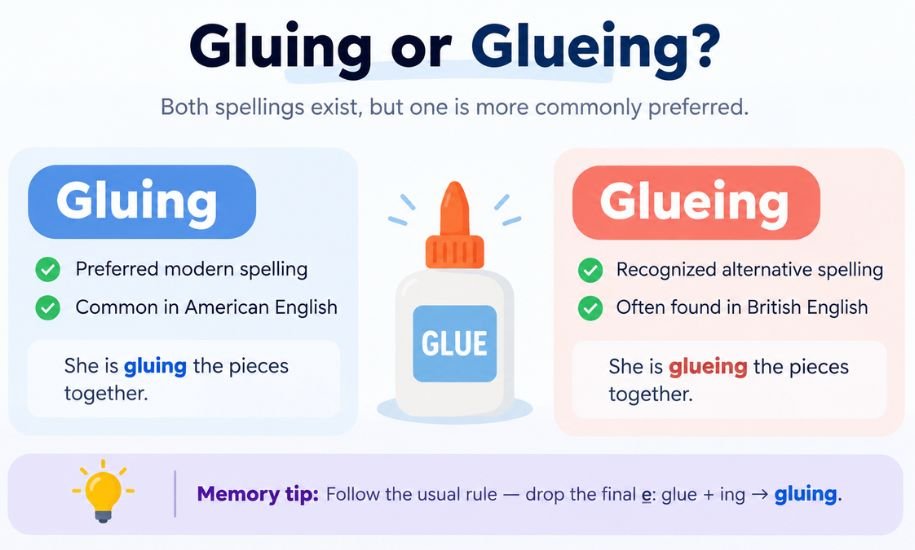
When writing about sticking two things together, you may hesitate over whether the correct form is “gluing” or “glueing.” The confusion is understandable because the base word is glue, and English spelling rules do not always make it obvious what happens when -ing is added. The good news is that you will usually want gluing in modern English. However, glueing is not simply a made-up spelling: it is recognized as an alternative form by some major dictionaries, particularly in British English.
Gluing is the preferred spelling for most modern English writing. Glueing is also a recognized variant, especially in British English, but it is less commonly preferred. If you need one form for general or American English, choose gluing.
Gluing or Glueing: The Quick Difference
The two forms come from the verb glue, which means to join or attach something using glue.
| Form | Status | Typical use |
|---|---|---|
| gluing | Preferred modern form | General English, especially American English |
| glueing | Accepted variant | Particularly found in British English and some other usage |
| glue | Base verb | To attach something with adhesive |
| glued | Past tense/past participle | Something that has been attached |
For example:
- Correct/preferred: She is gluing the photographs into her scrapbook.
- Alternative: She is glueing the photographs into her scrapbook.
The first sentence is the safer choice if you want a spelling that will look natural to the broadest English-speaking audience.
What Does “Gluing” Mean?
Gluing is the present participle and gerund form of the verb glue.
The verb glue means to attach, stick, or join something with glue or another adhesive. When -ing is added, the resulting word describes an action that is happening or an activity.
Examples of “gluing”
- Tom is gluing the broken pieces back together.
- We spent the afternoon gluing cardboard onto the model.
- Gluing the labels onto the jars took longer than expected.
- She is carefully gluing the paper to the board.
In the sentence “They are gluing the pieces together,” gluing is part of the present continuous verb phrase.
In “Gluing paper requires patience,” it functions as a gerund because the activity itself is being discussed.
Is “Glueing” a Real Word?
Yes. This is an important point because it is sometimes incorrectly described as nothing more than a spelling mistake.
Glueing is recognized as an alternative form of the present participle of glue in reputable dictionaries. Cambridge Dictionary includes glueing, while Collins lists both gluing and glueing among the forms of the verb.
That means you should not automatically mark every occurrence of glueing as grammatically incorrect.
However, recognition does not mean the two spellings are equally preferable in every situation. Gluing is generally the better default, particularly for American English and broad international audiences.
Why Is It Spelled “Gluing”?
The usual spelling pattern explains why gluing looks more natural to many readers.
English often drops a final silent e before adding -ing:
- make → making
- write → writing
- hope → hoping
- use → using
- move → moving
Following this familiar pattern gives:
glue → gluing
The spelling can look slightly unusual because glue ends in ue, but the final e is not retained in the preferred form.
This is why gluing is generally the form you should use when writing instructions, articles, schoolwork, professional material, or other standard English prose.
Why Does “Glueing” Exist?
The alternative spelling glueing has persisted because spelling conventions are not perfectly uniform across English.
A writer may see the word glue and naturally add -ing without removing the final e, producing glueing. Historically and regionally, that form has been used enough to appear in dictionaries.
This also explains why someone familiar with British English may encounter glueing without considering it an error.
The important distinction is therefore:
Gluing = preferred modern spelling
Glueing = recognized alternative spelling
It is more accurate to describe the second form as an alternative or less-preferred spelling than to call it universally incorrect.
Gluing or Glueing in UK English
If you are specifically wondering about glueing or gluing UK usage, both forms can be encountered in British English.
British English does not require writers to use glueing instead of gluing. Gluing is perfectly understandable and acceptable, while glueing has dictionary recognition as a variant.
So it would be misleading to say:
“Gluing is American, while glueing is British.”
The distinction is not that simple.
If you are writing for a British audience, you can use gluing without concern. If you encounter glueing in British material, however, it should not automatically be treated as a spelling error.
For consistency, choose one form and use it consistently throughout a document.
Is It “Gluing or Glueing” in American English?
In American English, gluing is the clear practical choice.
For example:
- The children are gluing shapes onto the poster.
- Make sure the surface is clean before gluing the pieces together.
- He is gluing the broken handle back onto the cup.
If your audience is primarily American, using gluing will avoid unnecessary questions about the spelling.
The same recommendation generally works for international websites because gluing is straightforward and widely recognized.
Examples: Correct Usage in Sentences
Here are several natural examples using the preferred form:
- She is gluing the two pieces of wood together.
- I finished gluing the pictures into my notebook.
- The students are gluing colored paper onto the poster.
- Wait until the paint dries before gluing the pieces together.
- He spent an hour gluing the model airplane together.
- Gluing the fabric requires a suitable adhesive.
You may also see the alternative:
She is glueing the pieces together.
This form can be found in English usage, but gluing is normally the better choice when you want the most widely accepted modern spelling.
Common Mistakes to Avoid
1. Assuming “glueing” has a different meaning
It does not. Gluing and glueing refer to the same basic action: attaching something with glue.
The difference is primarily spelling and usage preference, not meaning.
2. Calling “glueing” universally wrong
Because dictionaries recognize glueing as a variant, calling it an outright misspelling is too strong.
If you are teaching standard modern usage, it is better to recommend gluing while explaining that glueing exists as an alternative.
3. Treating British and American English as completely separate rules here
The distinction is not as straightforward as color/colour or center/centre. Both gluing and glueing can be encountered in British English.
4. Switching forms within the same document
If you choose gluing, continue using it rather than alternating between gluing and glueing. Consistent spelling makes writing look cleaner and more deliberate.
An Easy Way to Remember “Gluing”
A simple rule is:
Glue + -ing → gluing
Think of other common verbs where the final e disappears:
- use → using
- make → making
- write → writing
- glue → gluing
If you are unsure and need the safest modern form, remember: drop the final e and write “gluing.”
Frequently Asked Questions
Is it gluing or glueing?
Gluing is the preferred spelling for most modern English writing. Glueing is also a recognized variant, so it is not accurate to call it universally incorrect. For American English and general-purpose writing, gluing is the safest choice.
Is it glueing or gluing in the UK?
Both forms can be found in British English. Gluing is acceptable and is the preferred choice when you want a modern, broadly recognizable spelling. Glueing is also recorded as a variant in major dictionaries.
Is “glueing” a misspelling?
Not necessarily. Although gluing is generally preferred, glueing is a recognized alternative spelling. Its use is less common in many contexts, but it should not automatically be treated as an error.
Is “gluing” a verb?
Yes. Gluing is the present participle and gerund form of the verb glue. For example, “She is gluing the pieces together” uses it as part of a verb phrase.
Which spelling should I use in formal writing?
Use gluing. It is the safest and most widely recognizable choice for formal, academic, professional, and general-purpose writing, particularly when addressing an international or American audience.
Final Verdict: Gluing or Glueing?
Gluing is the best default spelling. It is the form most writers should choose for modern general English, especially American English. Glueing is not simply a fictional or meaningless spelling—it is recognized as a variant, including in British English. If you want a clear, consistent choice, use gluing. That practical approach fits the mission of Grammarifyr: Know the Difference. Use the Right Words.
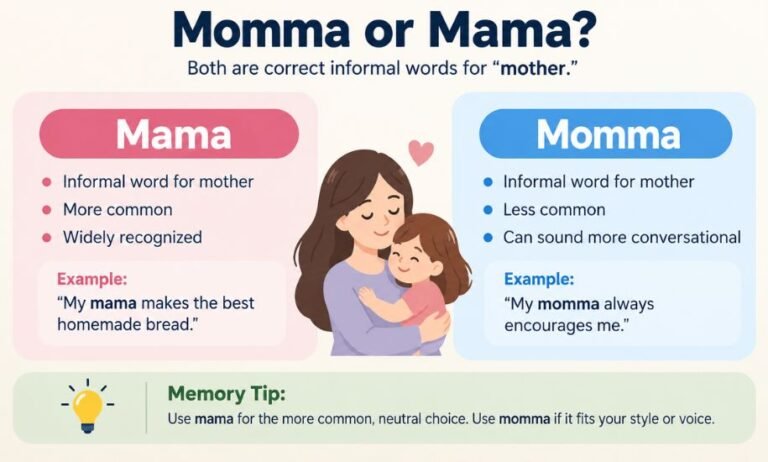
You may also Read : Momma or Mama: Meaning and Correct Usage
One Comment