Momma or Mama: Meaning and Correct Usage
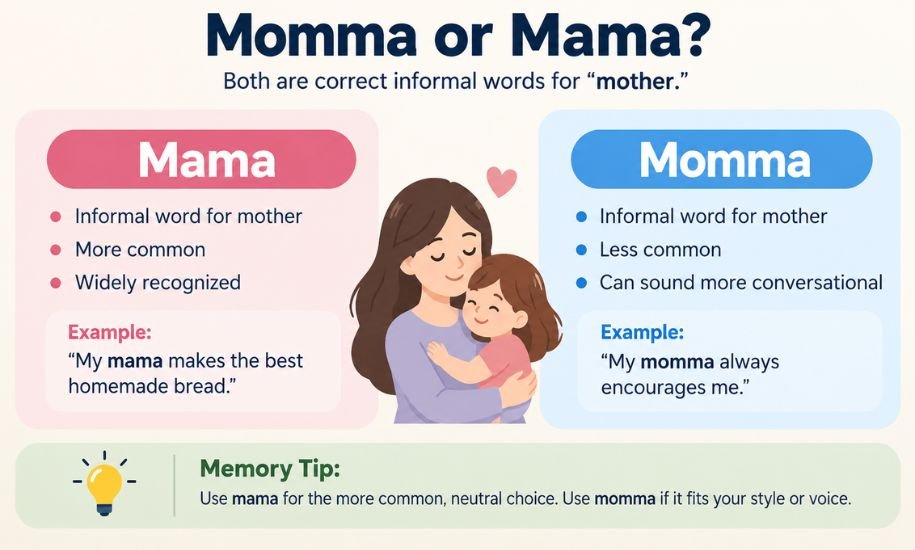
If you are unsure whether to write momma or mama, you are not alone. Both forms appear in everyday English, especially in affectionate or informal references to a mother. The good news is that neither spelling is simply a mistake. Mama is the more common and broadly recognized form, while momma is a less common variant that can sound especially conversational or affectionate. The right choice often depends on the tone you want and the context in which you are writing.
Both mama and momma are correct informal words for “mother.” Mama is generally the more common and neutral spelling, while momma is a less common variant that can give writing a more conversational or regional feel. In formal writing, mother is usually the better choice.
Momma or Mama: Which Is Correct?
The short answer is both.
Mama is an informal term for a mother and is widely recognized in English. Momma has the same basic meaning and is also an accepted spelling, although it is less common.
So, if you are asking, “Is it momma or mama?”, there is no need to treat one as a misspelling of the other.
Compare these sentences:
- “My mama makes the best homemade bread.”
- “My momma makes the best homemade bread.”
Both sentences are grammatically acceptable. The difference is mainly one of style, familiarity, and personal or regional preference.
For most general writing, mama is the safer choice because it is shorter and more widely recognized. However, momma is perfectly reasonable when it suits the speaker’s voice.
A Quick Comparison
| Feature | Mama | Momma |
|---|---|---|
| Correct spelling? | Yes | Yes |
| Meaning | Mother | Mother |
| Part of speech | Noun | Noun |
| Register | Informal/affectionate | Informal/affectionate |
| Frequency | More common | Less common |
| Best general choice | Yes | Depends on context |
| Formal writing | Usually avoid | Usually avoid |
Neither word should normally be confused with the formal word mother. Both are informal ways of referring to or addressing one’s mother.
What Does “Mama” Mean?
Mama is an informal noun meaning mother. It is often used by children and adults in affectionate family contexts.
For example:
- “I called my mama after I arrived home.”
- “Her mama taught her how to bake.”
- “Mama, could you help me with this?”
- “The child ran to her mama.”
The word can be used when talking about someone’s mother or when directly addressing her.
When it is used as a name-like form of address, it may be capitalized:
“Thank you, Mama.”
When it is simply an ordinary noun, lowercase is generally appropriate:
“My mama lives nearby.”
The exact capitalization can also depend on the style guide and the writer’s intended treatment of the word.
What Does “Momma” Mean?
Momma has essentially the same meaning as mama: an informal or affectionate word for mother.
Examples include:
- “My momma always encouraged me to work hard.”
- “I miss my momma when I am away.”
- “Come sit with me, Momma.”
- “His momma taught him to be patient.”
The additional m does not create a different grammatical meaning. Instead, it represents an alternative spelling.
Dictionaries generally treat momma as a variant or less common form of mama. It can be especially natural in dialogue, personal writing, songs, stories, or situations where a particular conversational voice is important.
Mama or Momma: What’s the Main Difference?
The biggest difference is usage rather than meaning.
Mama tends to be the more neutral and widely recognized spelling. If you are writing a general article, a school assignment, or an ordinary piece of prose and have no particular reason to use the alternative, mama is usually the simplest choice.
Momma, on the other hand, can feel more personal, conversational, or regional. A writer might choose it because that is the spelling used in their family or because it better reflects the way a character speaks.
Consider:
“My mama taught me never to give up.”
and:
“My momma taught me never to give up.”
The basic message is the same. The second version may simply convey a slightly different voice.
How Do You Spell Mama or Momma?
If you are wondering how to spell mama or momma, remember that both spellings are valid.
The standard-looking choice for many readers is:
mama
The alternative form is:
momma
The important thing is not to assume that momma is automatically incorrect just because mama is more common.
You should also avoid changing between the two spellings randomly within the same piece of writing. If you choose one form for a particular voice or document, consistency generally makes the writing look more polished.
When Should You Use “Mama”?
Choose mama when you want a familiar, straightforward informal term for mother.
It works particularly well when:
- You are writing generally about someone’s mother.
- You want a widely recognizable spelling.
- You are writing dialogue without a specific regional voice.
- You are using an affectionate family term.
- You want to avoid making the spelling feel deliberately dialectal or highly conversational.
Examples:
- “Her mama waited at the front door.”
- “I told my mama about the good news.”
- “Mama, are you ready to leave?”
- “He learned the recipe from his mama.”
If you have no particular stylistic reason to choose momma, mama is generally the easiest option.
When Should You Use “Momma”?
Use momma when that spelling fits the speaker, character, family preference, or tone of the writing.
For example, creative writing might use it to preserve a character’s natural voice:
“My momma always said that hard work pays off.”
It can also appear in affectionate personal writing:
“Happy birthday to my wonderful momma!”
There is no grammatical error in choosing this form. The choice simply has a different stylistic feel for some readers.
It is best not to claim that momma is exclusively a Southern American word. Although the spelling can be associated with particular regional or conversational varieties of American English, it is more accurate to describe it as an informal variant rather than restrict it to one specific region.
Correct Usage Examples
Here are some side-by-side examples:
Correct: “My mama is coming over tonight.”
Also correct: “My momma is coming over tonight.”
Correct: “I bought this gift for my mama.”
Also correct: “I bought this gift for my momma.”
Correct: “Mama, can you help me?”
Also correct: “Momma, can you help me?”
In each pair, the meaning remains essentially unchanged.
The choice becomes more about the voice and style of the sentence than its grammar.
Mama, Momma, and Mother: Choosing the Right Register
The three words can refer to the same person, but they do not have exactly the same level of formality.
Mother is the standard neutral or formal term.
Mama is informal and affectionate.
Momma is also informal and affectionate, with an alternative conversational flavor.
For example, a formal document would normally say:
“The child’s mother signed the form.”
An informal personal message might say:
“I called my mama this morning.”
And a personal or character-driven sentence might say:
“My momma always had a story to tell.”
Choosing between these terms is therefore partly a matter of register. The spelling is not the only consideration; the relationship between the speaker, audience, and subject matters too.
Should You Capitalize Mama or Momma?
Capitalization depends on how the word is used.
When the word is being used directly as a form of address, capitalization is common:
- “I love you, Mama.”
- “Good morning, Momma.”
- “Mama, where are my shoes?”
When it is used as a regular noun, lowercase is generally appropriate:
- “My mama called yesterday.”
- “Her momma lives in another state.”
Think of the distinction similarly to a person’s name. If the word functions like a name in direct address, capitalization can be appropriate; if it simply describes a relationship, lowercase is generally used.
Common Mistakes to Avoid
1. Assuming “momma” is always wrong
It is not. Momma is an accepted informal variant of mama, so calling it a simple misspelling is inaccurate.
2. Treating “mama” as a formal word
Although mama is correct, it is generally informal. In formal documents, mother is usually more appropriate.
3. Mixing spellings unnecessarily
If you write mama in one paragraph and momma in the next without a reason, the change can look inconsistent. Choose the form that best suits your voice and use it consistently.
4. Assuming the extra “m” changes the meaning
It does not. The two forms generally refer to the same relationship.
5. Using an informal form in a formal context
For professional, academic, legal, or official writing, consider whether mother would communicate the intended meaning more appropriately.
An Easy Way to Remember the Difference
There is no complicated grammar rule to memorize.
Just remember:
Mama = the more common, straightforward informal form.
Momma = an alternative informal spelling with the same basic meaning.
If you are choosing a form without any special stylistic reason, mama is usually the safest option.
If a particular person, family, character, or quotation uses momma, there is no need to “correct” it to mama simply because it looks less familiar.
Frequently Asked Questions
Is “momma” a correct word?
Yes. Momma is a recognized informal spelling meaning “mother.” It is generally treated as a less common variant of mama, rather than as a spelling error.
Is “mama” or “momma” more standard?
Mama is generally the more common and broadly recognizable form. Momma is also correct but is less common and may have a more conversational or regional feel.
Is it “mama” or “momma” in American English?
Both can be used in American English. Mama is widely recognized, while momma is an informal variant. Neither should automatically be labeled incorrect.
How do you spell mama or momma?
Both mama and momma are correct spellings when used as informal terms for “mother.” Choose the form that fits your preferred style, family usage, or the voice of your writing.
Should “Mama” be capitalized?
Capitalize Mama when it is being used as a direct form of address or name-like title, such as “Thank you, Mama.” Use lowercase when it functions as an ordinary noun, as in “My mama called.”
Is “momma” appropriate in formal writing?
Usually, no. Although momma is correct, it is informal. In formal writing, mother is generally the more suitable term.
Final Verdict: Momma or Mama?
Mama and momma are both correct. They have essentially the same meaning, but mama is the more common and neutral informal choice, while momma can give writing a more personal, conversational, or regional tone. If you are unsure which one to use, choose mama; if the voice or context calls for momma, that spelling is perfectly acceptable. For more clear explanations of confusing English choices, Grammarifyr helps you know the difference and use the right words.
You may also Read : Useable or Usable: Difference and Correct Usage
One Comment