Defence or Defense: Meaning and Correct Usage
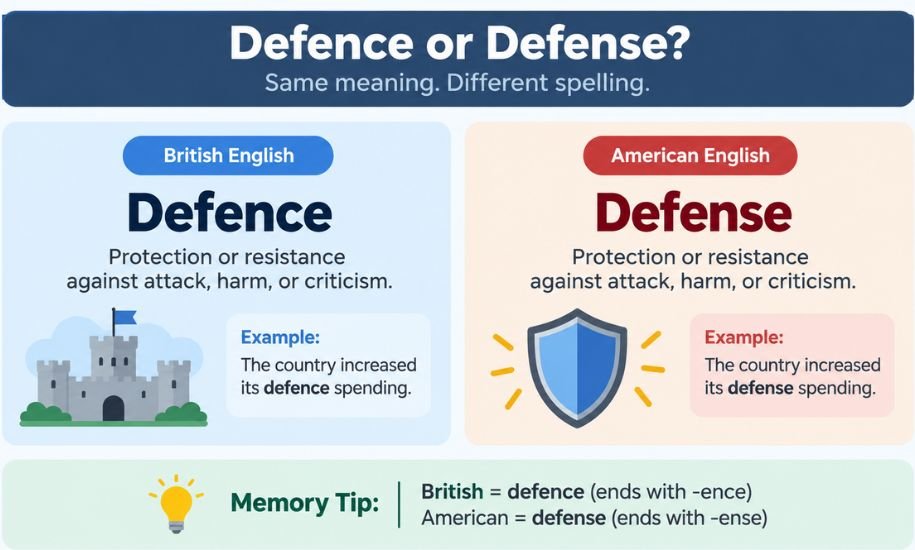
If you have ever wondered whether to write defence or defense, you are not dealing with two different words. Both spellings are correct, but they belong to different varieties of English. Defence is the standard spelling in British English, while defense is the standard American English form. The meaning is the same in both cases, whether you are talking about military protection, a legal argument, protection in sports, or support for an idea. The main challenge is choosing the spelling that matches your audience and using it consistently.
Defence and defense are both correct. “Defence” is used in British English, while “defense” is preferred in American English. The words have the same meaning; only the regional spelling differs.
Defence vs. Defense: The Key Difference
The simplest way to remember the distinction is:
- Defence = British English
- Defense = American English
Neither spelling is universally better or more correct. Your choice should depend on the variety of English you are writing.
| Feature | Defence | Defense |
|---|---|---|
| Correct spelling? | Yes | Yes |
| English variety | British English | American English |
| Meaning | Protection or resistance against attack, harm, or criticism | Same |
| Part of speech | Noun | Noun |
| Plural | Defences | Defenses |
| Example | The country’s defence was strengthened. | The country’s defense was strengthened. |
The same distinction applies to related expressions. For example, British writers generally use defence policy, defence spending, and defence forces, whereas American writers use defense policy, defense spending, and defense forces.
What Does “Defence” Mean?
Defence is the British English spelling of the noun. It can describe protection from physical attack, danger, criticism, or opposition.
It is commonly used in military, legal, sporting, and general contexts.
For example:
- The country increased its defence spending.
- The army is responsible for national defence.
- She gave a strong defence of her decision.
- The team’s defence performed well during the match.
The word can also refer to an argument or evidence presented to protect someone against an accusation.
The lawyer prepared a detailed defence for the accused.
In sports, defence refers to the players or tactics used to prevent an opponent from scoring.
Their defence remained organized throughout the game.
What Does “Defense” Mean?
Defense is the American English spelling. It has exactly the same core meanings as defence.
It can refer to military protection:
The government announced a new defense strategy.
It can describe protection against criticism:
She offered a passionate defense of the proposal.
It can have a legal meaning:
The attorney prepared the defense for the trial.
And it can describe a sporting role:
The team’s defense stopped several scoring opportunities.
So if you are writing for an American audience, defense is normally the appropriate choice.
When Should You Use “Defence”?
Choose defence when your writing follows British English spelling conventions.
This is particularly appropriate when writing for audiences or publications that use British English.
Examples include:
- national defence
- defence minister
- defence policy
- defence spending
- defence system
- defence strategy
- defence mechanism
- legal defence
For example:
The government is reviewing its national defence policy.
The lawyer presented a convincing defence.
If the rest of your document uses spellings such as colour, centre, and organise, using defence keeps the spelling consistent.
When Should You Use “Defense”?
Use defense when you are following American English.
Examples include:
- national defense
- defense minister
- defense policy
- defense spending
- defense system
- defense strategy
- defense mechanism
- legal defense
For example:
The government is reviewing its national defense policy.
The attorney presented a convincing defense.
If your writing otherwise follows American conventions such as color, center, and organize, then defense is the natural choice.
Defenses or Defences: Which Plural Is Correct?
Both defences and defenses are correct. The difference follows the same British-American spelling pattern.
British English: defences
When defence is used as the singular form, its plural is defences.
Examples:
The country’s coastal defences were strengthened.
Several natural defences protect the plant from insects.
American English: defenses
When defense is the singular form, the plural is defenses.
Examples:
The country’s coastal defenses were strengthened.
Several natural defenses protect the plant from insects.
Therefore:
defence → defences
defense → defenses
If you are deciding between defenses or defences, neither is inherently wrong. Select the form that matches the English variety you are using.
Likewise, if you are wondering about defences or defenses, the answer depends on whether your text follows British or American spelling.
Is It Defense or Defence in Formal Writing?
Both forms are acceptable in formal writing, provided that you use the spelling appropriate to your chosen variety of English.
For British English:
The report examines the country’s defence capabilities.
For American English:
The report examines the country’s defense capabilities.
The important issue is consistency. A document should not randomly switch between defence and defense unless you are deliberately reproducing a quotation, official name, or source that uses a different spelling convention.
For example, an American publication would normally write defense, while a British publication would normally write defence.
Defence and Defense in Different Contexts
The spelling difference remains the same regardless of the meaning.
Military context
British:
The government announced increased defence spending.
American:
The government announced increased defense spending.
Legal context
British:
The barrister presented the accused person’s defence.
American:
The lawyer presented the defendant’s defense.
Sports context
British:
The team’s defence conceded only one goal.
American:
The team’s defense allowed only one score.
General protection
British:
Wearing protective clothing provides an additional defence against the cold.
American:
Wearing protective clothing provides an additional defense against the cold.
The meaning does not change simply because the spelling changes.
Why Are These Spellings Different?
The difference is part of the broader spelling distinction between British and American English. A number of words ending in -ence in British English have corresponding American forms ending in -ense.
For example:
- defence → defense
- offence → offense
- pretence → pretense
These differences developed as English spelling conventions evolved on both sides of the Atlantic.
For everyday writing, however, you do not need to remember the historical details. The practical rule is much easier: British English uses defence; American English uses defense.
Common Mistakes to Avoid
1. Treating one spelling as universally wrong
It is incorrect to assume that defense is a spelling mistake simply because you normally use British English. It is the standard American spelling.
Likewise, defence is not a spelling error in British English.
2. Mixing spelling systems
A document that otherwise follows American English should generally use defense, not switch unexpectedly to defence.
The same applies in reverse for British English.
3. Using the wrong plural
The plural forms correspond to their singular spellings:
- defence → defences
- defense → defenses
4. Changing the spelling based on meaning
The spelling does not change because the word refers to military protection, a legal argument, or sports. The regional convention remains the same.
5. Assuming pronunciation determines the spelling
The two forms are pronounced essentially alike in standard varieties of English. Listening to the word alone therefore will not reliably tell you whether to write -ence or -ense.
An Easy Way to Remember the Difference
Think of the final letter pattern:
British: -ence → defence
American: -ense → defense
A useful comparison is:
- British: offence
- American: offense
This can help reinforce the spelling pattern.
The most reliable method, though, is simply to associate defence with British English and defense with American English.
Which Spelling Should You Choose?
Choose based on your readers.
If you are writing for a British audience, use defence. If your audience is primarily American, use defense.
For international websites, either can work. What matters most is establishing a consistent editorial style. If the rest of your content uses British spelling, defence will fit naturally. If your content follows American English, choose defense.
There is no need to use both forms repeatedly in the same article just to accommodate different readers. Pick the appropriate spelling and stick with it.
Examples: Correct and Incorrect Usage
Because both forms are valid, calling one “incorrect” without considering regional English can be misleading.
British English:
Correct: The country strengthened its defence capabilities.
Correct: The team’s defence was excellent.
Correct: She gave a strong defence of the policy.
American English:
Correct: The country strengthened its defense capabilities.
Correct: The team’s defense was excellent.
Correct: She gave a strong defense of the policy.
The following would be inconsistent rather than universally grammatically wrong:
The country strengthened its defence capabilities.
in an otherwise strictly American English document.
Similarly, using defense in an otherwise strictly British English document would create a spelling inconsistency.
Frequently Asked Questions
Is “defence” or “defense” correct?
Both are correct. Defence is the standard British English spelling, while defense is the standard American English spelling. They have the same meaning and grammatical function.
Is it defense or defence in American English?
Use defense in American English. For example, “The team has a strong defense” follows standard American spelling.
Is defence British spelling?
Yes. Defence is the standard British English spelling. It is also used in other varieties of English that generally follow British spelling conventions.
Are “defenses” and “defences” both correct?
Yes. Defenses is the American English plural of defense, while defences is the British English plural of defence.
Can I use both spellings in the same article?
You can encounter both in a document, particularly when quoting different sources, but normally you should choose one English variety and use it consistently throughout your own writing.
How can I remember the difference?
Remember the basic pairing: British = defence, American = defense. The plural forms follow the same pattern: defences in British English and defenses in American English.
Final Verdict: Defence or Defense?
There is no single winner between defence or defense. Both are correct spellings of the same word. Use defence for British English and defense for American English, including their respective plural forms defences and defenses. The best choice is the one that matches your audience and the spelling style used throughout your writing. For more clear explanations of easily confused English words and spelling choices, Grammarifyr helps you know the difference and use the right words.
You may also Read : Is or Are? Simple Grammar Rules and Examples

One Comment