Dialog or Dialogue: Meaning and Usage Explained
If you have ever wondered whether to write “dialog or dialogue,” you are not alone. Both forms appear in English, but they are not equally common in every context. Dialogue is the standard choice when talking about conversations, discussions, or the spoken words of characters. Dialog is also a legitimate spelling, especially in American English and in computing, where terms such as “dialog box” are widely used. Understanding the context makes it much easier to choose the right form.
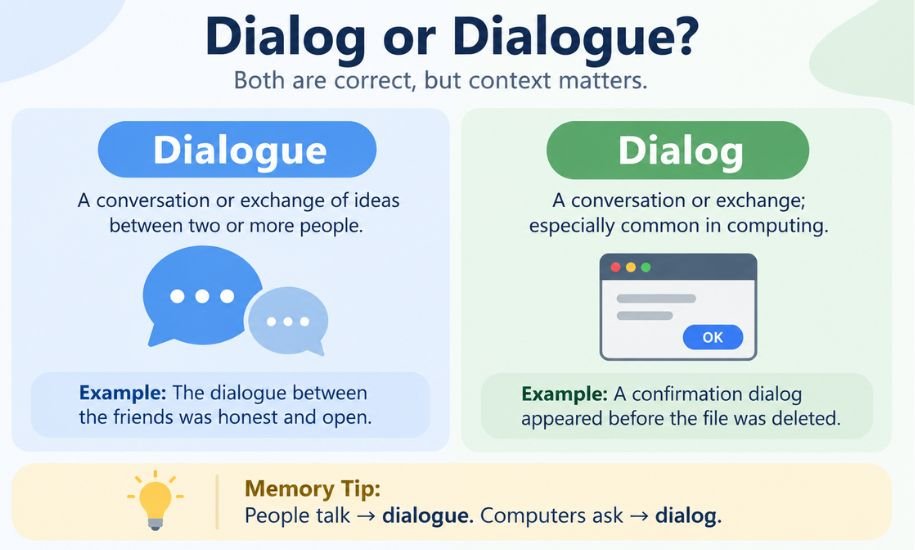
Both dialog and dialogue are correct words. Use dialogue for ordinary conversation, literary or dramatic speech, and discussions; dialog is especially common in American English and in computer terminology such as “dialog box.”
Dialog or Dialogue: What’s the Difference?
The two spellings share the same basic meaning, but their preferred contexts differ.
| Feature | Dialogue | Dialog |
|---|---|---|
| Correct spelling? | Yes | Yes |
| Main meaning | Conversation or exchange | Conversation or exchange |
| Literary use | Very common | Less common |
| Formal discussion | Common | Less common |
| Computing | Less common | Very common |
| British English | Preferred | Uncommon |
| American English | Standard | Standard variant |
The simplest rule is:
Use “dialogue” when you mean conversation. Use “dialog” particularly when referring to software or a computer interface.
This is not an absolute grammatical rule. In American English, dialog can also refer to a normal conversation. Likewise, dialogue is perfectly acceptable in American English for literary and everyday contexts.
What Does “Dialogue” Mean?
Dialogue is a noun meaning a conversation or exchange of ideas between two or more people. It can describe casual speech, formal discussion, or the spoken exchanges between characters in a creative work.
For example:
- The dialogue between the two friends sounded natural.
- The novel contains realistic dialogue.
- The actors practiced their dialogue before filming.
- The two organizations opened a dialogue about the disagreement.
The word can also describe a constructive exchange between groups, institutions, or countries:
The governments continued dialogue to find a peaceful solution.
So, when someone asks, “Dialogue is ___ between two or more people,” a good completion is:
Dialogue is a conversation or exchange of ideas between two or more people.
It is worth noting that dialogue does not have to involve only two individuals. It can involve several participants or even represent an exchange between larger groups.
What Does “Dialog” Mean?
Dialog is a valid English word and a recognized variant of dialogue. It can mean a conversation or discussion, particularly in American English.
However, you will frequently encounter the shorter spelling in computing and software terminology.
Examples include:
- dialog box
- dialog window
- print dialog
- login dialog
- confirmation dialog
- settings dialog
For example:
A confirmation dialog appeared before the file was deleted.
In this technical context, dialog is completely natural.
That is why it would be inaccurate to describe dialog as merely a misspelling of dialogue. It is an established variant.
When Should You Use “Dialogue”?
Choose dialogue in most general writing when you are referring to people talking or exchanging ideas.
1. Books and stories
When referring to what fictional characters say, dialogue is the conventional choice.
The author uses short dialogue to create a sense of tension.
2. Movies and plays
The spoken exchanges between characters are generally called dialogue.
The movie’s dialogue was witty and memorable.
3. Conversations and discussions
The word can describe an actual exchange between people.
We need an honest dialogue about the problem.
4. Formal discussions
Dialogue is also frequently used when describing communication between organizations, communities, or opposing sides.
The two groups agreed to begin a dialogue.
For these situations, dialogue is the safest and most natural choice.
When Is “Dialog” the Better Choice?
The shorter spelling is particularly useful in technical writing.
Software interfaces
You might see:
Open the preferences dialog.
or:
A warning dialog will appear.
Dialog boxes
Dialog box is a well-established computing term. It refers to a small interface window that asks the user to provide information, select an option, or confirm an action.
For example:
Click “Cancel” to close the dialog box.
In technical documentation, changing dialog box to dialogue box would usually sound unusual.
Programming and development
Software developers and technical writers commonly use dialog when naming interface components or describing application behavior.
For example:
The application displays a login dialog when authentication is required.
Here, dialog is the natural technical term.
Is It “Dialog or Dialogue” in American English?
American English accepts both spellings.
However, context often determines which one sounds most natural. Dialogue is widely used for conversations, fictional speech, and formal exchanges, while dialog has a particularly strong presence in computing.
Consider these examples:
General conversation:
The dialogue between the students continued for an hour.
Software:
The application opened a new dialog.
Both sentences use accepted English, but switching the spellings would make the contexts sound less conventional.
Therefore, it is too simplistic to say that dialog is the American spelling and dialogue is the British spelling. American English uses both.
What About British English?
In British English, dialogue is the normal spelling for general conversation and discussion.
For example:
The characters’ dialogue was carefully written.
The shorter dialog is much less common in ordinary British writing, although technical terminology can sometimes follow conventions used by software products and programming communities.
If you are writing for an international or British audience and are not discussing a software interface, dialogue is generally the better choice.
Dialogue or Dialog in Everyday Writing
For everyday writing, dialogue is usually the easiest choice.
Suppose you want to write about a conversation between coworkers:
Natural:
The dialogue between the coworkers helped resolve the disagreement.
You could technically use dialog in American English, but the longer form is more conventional in this context.
The same applies to essays, articles, fiction, and general communication.
Compare these examples
Conversation:
The dialogue between the teacher and student was respectful.
Film:
The director wanted the dialogue to sound realistic.
Political discussion:
Both sides agreed that dialogue was necessary.
Software:
A dialog box asked the user to confirm the action.
The context provides a useful clue about which spelling to select.
Common Mistakes to Avoid
Mistake 1: Assuming “dialog” is always wrong
It is not. Dialog is a legitimate word and an established variant of dialogue.
❌ “Dialog” is never correct.
That statement is inaccurate.
A better understanding is that dialog is particularly common in computing and is also accepted in American English.
Mistake 2: Using “dialogue box” in technical writing
The standard computing expression is generally dialog box, not dialogue box.
Correct: The dialog box asks you to save your changes.
Mistake 3: Assuming the difference is simply US versus UK
The distinction is more complicated than that. American English uses both forms, and dialogue remains very common in American writing.
Mistake 4: Treating “dialog” and “dialogue” as completely different words
They can function as variants with the same fundamental meaning. Their main difference is often context and conventional usage, rather than a completely different definition.
Dialog or Dialogue Examples
Here are some examples that show the difference naturally:
General conversation
The dialogue between the neighbors helped clear up the misunderstanding.
Literature
The writer uses dialogue to reveal the character’s personality.
Movie
The dialogue in the opening scene establishes the main conflict.
Formal discussion
Continued dialogue may help both parties reach an agreement.
Software
The program displays a dialog when the user selects the advanced settings.
Dialog box
Choose “Save” in the dialog box to continue.
These examples demonstrate why context matters more than simply memorizing one spelling.
An Easy Way to Remember the Difference
A practical rule is:
People talk → dialogue.
Computers ask → dialog.
This is not an unbreakable grammar rule, but it is a useful guide for everyday writing.
If you are describing a conversation in a novel, movie, classroom, workplace, or formal discussion, dialogue will usually be your best choice.
If you are describing a software window or interface element, dialog is generally the conventional form.
Frequently Asked Questions
Is “dialog” a correct word?
Yes. Dialog is an accepted variant of dialogue. It is especially common in American English and in computing terminology. It should not automatically be treated as a spelling mistake.
Is “dialogue” more correct than “dialog”?
Not universally. Dialogue is the more conventional choice for general conversation, literary speech, and formal discussion. Dialog is especially conventional in technical contexts such as software interfaces.
Is “dialog” American or British English?
Dialog is particularly associated with American English, while British English generally prefers dialogue. However, American English also uses dialogue extensively, so the distinction is not simply American versus British.
What is a dialogue between two or more people?
A dialogue is a conversation or exchange of ideas between two or more people. It can be informal, such as a conversation between friends, or formal, such as a discussion between organizations.
Should I write “dialog box” or “dialogue box”?
In computing, dialog box is the conventional expression. For example: “A dialog box appeared asking me to confirm the installation.”
Is “dialogue” acceptable in American English?
Yes. Absolutely. American English commonly uses dialogue for conversations, fictional speech, discussions, and formal exchanges. Dialog is an accepted American variant and is especially familiar in technical contexts.
Final Verdict: Dialog or Dialogue?
Both dialog and dialogue are correct, but they are preferred in different situations. Dialogue is the best general-purpose choice for conversations, literary speech, films, and discussions. Dialog is especially useful for software and computing terms such as dialog box and dialog window. When there is no technical context and you are unsure which form to choose, dialogue is usually the safest option. For more practical explanations of confusing English words, Grammarifyr helps you know the difference and use the right words.
You may also Read : Eyeing or Eying: Difference, Meaning and Examples
One Comment