Cosy or Cozy: British and American English Explained
Have you ever wondered whether to write cosy or cozy? Both spellings are correct, but the one you should use depends on your audience. British English generally prefers cosy, while American English uses cozy. The two words have exactly the same meaning: warm, comfortable, snug, or pleasant. Although the difference is only one letter, choosing the appropriate spelling helps make your writing consistent and natural. From describing a welcoming living room to talking about a relaxing evening, understanding this simple distinction will help you use the word confidently.
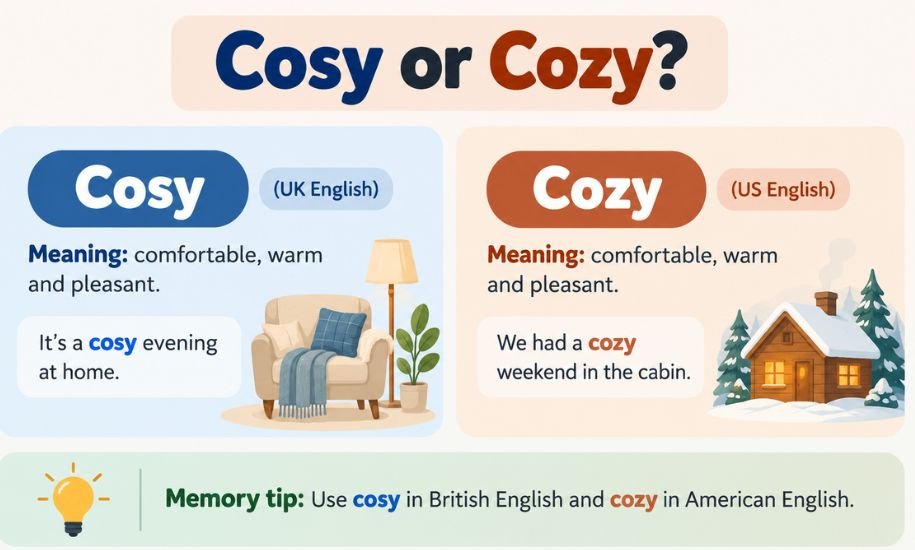
Both cosy and cozy are correct spellings. Cosy is standard in British English, while cozy is standard in American English. Both describe something warm, comfortable, snug, or inviting.
Cosy or Cozy: What Is the Difference?
The main difference is regional spelling, not meaning or pronunciation. British and American English use different spelling conventions for certain words, and this is one example.
| Feature | Cosy | Cozy |
|---|---|---|
| Correct spelling? | Yes | Yes |
| Preferred variety | British English | American English |
| Meaning | Warm and comfortable | Warm and comfortable |
| Pronunciation | Same within a given accent | Same within a given accent |
| Example | A cosy cottage | A cozy cottage |
In the United Kingdom, writers typically use cosy in books, articles, emails, and everyday messages. In the United States, cozy is the conventional choice.
For example:
- British English: We spent a cosy evening reading beside the fire.
- American English: We spent a cozy evening reading beside the fire.
Both sentences communicate the same idea. Neither spelling is universally wrong, so the best choice depends on the variety of English you are writing.
What Does Cosy or Cozy Mean?
Both words are adjectives most commonly used to describe a place, object, atmosphere, or experience that feels comfortable, warm, pleasant, and welcoming.
The word often suggests more than physical warmth. A room can feel cosy because it has soft lighting, comfortable furniture, blankets, and a peaceful atmosphere. Similarly, a quiet evening with friends can feel cosy even when the temperature is not particularly cold.
Here are a few examples:
- The small bedroom feels cosy with its soft blankets and warm lighting.
- We found a cosy little café tucked away on a quiet street.
- She settled into a comfortable chair with a book and a cup of tea.
- Their cottage has a welcoming, cosy atmosphere during winter.
In American English, simply replace cosy with cozy. The meaning remains unchanged.
Can You Describe a Person as Cosy?
Yes, although the expression is less common than describing a room or atmosphere. Calling someone cosy might suggest that they are comforting to be around, enjoy familiar surroundings, or create a relaxed atmosphere.
For example, She is a cosy person to spend an evening with suggests comfort and companionship, although many speakers would find warm, friendly, or comforting more natural in this sentence.
The precise meaning depends on context. If you want to describe someone’s personality, choose a synonym that communicates your intended meaning clearly.
Is It Cosy or Cozy in the UK?
In British English, cosy is the preferred spelling. You will commonly see it in descriptions of homes, restaurants, clothing, holidays, and relaxing experiences.
Consider these British English examples:
- We booked a cosy cottage in the countryside.
- This café has a cosy corner where customers can relax.
- I bought a cosy jumper for the colder months.
- The hotel offers cosy rooms with comfortable beds.
In American English, these sentences would generally use cozy instead.
The distinction also applies to related forms. British writers normally use cosier, cosiest, cosily, and cosiness. American writers generally use cozier, coziest, cozily, and coziness.
When writing for a British audience, use the British forms consistently. For an American audience, follow American conventions.
Cosy or Cozy Pronunciation
The two spellings represent the same word and do not create a separate pronunciation distinction.
The pronunciation varies mainly by accent:
- British English: /ˈkəʊ.zi/
- American English: /ˈkoʊ.zi/
In both cases, the word has two syllables, with the stress on the first syllable. The final sound is like the letter z, even when the word is spelled with an s.
This is a useful detail to remember: the British spelling cosy does not have an s sound in the middle.
Cosy or Cozy Synonyms
Several words can replace cosy or cozy, but each has a slightly different emphasis. Choose the synonym that best fits the sentence.
| Synonym | Best use | Example |
|---|---|---|
| Snug | A small, comfortable space | We sat in a snug reading nook. |
| Comfortable | Physical ease or general comfort | This sofa is comfortable. |
| Comfy | Informal descriptions of comfort | She wore comfy clothes at home. |
| Inviting | Something that looks welcoming | The room looked warm and inviting. |
| Warm | Physical warmth or a friendly atmosphere | The house felt warm and welcoming. |
| Homey | A familiar, homelike atmosphere, especially in American English | The restaurant has a homey feel. |
| Relaxing | An atmosphere that helps you unwind | We enjoyed a relaxing evening. |
Homely can also mean home-like and welcoming in British English, but in American English it often means unattractive. For this reason, it is not always an appropriate substitute.
Common Examples of Cosy and Cozy in Sentences
Seeing both forms in context makes the spelling rule easier to apply.
British English examples
- The family gathered in their cosy living room after dinner.
- We discovered a cosy café near the railway station.
- She wore a cosy jumper while walking through the village.
- The bed looked especially cosy with its thick duvet.
- They spent a cosy weekend at a cottage by the lake.
American English examples
- The family gathered in their cozy living room after dinner.
- We discovered a cozy café near the train station.
- She wore a cozy sweater while walking through the neighborhood.
- The bed looked especially cozy with its thick comforter.
- They spent a cozy weekend at a cabin by the lake.
Notice that some vocabulary differs as well. British English commonly uses jumper, railway station, and duvet, while American English often uses sweater, train station, and comforter. These are separate regional vocabulary differences; the spelling of cosy/cozy follows the same general principle.
Related Forms: Cosier, Coziest, and Cosiness
The spelling distinction continues when you use comparative forms or turn the adjective into an adverb or noun.
| British English | American English | Example |
|---|---|---|
| Cosy | Cozy | The room is cosy/cozy. |
| Cosier | Cozier | This chair is cosier/cozier. |
| Cos iest? | — | — |
The standard spellings of the remaining forms are cosiest/coziest, cosily/cozily, and cosiness/coziness.
For clarity, here is how the words work in sentences:
- Comparative: This reading corner is cosier than the one upstairs. (UK)
- Comparative: This reading corner is cozier than the one upstairs. (US)
- Superlative: It is the cosiest room in the house. (UK)
- Superlative: It is the coziest room in the house. (US)
- Adverb: She sat cosily beneath a blanket. (UK)
- Noun: The room’s coziness made it a favourite place to relax. (US)
Keep the spelling consistent with the rest of your writing. Do not mix British and American forms without a good reason.
Common Mistakes to Avoid
Although the distinction is straightforward, a few errors are worth watching for.
1. Treating one spelling as incorrect everywhere
Neither form is a universal misspelling. Cosy is standard British English, and cozy is standard American English.
2. Mixing regional forms in the same article
Using cosy in one paragraph and coziness in another can make your writing inconsistent if you are following one variety of English. Choose your regional style and apply it throughout.
3. Assuming the words have different meanings
There is no general difference in meaning between the two spellings. Both refer to warmth, comfort, snugness, or a pleasant atmosphere.
4. Forgetting the related spelling changes
The difference continues in forms such as cosier/cozier and cosiest/coziest. Check these variations when editing your writing.
How to Remember Which Spelling to Use
The easiest way to remember the distinction is to associate the letter s with British English and the letter z with American English in this particular word.
- Writing for readers in the UK? Use cosy.
- Writing for readers in the US? Use cozy.
- Writing for an international audience? Choose one spelling style and stay consistent.
This rule is practical for articles, school assignments, business writing, and website content. It also helps when checking related forms such as cosiness and coziness.
Frequently Asked Questions
Is cosy or cozy more correct?
Neither is inherently more correct. Cosy is the standard spelling in British English, while cozy is standard in American English. The correct choice depends on your audience and the spelling conventions you follow.
Is cosy acceptable in American English?
Readers in the United States will generally understand cosy, but cozy is the conventional American spelling. If you are writing for an American publication or audience, use cozy to maintain consistency.
Does cozy mean comfortable?
Yes. Cozy can mean comfortable, warm, snug, or inviting. It commonly describes a room, home, café, bed, or relaxing experience. It can also describe an atmosphere that feels friendly and intimate.
What is a cosy person called?
Depending on the intended meaning, you could describe the person as warm, friendly, comforting, or easy to be around. Although cosy person is understandable in some contexts, these alternatives often sound more natural when describing personality.
Is it cosy or cozy weather?
Both spellings can describe weather or an atmosphere that feels pleasant and relaxing. However, cosy weather and cozy weather are informal expressions rather than precise meteorological terms. The spelling depends on whether you follow British or American English.
Is it tea cosy or tea cozy?
Both forms refer to an insulated cover placed over a teapot to help keep the tea warm. Tea cosy is the usual British spelling, while tea cozy is the American form.
Final Verdict: Cosy or Cozy?
The choice is simple: use cosy for British English and cozy for American English. Both are correct, share the same meaning, and describe something warm, snug, comfortable, or inviting. Remember to use the matching spelling in related forms and keep your writing consistent. At Grammarifyr, our goal is to help you understand these small but useful language differences so you can choose the right words with confidence.
You may also Read : Acception or Exception: Spelling and Usage Guide