Eery or Eerie: Definition, Synonyms and Examples
Have you ever described a deserted house, a strange noise, or an unsettling atmosphere and wondered whether to write eery or eerie? The two spellings look slightly different, but their meanings are essentially the same. The confusion arises because one form is much more familiar in everyday writing, while the other is recognised as an alternative spelling. Understanding their usage will help you choose the right word for your sentence, whether you are writing a story, an article, or a school assignment.
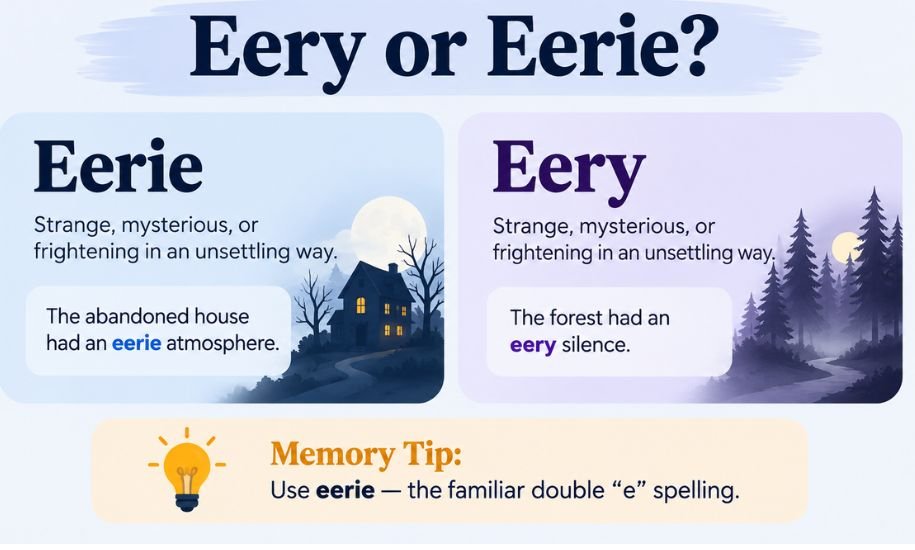
Both eerie and eery are recognised English spellings with the same meaning: strange, mysterious, or frightening in an unsettling way. However, eerie is the standard and more widely used spelling. Choose eerie for everyday and formal writing unless you have a specific reason to use the alternative.
Eery or Eerie: What’s the Difference?
The main difference between these words is their spelling frequency, not their meaning. Both are adjectives used to describe something that creates a feeling of fear, unease, or strangeness.
| Feature | Eerie | Eery |
|---|---|---|
| Correct spelling | Yes | Yes, as a recognised variant |
| Meaning | Strange, unsettling, or frightening | The same meaning |
| Part of speech | Adjective | Adjective |
| Common usage | Standard and widely familiar | Less common |
| Best choice for general writing | Recommended | Use selectively |
For example:
- Eerie: The abandoned school had an eerie atmosphere.
- Eery: The abandoned school had an eery atmosphere.
Both sentences communicate the same idea. Nevertheless, the first spelling is the safer choice because readers are more accustomed to seeing it.
What Does “Eerie” Mean?
Eerie is an adjective that describes something strange, mysterious, or frightening in a way that makes people feel uneasy. It often suggests something supernatural, ghostly, or difficult to explain.
The word is particularly useful when describing places, sounds, expressions, experiences, or situations that feel unsettling rather than simply unpleasant.
Examples of “Eerie” in Sentences
- An eerie silence settled over the village after midnight.
- The old mansion looked eerie in the fading evening light.
- We heard an eerie sound coming from the empty basement.
- Her eyes had an eerie expression that made me uncomfortable.
- The fog created an eerie atmosphere along the narrow road.
In each example, the word adds a sense of mystery or unease. A house can be eerie because it appears abandoned, while a sound can be eerie because it is unfamiliar or seems to come from nowhere.
When Should You Use “Eerie”?
Use this spelling when you want to describe something that feels uncanny, spooky, ghostly, or unnaturally quiet.
For instance, an eerie forest suggests a place that feels mysterious or frightening. By contrast, a dark forest simply tells readers that there is little light. The adjective adds an emotional impression rather than describing only a physical feature.
Is “Eery” a Real Word?
Yes. Eery is a recognised alternative spelling of eerie, not merely an invented word. Major dictionary resources, including Collins and Dictionary.com, list the alternative form.
Although it is valid, it is much less familiar to many readers. Consequently, some people may assume it is a typographical error when they encounter it in ordinary prose.
Consider these examples:
- The abandoned railway station had an eery atmosphere.
- An eery whistle echoed across the empty field.
- The photograph captured an eery resemblance between the two strangers.
These sentences use the alternative spelling with the same meaning as eerie. There is no separate definition that distinguishes eery from eerie in ordinary contemporary usage.
For most writers, choosing the more familiar spelling makes the text easier to recognise and read. If you are editing a document, article, or book, consistency is also important.
Eerie Synonyms: What Words Can You Use Instead?
Several words can replace eerie, but each has a slightly different emphasis. Choosing the right synonym helps you describe the exact feeling or atmosphere you want to convey.
| Synonym | Meaning | Example |
|---|---|---|
| Creepy | Uncomfortably frightening | The creepy hallway was full of shadows. |
| Spooky | Suggestive of ghosts or the supernatural | We explored a spooky old house. |
| Uncanny | Strange in a difficult-to-explain way | She had an uncanny ability to predict events. |
| Ghostly | Resembling or suggesting a ghost | A ghostly figure appeared through the mist. |
| Haunting | Leaving a lasting, often unsettling impression | A haunting melody filled the room. |
| Ominous | Suggesting that something bad may happen | Dark clouds created an ominous scene. |
| Unsettling | Causing discomfort or unease | His unexplained behaviour was unsettling. |
| Sinister | Suggesting danger or evil | The building had a sinister appearance. |
Eerie vs. creepy: These words are close in meaning, but creepy often describes something that directly makes a person uncomfortable or afraid. Eerie frequently emphasises an unusual, mysterious, or uncanny atmosphere.
For example, a person behaving inappropriately might be described as creepy, while an empty street with no visible signs of life might be described as eerie.
How Do You Pronounce “Eerie”?
Both eerie and eery are generally pronounced the same way. The word has two syllables, and the pronunciation sounds like “eer-ee.”
The exact vowel quality can vary slightly between English accents, but the spelling difference does not normally change the pronunciation.
Here are a few related word forms:
- Eerie: adjective — The room felt eerie.
- Eerily: adverb — The room was eerily quiet.
- Eeriness: noun — The eeriness of the abandoned house frightened us.
- Eerier: comparative adjective — The road looked eerier after dark.
- Eeriest: superlative adjective — That was the eeriest place I had ever visited.
These forms are useful when you want to describe degrees of strangeness or explain how something creates an unsettling impression.
Why Are the Two Spellings Confused?
The confusion is understandable because the words look almost identical and sound the same. Only one letter separates them, and both are associated with the same meaning.
There is also no reliable rule that says adding or removing the second letter e changes the meaning. Unlike pairs such as affect and effect, which commonly serve different grammatical purposes, these two forms are spelling variants of the same adjective.
Writers may encounter the less familiar form in older texts, particular publications, or informal writing. Seeing both versions can make it difficult to decide which one to use.
The simplest approach is to remember that eerie is the preferred everyday spelling. You can recognise eery without needing to choose it in your own writing.
Common Mistakes to Avoid
A few practical points can help you use the word accurately.
1. Assuming that “eery” is always incorrect.
It is recognised as an alternative spelling. Calling it universally wrong overlooks its dictionary status.
2. Treating the two forms as having different meanings.
In ordinary usage, both describe the same kind of unsettling or mysterious quality.
3. Using “eerie” when you mean merely “dark.”
A dark room has little light, but an eerie room creates a feeling of strangeness or unease. The two descriptions are not interchangeable in every context.
4. Confusing “eerie” with “eyrie.”
An eyrie is a nest or high resting place associated especially with a bird of prey, such as an eagle. It is a different word with a different meaning.
5. Switching spellings unnecessarily.
If you choose the standard spelling in an article, use it consistently throughout the text. Consistency makes your writing look polished and professional.
Easy Way to Remember the Correct Choice
A simple memory aid is to associate eerie with the familiar double “e” spelling.
Think of the phrase “eerie evening.” Both words begin with the same two-letter sequence, making the phrase an easy way to remember the standard form.
When writing about a creepy house, a mysterious sound, or an unsettling atmosphere, choose eerie. You can still recognise eery when reading it, but there is generally little reason to prefer the less familiar alternative in new writing.
Frequently Asked Questions
Is “eery” or “eerie” correct?
Both are recognised spellings, but eerie is the standard and more widely familiar form. It is the best choice for most everyday, academic, and professional writing. Eery is an alternative spelling with the same meaning.
Is “eery” a misspelling?
Not necessarily. Major dictionaries recognise eery as a variant of eerie. However, because it is less common, readers may mistake it for a typo. Use eerie when you want the most familiar spelling.
Is “eerie” British or American English?
Eerie is used in both British and American English. The alternative eery is also documented, but neither spelling is an exclusive British or American form.
What is the difference between eerie and creepy?
Both words describe something frightening or unsettling. Eerie often emphasises mystery, strangeness, or an uncanny atmosphere, whereas creepy more directly suggests discomfort or fear. Their meanings overlap, so the best choice depends on the context.
What is the opposite of eerie?
Possible opposites include comforting, reassuring, familiar, pleasant, and welcoming. The best antonym depends on what makes a situation eerie. A comforting atmosphere, for example, creates a sense of safety rather than unease.
What is the adverb form of eerie?
The adverb is eerily. For example, “The streets were eerily quiet after the storm.” The noun form is eeriness, while eerier and eeriest are the comparative and superlative forms of the adjective.
Final Verdict: Eery or Eerie?
Both spellings are accepted, and they convey the same meaning. However, eerie is the more familiar standard form and is the best choice for most writing. Remember this distinction when describing something mysterious, ghostly, or unsettling, and you will make a confident spelling choice. At Grammarifyr, our goal is simple: Know the Difference. Use the Right Words.
You may also Read : Beside or Besides? Examples and Common Mistakes

One Comment