Bear or Bare: Meaning, Difference, and Examples
Have you ever wondered whether to write “bear with me” or “bare with me”? These two words sound exactly alike, but they have different meanings and uses. Choosing the wrong one can change the meaning of a sentence or make an otherwise clear message confusing. The good news is that the difference is easy to understand once you know what each word means. Bear usually refers to carrying, enduring, or tolerating something, while bare describes something uncovered or means to reveal something. Learning a few simple rules will help you use both words correctly.
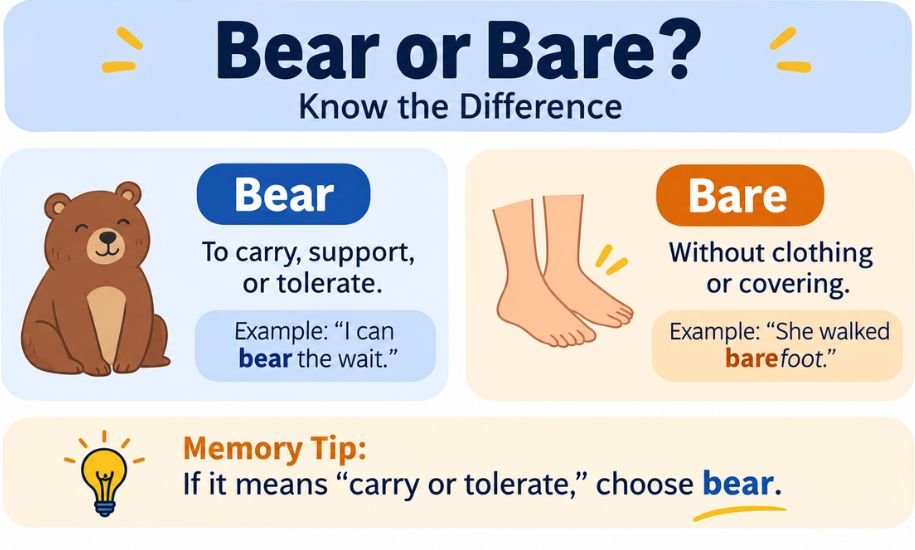
Both bear and bare are correct English words, but they have different meanings. Use bear to mean carry, endure, tolerate, or refer to the animal. Use bare to mean uncovered, minimal, or reveal. For example, “Please bear with me” is correct when asking someone to be patient.
Bear or Bare: What’s the Difference?
The main difference lies in what you want to express. Although the words have the same pronunciation, they cannot be used interchangeably in most situations.
Bear is commonly used as a verb meaning to carry, support, endure, or tolerate. It is also the name of a large mammal.
Bare is usually an adjective meaning uncovered, exposed, or lacking something. As a verb, it means to uncover or reveal something.
Here is a quick comparison:
| Feature | Bear | Bare |
|---|---|---|
| Main meaning | Carry, endure, or tolerate | Uncovered or exposed |
| Part of speech | Noun or verb | Adjective or verb |
| Common expression | Bear with me | Bare feet |
| Another example | Bear the cost | Bare the truth |
| Animal meaning | A large mammal | No animal meaning |
Both spellings are valid, so the correct choice depends on the meaning of your sentence.
What Does Bear Mean?
The word bear has several meanings. As a noun, it refers to an animal. As a verb, it can describe carrying a burden, supporting weight, tolerating a difficult situation, or accepting responsibility.
1. To endure or tolerate
One of the most common uses of bear is to describe dealing with something unpleasant or difficult.
Examples:
- I cannot bear the thought of losing my best friend.
- She could barely bear the noise coming from the construction site.
- He had to bear the disappointment of losing the competition.
- I cannot bear it when people interrupt others.
In these sentences, bear means to endure or tolerate an experience.
2. To carry or support
The verb can also describe carrying something physically or supporting a load.
Examples:
- The old bridge cannot bear the weight of heavy trucks.
- She struggled to bear the heavy box up the stairs.
- The table is strong enough to bear several large books.
It can also refer to financial responsibility, as in “The company will bear the cost of the repairs.”
3. To give birth to a child
The verb bear can also mean to give birth to a child. In this sense, it is often used in formal writing or expressions such as “bear a child.”
For example:
- The historical account describes how she bore three children.
- She was the first woman in her family to bear a child abroad.
The past tense of bear in this meaning is generally bore, while the past participle is born when referring to birth.
4. To refer to an animal
A bear is a large mammal that typically has a powerful body, thick fur, and strong limbs.
Examples:
- We spotted a black bear during our camping trip.
- The polar bear moved across the ice.
- A bear was searching for food near the forest.
In these examples, bear is a noun rather than a verb.
What Does Bare Mean?
The word bare describes something that is uncovered, exposed, empty, or reduced to the minimum. It can also function as a verb meaning to uncover or reveal something.
1. Uncovered or exposed
When used as an adjective, bare often describes something without a covering.
Examples:
- He walked across the grass with bare feet.
- The room contained only a bed and a bare wooden table.
- The trees were bare during the winter.
- She placed her bag on the bare floor.
Here, the word emphasizes the absence of a covering, decoration, or other material.
2. The minimum amount necessary
Bare can also describe something that is limited to the essentials.
Examples:
- They survived on the bare necessities.
- The apartment had only the bare minimum of furniture.
- We need to provide the bare essentials for the trip.
The phrase “bare minimum” refers to the smallest amount needed or acceptable.
3. To uncover or reveal
As a verb, bare means to expose something that was previously hidden or covered. It can refer to physical objects, feelings, or information.
Examples:
- The workers removed the damaged plaster to bare the brick wall.
- He decided to bare his soul during the conversation.
- The investigation helped bare the facts behind the incident.
The expression “bare your soul” means to reveal your deepest thoughts or feelings. In the last example, bare means to expose or reveal facts.
Is It “Bear With Me” or “Bare With Me”?
The correct expression is “bear with me.”
It is used when asking someone to be patient while you complete a task, explain something, or resolve a problem.
Correct: Please bear with me while I find your booking details.
Incorrect for this meaning: Please bare with me while I find your booking details.
The distinction is straightforward: you are asking someone to tolerate a short delay, so you need the verb bear.
More examples:
- Bear with me while I explain how the process works.
- Please bear with us as we update our website.
- Thank you for bearing with me during the delay.
- I appreciate your patience, so please bear with me for another minute.
The phrase is appropriate in everyday conversation, emails, customer service messages, and professional communication.
However, “bare with me” could theoretically have a literal meaning involving uncovering or exposing something together. It does not mean “be patient with me,” so it is not the correct expression for that situation.
Should You Write “Bear in Mind” or “Bare in Mind”?
The correct phrase is “bear in mind.”
It means to remember, consider, or keep something in your thoughts when making a decision.
Correct: Bear in mind that the delivery may take several days.
Incorrect: Bare in mind that the delivery may take several days.
The phrase uses bear because it expresses the idea of holding or keeping something in consideration.
Here are additional examples:
- Bear in mind that prices may change without notice.
- You should bear in mind the needs of everyone involved.
- Bear in mind that the instructions apply to all applicants.
- We must bear in mind that not everyone has the same experience.
A simple way to check the expression is to replace it with “remember.” If that substitution preserves the intended meaning, bear in mind is the correct choice.
Is It “Bear the Pain” or “Bare the Pain”?
The correct expression is generally “bear the pain.”
When you bear pain, you endure it or tolerate it. The phrase can refer to physical discomfort or emotional suffering.
Correct: He tried to bear the pain without complaining.
Incorrect for the intended meaning: He tried to bare the pain without complaining.
Consider these examples:
- She found it difficult to bear the pain after the accident.
- He could no longer bear the emotional strain.
- They had to bear the consequences of their decision.
- I cannot bear the thought of disappointing my family.
By contrast, bare would be appropriate if you meant to reveal or expose something. For example, “She bared her feelings” means she openly revealed her emotions.
The distinction is between enduring an experience and exposing something that was hidden.
Is It “Bear the Cost” or “Bare the Cost”?
The correct phrase is “bear the cost.”
It means to pay for something or accept financial responsibility for an expense.
Examples:
- The landlord agreed to bear the cost of the repairs.
- The company will bear the cost of employee training.
- We cannot afford to bear the cost of another delay.
- The government decided to bear part of the expense.
Using bare in this expression would be incorrect because the sentence refers to accepting a financial burden, not uncovering something.
Other expressions that use bear include:
- Bear responsibility: Accept responsibility for an action.
- Bear the burden: Carry a difficult responsibility.
- Bear witness: Give evidence or testify to something.
- Bear fruit: Produce a positive result.
- Bear the brunt: Suffer the main impact of something unpleasant.
Recognizing these expressions can make it easier to choose the right spelling without stopping to think about the rule each time.
How to Remember the Difference
A simple memory trick can help you distinguish the two words.
Bare = uncovered. Think of bare feet, bare walls, or bare branches. These things have no covering or decoration.
Bear = carry or endure. Think of carrying a heavy box, bearing a responsibility, or bearing the pain of a difficult experience.
You can also use a substitution test.
If you can replace the word with endure, tolerate, or carry, use bear.
If you can replace it with uncovered, exposed, or reveal, use bare.
For example:
- “I cannot ___ the noise.” Replace the blank with tolerate: bear.
- “She walked with ___ feet.” Replace the blank with uncovered: bare.
- “Please ___ in mind the deadline.” Replace the phrase with remember: bear in mind.
- “He decided to ___ his feelings.” Replace the word with reveal: bare.
This method works for many everyday sentences, although the intended meaning should always guide your final choice.
Common Mistakes to Avoid
Even experienced writers sometimes confuse these words because they sound alike. The following examples illustrate the most important distinctions.
| Incorrect usage | Correct usage | Reason |
|---|---|---|
| Bare with me for a moment. | Bear with me for a moment. | You are asking for patience. |
| Bare in mind the deadline. | Bear in mind the deadline. | The phrase means to remember. |
| I cannot bare the noise. | I cannot bear the noise. | The meaning is to tolerate. |
| The business will bare the expense. | The business will bear the expense. | The business accepts the cost. |
| He walked with bear feet. | He walked with bare feet. | His feet were uncovered. |
One useful point to remember is that bare is not an incorrect version of bear. Both words have legitimate meanings. The mistake occurs when you choose the right word for the wrong meaning.
Frequently Asked Questions
1. What is the difference between bear and bare?
Bear usually means to carry, support, endure, or tolerate something. It can also refer to an animal. Bare means uncovered or minimal, or it can mean to uncover or reveal something. Their pronunciation is the same, but their meanings and grammatical uses differ.
2. Is it “bear with me” or “bare with me”?
“Bear with me” is correct when you want someone to be patient. For example, “Please bear with me while I check the information.” The alternative does not express this meaning because bare means uncovered or reveal.
3. Is “bear in mind” grammatically correct?
Yes. “Bear in mind” is a standard English expression meaning to remember or consider something. For example, “Bear in mind that the meeting may finish late.” The spelling bare in mind is incorrect when you intend to use this expression.
4. Can both bear and bare be used as verbs?
Yes. Bear can mean to carry, support, endure, or give birth to a child. Bare means to uncover or reveal something. For instance, “She bore the responsibility” and “She bared her feelings” use the two verbs correctly.
5. Is it “I can’t bear it” or “I can’t bare it”?
“I can’t bear it” is correct when you mean that you cannot tolerate or endure a situation. For example, “I can’t bear the thought of losing my job.” Bare it does not convey the intended meaning in this expression.
6. How can I remember when to use each word?
Associate bare with uncovered things, such as bare feet or bare walls. Associate bear with carrying or enduring something, such as bearing a burden or bearing the cost. This simple distinction will help you choose the correct word in most everyday contexts.
Final Verdict: Bear or Bare?
Both words are correct, but their meanings are different. Use bear when you mean to carry, endure, tolerate, or refer to the animal. Choose bare when you mean uncovered, minimal, or reveal. Remember that you bear with someone, bear something in mind, and bear the cost, but you can have bare feet or bare your feelings. For more practical explanations of confusing English words, Grammarifyr helps you know the difference and use the right words.
You may also Read : Cosy or Cozy: British and American English Explained