Dragged or Drug: The Correct Past Tense Explained
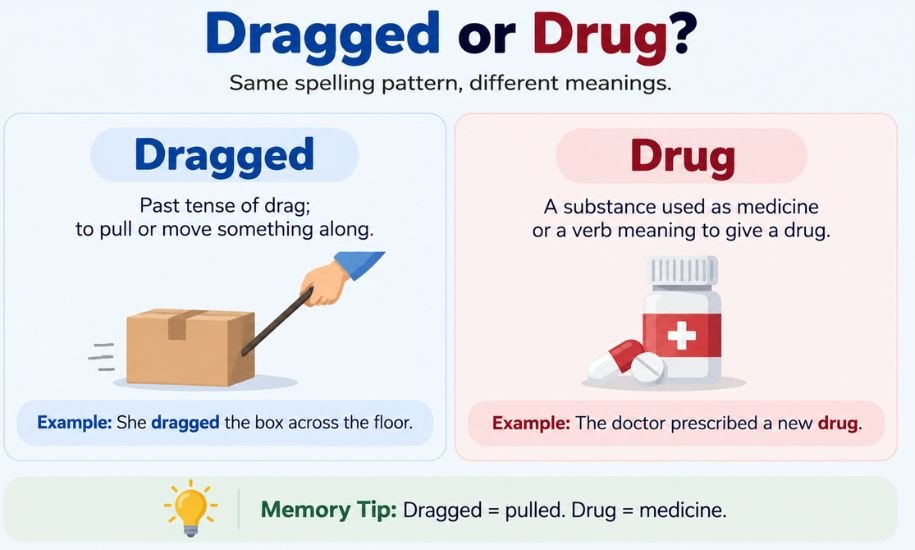
If you are wondering whether the past tense of drag is dragged or drug, the standard answer is straightforward: dragged. The confusion comes from the fact that drug is a real English word and is also used as a regional past-tense form of drag in some American dialects. However, these words have different standard meanings and grammatical roles. Understanding the distinction is especially useful when writing formal, academic, or professional English.
Dragged is the standard past tense and past participle of drag. Drug is a separate standard word and can also occur as a regional American past-tense form of drag. For general and formal writing, use dragged.
Dragged or Drug: The Key Difference
The standard verb forms are:
| Verb form | Standard form | Example |
|---|---|---|
| Present | drag | I drag the chair. |
| Past | dragged | I dragged the chair. |
| Past participle | dragged | I have dragged the chair. |
| Present participle | dragging | I am dragging the chair. |
So the standard pattern is:
drag → dragged → dragged
For example:
She dragged the heavy suitcase across the floor.
Not:
She drug the heavy suitcase across the floor.
The latter can be heard in some regional American speech, but dragged is the standard form expected in general written English.
What Does “Dragged” Mean?
Dragged is the simple past tense and past participle of drag, a verb meaning to pull something along a surface, usually with some effort.
Examples
Tom dragged the box into the garage.
The dog dragged its blanket across the room.
We dragged the table closer to the window.
She had dragged the suitcase through the airport.
The word can also describe figurative actions. For example:
He was dragged into an argument he wanted to avoid.
Here, dragged does not mean physically pulled. It means that someone was unwillingly brought into a situation.
Is “Drug” the Past Tense of Drag?
In standard English, the past tense of drag is dragged, not drug.
However, drug is documented as a regional or dialectal past-tense form of drag, particularly in some varieties of American English. You may therefore encounter sentences such as:
He drug the chair across the room.
This usage is not simply a random spelling mistake. It is a genuine dialect form. Nevertheless, if your goal is standard English for general readers, formal writing, schoolwork, business communication, or academic work, dragged is the safer and conventional choice.
It is also worth remembering that drug has other standard meanings, which makes the distinction especially important.
What Does “Drug” Mean?
Drug is a perfectly standard English word.
As a noun, it commonly refers to a substance used as medicine or one that affects the body or mind.
The doctor prescribed a new drug.
The drug is available only by prescription.
As a verb, drug has a different meaning. Its past-tense form is drugged, meaning that someone administered a drug or substance to a person or animal.
Someone drugged his drink.
The animal was drugged before the procedure.
Therefore, it is useful to keep these two verb patterns separate:
drag → dragged
drug → drugged
That distinction explains why dragged or drugged can be confusing.
Dragged or Drugged: They Are Not the Same
Although the words look similar, they come from different verbs.
Dragged
Dragged comes from drag and means pulled or moved along.
The child dragged the toy behind her.
Drugged
Drugged comes from drug and means given a drug or substance.
The patient was drugged before the operation.
Compare:
The nurse dragged the equipment into the room.
The equipment was pulled.
The nurse drugged the patient.
The patient was given a drug.
Changing one letter can completely change the meaning.
Examples in Sentences
Seeing the forms in context makes the difference easier to understand.
Standard uses of “dragged”
Mark dragged the chair across the wooden floor.
The workers dragged the damaged equipment outside.
She dragged herself out of bed after a long night.
The conversation dragged on for hours.
He was dragged into the dispute despite having no involvement.
Uses of “drug”
The doctor prescribed a drug for the condition.
The new drug must be stored carefully.
The police investigated whether the victim had been drugged.
Notice that none of these examples uses drug as the standard past tense of drag.
“Was Dragged” or “Was Drug”?
This question often causes confusion because both was dragged and was drug can be encountered.
For standard English, use was dragged when you mean that someone or something was pulled.
The sofa was dragged across the room.
He was dragged away from the doorway.
The heavy cabinet was dragged into the hallway.
You may encounter was drug in regional American speech or writing intended to reproduce a particular dialect:
The sofa was drug across the room.
For general-purpose writing, was dragged is the standard choice.
Why Do People Confuse These Forms?
The main grammatical reason is that English has many irregular verbs whose past forms change considerably:
- sing → sang
- drink → drank
- swim → swam
- begin → began
Because drag sounds somewhat like verbs with changing past forms, speakers may use drug by analogy or because it is part of a regional dialect.
There is also a natural source of confusion: drug is already an established English word. A reader who sees drug in a sentence about pulling something may therefore wonder whether it is a spelling error or an alternative verb form.
The important distinction is that drug does exist as a dialectal past form of drag, but dragged remains the standard form.
Common Mistakes
1. Using “drug” in formal writing
If you are writing an essay, report, article, or professional document, use:
She dragged the box outside.
rather than:
She drug the box outside.
2. Confusing “drug” and “drugged”
If the intended meaning is “gave someone a drug,” the past tense is:
Someone drugged him.
Not:
Someone drug him.
3. Assuming “drug” is always incorrect
This is also an oversimplification. Drug is a standard noun:
The drug helped control the symptoms.
And it has its own verb forms:
drug → drugged → drugging
It can additionally function as a regional past-tense form of drag.
4. Treating “dragged” as only a physical action
The word is also common in figurative expressions:
The meeting dragged on.
She was dragged into the controversy.
So the standard form applies whether the action is physical or figurative.
An Easy Way to Remember
Use this simple three-part rule:
Dragged = pulled
He dragged the suitcase.
Drug = a substance or medicine
The doctor prescribed a drug.
Drugged = given a drug
Someone drugged his drink.
If you mean pull, think dragged.
The standard verb pattern is easy to memorize:
drag → dragged → dragged
Is “Drug” Ever Acceptable?
Yes, but context matters.
If you are writing standard English, dragged is the appropriate past tense.
If you are quoting someone, reproducing dialogue, studying dialect, or discussing regional American English, you may encounter drug used as the past tense of drag. In those contexts, recognizing the form can help you understand what the speaker or writer means.
The key is not to confuse dialectal usage with the standard form used in formal writing.
FAQ
Is “dragged or drug” correct?
Dragged is the standard past tense of drag. Drug can be used as a regional American dialect form of the past tense, but it is not the standard form for general formal writing.
What is the past tense of drag?
The standard past tense of drag is dragged. The past participle is also dragged.
Present: I drag the box.
Past: I dragged the box.
Past participle: I have dragged the box.
Is “drug” the past tense of drag?
Not in standard English. Drug is documented as a regional American past-tense form of drag, but dragged is the standard form used in general written English.
Is it dragged or drugged?
They have different meanings. Dragged means pulled or moved along, while drugged means given a drug or substance.
He dragged the suitcase.
Someone drugged his drink.
Which should I use in formal writing: dragged or drug?
Use dragged when you mean the past tense of drag. It is the standard form and avoids confusion with the noun drug and the verb drugged.
The Bottom Line
For standard English, the answer is dragged: drag → dragged → dragged. Drug is a legitimate English word and also occurs as a regional American past-tense form of drag, but it can easily be confused with the separate word meaning a medicine or substance. If you want a clear, conventional choice in formal or general writing, dragged is the form to use. For more straightforward explanations of confusing English forms, Grammarifyr helps you know the difference and use the right words.
You may also Read : Hanged or Hung? Meaning and Grammar Guide
One Comment