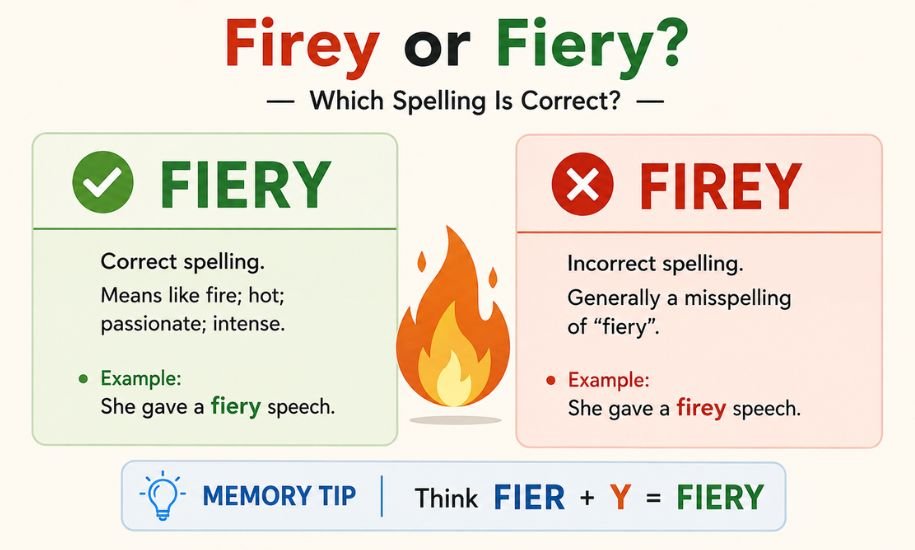
Firey or Fiery: Which Spelling Is Correct?
It is easy to see why firey and fiery can cause confusion. The word comes from fire, so adding -y seems as though it should naturally produce firey. However, standard English uses a different spelling. If you are wondering is it firey or fiery, the answer is straightforward: fiery is the standard spelling when you mean “like fire,” “very hot,” “passionate,” or “intense.” The form firey is generally a misspelling in this context.
Fiery is the correct standard spelling. Firey is normally a misspelling when used as the adjective meaning “like fire,” “hot,” “passionate,” or “intense.” For example, write “a fiery sunset,” not “a firey sunset.”
Fiery or Firey: What’s the Difference?
For ordinary English writing, fiery is the form you should use. It is an adjective with several related meanings, including:
- resembling or relating to fire
- extremely hot
- bright or fire-like in color
- passionate or intense
- quick-tempered
- strongly spicy or burning in taste
Firey, by contrast, is generally not the standard spelling of this adjective.
| Feature | Fiery | Firey |
|---|---|---|
| Standard adjective? | Yes | No |
| Meaning | Like fire; hot; passionate; intense | Usually intended as fiery |
| Standard formal writing | Correct | Avoid |
| Example | “She gave a fiery speech.” | “She gave a firey speech.” |
So, if you are deciding between fiery or firey, choose fiery in standard English.
What Does “Fiery” Mean?
Fiery is an adjective. Its exact meaning depends on the context, but all of its uses are connected to the ideas of fire, heat, intensity, or strong emotion.
1. Related to fire
The most literal meaning is something that resembles, contains, or is associated with fire.
- The firefighters watched the fiery building from a safe distance.
- A fiery glow appeared beyond the mountains.
- The dragon was illustrated with fiery breath.
2. Very hot or burning
Fiery can describe something that produces an intense sensation of heat.
- The fiery heat made the afternoon uncomfortable.
- He stepped away from the fiery grill.
3. Bright red, orange, or fire-like in color
The word can also describe colors that resemble flames.
- The clouds turned fiery orange at sunset.
- She wore a fiery red dress.
- The horizon had a fiery glow.
4. Passionate or intense
Fiery is frequently used figuratively for strong emotions, energetic arguments, or forceful communication.
- The politician delivered a fiery speech.
- The two teams had a fiery debate.
- She defended her idea with fiery passion.
In these examples, fiery does not mean that something is literally burning. Instead, it suggests energy, emotion, force, or intensity.
5. Easily angered
A person with a fiery temper tends to become angry quickly or express anger strongly.
- His fiery temper sometimes caused arguments.
- She has a fiery personality, but she is also very generous.
6. Very spicy
Fiery can describe food with an intense heat or burning sensation.
- This curry has a fiery flavor.
- The restaurant serves a fiery chili sauce.
Is “Firey” a Real Word?
For the adjective normally intended in firey or fiery, firey should be treated as a misspelling.
The confusion is understandable because the word appears to be formed from fire + y. That makes firey look logical at first glance. Nevertheless, the established standard spelling is fiery.
There is a specialized regional use of firey recorded in some dictionaries and word references, particularly as an Australian colloquial noun referring to a firefighter. That is a separate use and does not make firey an acceptable replacement for the standard adjective fiery in ordinary English.
For general writing, schoolwork, professional communication, and published content, use fiery.
Why Is “Firey” So Easy to Spell Incorrectly?
The main reason is the structure of the original word.
When people see:
fire + y
they may naturally expect:
firey
But English spelling does not always work by simply attaching a suffix to the unchanged spelling of the base word. In this case, the established adjective is spelled fiery.
The pronunciation can also contribute to the confusion because the spelling does not look exactly like what a writer might expect from the word fire.
This is why firey is an understandable spelling mistake, even though it is not the standard spelling of the adjective.
Examples: Correct vs. Incorrect
Seeing the two forms side by side makes the distinction easy to remember.
Correct: The sunset was fiery orange.
Incorrect: The sunset was firey orange.
Correct: The coach gave the players a fiery speech.
Incorrect: The coach gave the players a firey speech.
Correct: She has a fiery temper.
Incorrect: She has a firey temper.
Correct: The dish has a fiery kick.
Incorrect: The dish has a firey kick.
Correct: The sky looked fiery after the storm.
Incorrect: The sky looked firey after the storm.
The important point is that changing the spelling does not create a different standard adjective. In normal usage, firey is simply the form to avoid.
How to Remember the Correct Spelling
A simple memory trick is:
FIERY = FIER + Y
Think of the word as fier-y, not fire-y.
Another useful association is to connect fiery with fierce. Both begin with fier-, and both can suggest something strong or intense.
For example:
Fiery speech = fierce or passionate speech.
You do not need to remember a complicated spelling rule. Just remember that the standard adjective is fiery, with ie before the final y.
Common Mistakes to Avoid
1. Writing “firey” because it looks logical
The spelling may seem intuitive, but standard English uses fiery.
Use: a fiery sunset
Avoid: a firey sunset
2. Assuming “fiery” only refers to literal fire
The adjective has several figurative uses. A fiery debate is not literally on fire; it is intense or passionate.
3. Confusing “fiery” with “fierce”
These words can overlap in some contexts, but they are not interchangeable in every sentence.
A fiery temper describes intense or easily expressed anger, while a fierce competitor describes someone extremely determined or competitive.
4. Using the incorrect spelling in formal writing
Even though readers will usually understand firey, it is not the standard spelling of the adjective. In formal writing, choose fiery.
Is It “Fiery” or “Firey” in Formal Writing?
Use fiery.
Whether you are writing an essay, article, email, report, website content, or professional document, fiery is the appropriate standard spelling for the adjective.
For example:
The author uses fiery imagery to describe the battlefield.
Not:
The author uses firey imagery to describe the battlefield.
The same applies across the different meanings of the word: fiery heat, fiery red, fiery personality, fiery speech, fiery temper, and fiery food.
Frequently Asked Questions
Is it firey or fiery?
Fiery is the standard spelling. Use it when describing something related to fire or something that is hot, intense, passionate, quick-tempered, or strongly spicy. Firey is generally a misspelling in these contexts.
Is “firey” ever correct?
In ordinary English, firey is not the standard spelling of the adjective. Some dictionaries record a specialized Australian colloquial noun firey for a firefighter, but this is a separate regional use. For the adjective, use fiery.
What is the meaning of fiery?
Fiery can mean related to fire, very hot, fire-colored, passionate, intense, quick-tempered, or strongly spicy. The intended meaning depends on the sentence.
Why is fiery not spelled firey?
English spelling does not always preserve the full spelling of a base word when forming related words. Although firey may look logical from fire + y, the established standard adjective is fiery.
Is fiery an adjective?
Yes. Fiery is an adjective. It can modify nouns in expressions such as fiery speech, fiery eyes, fiery sunset, fiery temper, and fiery sauce.
How can I remember the spelling?
Remember FIER + Y = FIERY. You can also associate fiery with fierce because both begin with fier- and can describe something intense.
The Bottom Line
If you are choosing between firey or fiery, choose fiery for the standard adjective. It can describe literal fire and heat, but it can also refer to intense colors, passionate behavior, strong emotions, quick tempers, and spicy food. Although firey may look like a logical spelling, it should normally be corrected to fiery. At Grammarify, the simplest rule to remember is: when you mean “like fire” or “intense,” spell it FIERY.
You may also Read : That or Which: What’s the Difference and When Should You Use Each?